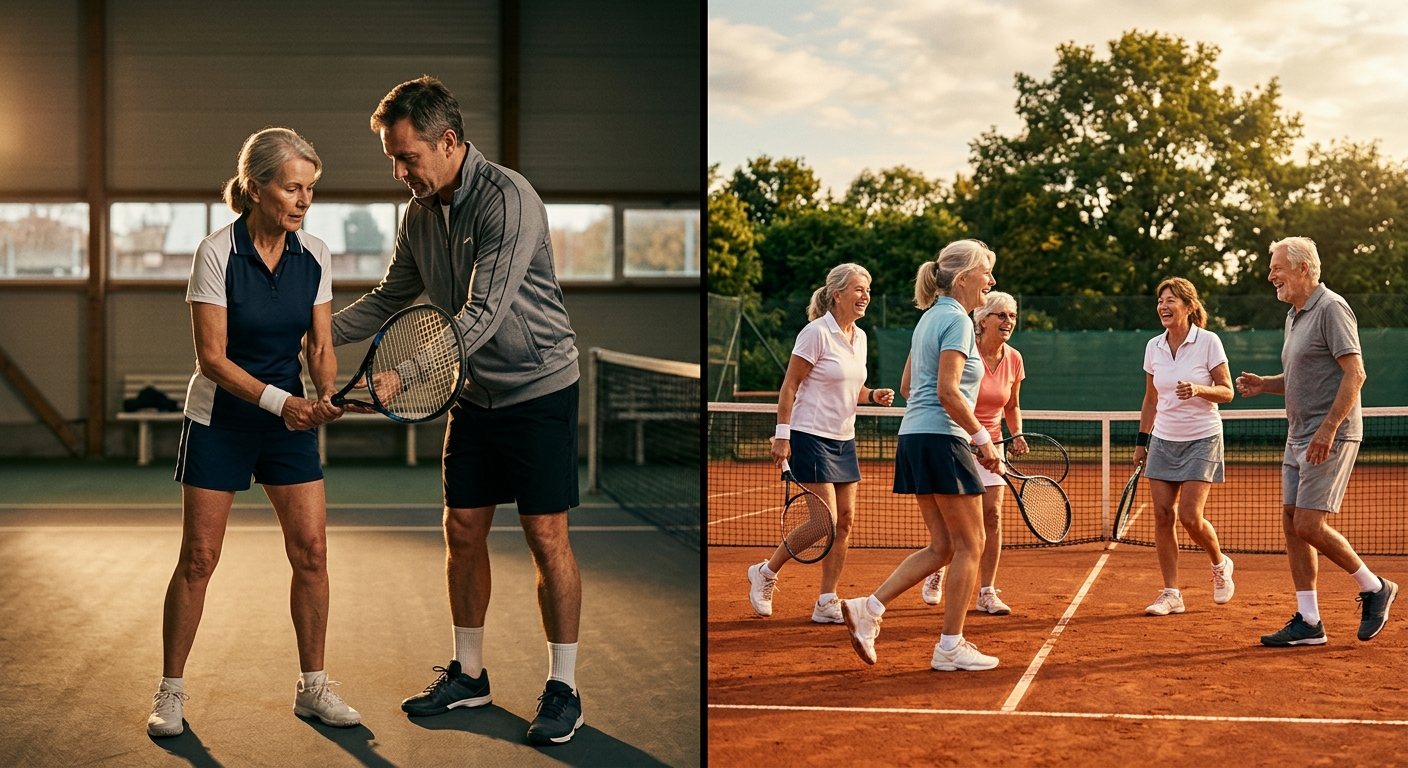
Why the Private vs. Group Decision Matters More After 55
Here's a stat that surprises most people: according to USTA data, adults over 55 are one of the fastest-growing segments of new tennis participants, with participation up significantly through 2025 and into 2026. And yet, almost every comparison article about lesson formats treats seniors as an afterthought — a footnote to advice really written for 25-year-olds.
That's a problem, because the private vs. group decision genuinely hits differently after 55. It's not just about budget (though we'll absolutely break that down). It's about how your body responds to repeated drilling, whether social energy keeps you showing up in January, how a rotator cuff repair from 2019 changes what a good coach needs to know, and whether you're trying to get back to competitive club play or simply stay active and enjoy the sport for another decade.
I've spent years building communities around shared activities, and one thing I've learned is this: the format of participation shapes the experience just as much as the content. For senior tennis players, getting that format right can be the difference between sticking with the sport long-term and quietly dropping out after three months.
Let's work through what each format actually offers — and which one fits your specific situation.
Current State: Senior Tennis Participation in 2026
Senior tennis has genuinely changed. Programs like USTA Adult Tennis have expanded their 55+ divisions, and facilities like Asphalt Green in New York City, the Vanderbilt Tennis Club, and Central Park Tennis Center have all developed dedicated senior programming in response to demand. This isn't a niche anymore — it's a recognized growth market.
What's driving it? A few things. Pickleball's rise has actually pulled some older players back to tennis, as people realize they want the fuller athletic challenge. Doctors are increasingly recommending racket sports for cardiovascular health, balance, and cognitive engagement. And the social dimension of club tennis has become more appealing as people seek structured, regular community after retirement.
But here's the thing — more options means more decisions. Many seniors are now choosing between dedicated senior group classes, open adult clinics, private coaching, and hybrid programs. Understanding what each format actually delivers is more important than ever.
What Private Lessons Offer Senior Players
Pace Control and Individualized Technique Adjustments
Private lessons give you something group settings structurally can't: a coach who adjusts every single rep to your specific mechanics. For seniors, this matters enormously. A grip issue that causes wrist strain in a 30-year-old is a potential injury trigger in a 65-year-old. A coach who can slow down, repeat a drill six different ways, and patiently rebuild a backhand without the pressure of a group watching — that's genuinely valuable.
In my experience, seniors who return to tennis after a long break benefit most dramatically from private instruction in the first three to six months. The muscle memory they have is often outdated — they're trying to play the game they played in 1995, with a body that's moved differently for 30 years. A private coach can bridge that gap systematically.
Pace control also means you're not getting left behind. Group classes, even well-intentioned senior-specific ones, have to move at the median pace. If you need an extra week on your serve toss, you get that in private lessons. (And honestly, most adults need more time on fundamentals than they think they do.)
Injury History and Mobility Accommodations
This is where private lessons pull ahead most clearly for a significant portion of seniors. Knee replacements, hip surgeries, shoulder repairs, lower back conditions — these aren't edge cases in the 60+ population. They're common realities that a good private coach incorporates into every session.
A private coach can design drills that keep you away from the net if quick forward movement is risky. They can modify your serve motion to protect a repaired shoulder. They can position you differently during rallies to reduce lateral stress on a replaced knee. None of this is possible in a group setting where the coach is managing six to eight players simultaneously.
For more on what coaches should understand about senior-specific physical needs, the parent resource what your coach should know about teaching senior players covers this in real depth — it's worth reading before you commit to any program.
What Group Lessons Offer Senior Players
Social Motivation and Consistency
Here's the honest truth about private lessons: they require a lot of self-motivation. You show up, you work hard, you leave. The relationship is transactional in a way that group settings simply aren't.
Group classes create community. And for seniors, that community is often the single biggest predictor of whether they stick with the sport. When you've got six people in a Tuesday morning clinic who text each other, celebrate each other's progress, and hold each other accountable for showing up — that's powerful. I've seen it drive consistency that no amount of individual discipline could match.
Senior group tennis programs at facilities like Asphalt Green and the Central Park Tennis Center explicitly build this social dimension into their programming. They're not just teaching tennis — they're creating a recurring social event that happens to involve tennis. For many seniors, that's exactly what they need.
And look, the research on social connection and healthy aging is clear: regular social engagement is protective against cognitive decline and depression. A group tennis class that you genuinely enjoy showing up to is doing more than improving your forehand.
Competitive Peer Environment Without Pressure
Group lessons with age-appropriate peers create a specific kind of energy that's hard to replicate in private settings. You're watching someone your age figure out the same cross-court backhand you've been struggling with. You're laughing together when the ball goes into the net for the fourth time. You're genuinely celebrating when someone in your group nails a shot they've been working on.
This peer dynamic reduces the self-consciousness that many adult beginners or returning players feel. In a private lesson, every mistake is visible to your coach and only your coach — which can feel like a spotlight. In a group, mistakes are shared, normalized, and often funny.
The USTA Adult Tennis programming specifically structures 55+ group clinics to emphasize this — skill development within a social, low-pressure environment. It's a format that works particularly well for seniors who are new to the sport or returning after a long absence.
For a broader look at how group formats are structured, how group tennis lessons actually work is a solid reference that covers class sizes and what to realistically expect.
Cost Comparison: What You're Actually Paying Per Hour of Instruction
Let's talk numbers — because the price difference is real, but the value calculation is more nuanced than most people realize.
| Strategy | Best For | Pros | Cons | ROI |
|---|---|---|---|---|
| Private Lessons (1:1) | Injury rehab, rapid skill-building, specific technique fixes | Full attention, customized pace, mobility accommodations | $80–$150/hour, no social element, requires self-motivation | High for targeted goals; lower for general fitness/fun |
| Group Lessons (6–8 players) | Social motivation, consistency, budget-conscious learners | Community, accountability, lower cost, peer energy | Less individual attention, fixed pace, may not accommodate injuries | High for long-term adherence; lower for rapid skill gains |
| Semi-Private (2–3 players) | Friends learning together, moderate budget | More attention than group, shared experience, cost split | Requires compatible partners, still limited customization | Strong middle-ground option |
| Hybrid (Private + Group) | Motivated learners with specific technique goals AND social needs | Best of both worlds, technique gains + community | Highest total cost, scheduling complexity | Highest overall for committed players |
| Tennis Clinics (10+ players) | Fitness-focused play, social tennis, experienced players | High energy, game-like conditions, affordable | Minimal instruction, not suitable for beginners or injury recovery | Good for fitness; poor for skill development |
The honest math: a private lesson at $100/hour gives you 60 minutes of dedicated instruction. A group class at $25/person gives you perhaps 8–10 minutes of direct coaching attention across the hour, but 60 minutes of active play and social engagement. Neither is objectively better — they're delivering different things.
For seniors on fixed incomes or retirement budgets, the group option often makes sustainable long-term participation possible in a way that weekly private lessons simply don't. But if you're recovering from injury or trying to fix a specific technical problem before a club tournament, private instruction delivers value that group classes structurally can't.
Hybrid Approaches: When to Combine Both Formats
So here's what I recommend most often for senior players who are serious about improvement but also want the community dimension: start with a block of private lessons, then transition to group classes with occasional private check-ins.
Specifically: four to eight private sessions to establish fundamentals, address any injury-related modifications, and build a technical foundation. Then move into a regular group class (ideally two times per week) for consistency, social motivation, and game-like practice. Every four to six weeks, schedule a private session to diagnose what's breaking down and reset your technique.
This hybrid model is actually what several high-quality senior programs at places like the Vanderbilt Tennis Club structure into their curriculum — they pair group clinics with optional private coaching add-ons specifically for this reason.
If you're wondering whether the investment in coaching is worth it at all, is hiring a tennis coach actually worth it does a rigorous cost-benefit breakdown that's worth reading before you commit to any format.
Red Flags in Group Classes That Aren't Senior-Appropriate
Not all group classes marketed to adults are actually appropriate for seniors. Here's what to watch for:
The pace is set by the youngest or fittest person in the group. If the coach is designing drills around the 40-year-old former college player in the back corner, everyone over 60 is just trying to keep up — and that's a recipe for injury and frustration.
There's no modification option for physical limitations. A good senior group class has a coach who can give you an alternative drill on the spot if the standard version doesn't work for your knee. If the answer is always 'just do your best,' that's a problem.
The class size is too large for meaningful feedback. More than eight to ten players with one coach means you might go an entire hour without a single piece of individual feedback. That's fitness, not instruction.
There's no age-banding. Mixed-age adult classes can work, but seniors generally benefit most from being with peers. The physical pace, social dynamic, and instructional approach should all be calibrated to the same life stage.
And look, if a program can't answer basic questions about how they accommodate seniors with mobility limitations, that tells you everything you need to know.
How to Choose Based on Your Starting Skill Level
Your current skill level should heavily influence your format choice — probably more than budget, honestly.
Complete beginners (never played or last played 20+ years ago): Private lessons first. The fundamentals need to be established correctly before group dynamics accelerate any bad habits. Even four to six sessions can set you up for successful group participation. Alternatively, look for true beginner group classes with very small class sizes (four to six players maximum).
Intermediate players (played regularly, returning after a break): Group classes with occasional private sessions work well. You have enough baseline that you can absorb instruction in a group context, and the social energy will keep you consistent.
Advanced seniors (competitive club players, USTA rated): Honestly, you might need private lessons specifically for the strategic and technical refinements that matter at your level. Group clinics can supplement for match-play practice, but the coaching depth you need usually requires private time.
For seniors specifically navigating what's realistic after 70, can seniors over 70 learn tennis addresses this directly with a lot of practical nuance.
And if you're trying to evaluate whether a specific coach or program is the right fit, what to look for in a tennis coach for senior adults gives you a concrete framework.
Questions to Ask Any Program Before Enrolling
Before you sign up for anything — private or group — here are the questions that will tell you whether a program actually understands senior players:
1. What's your coach-to-student ratio in group classes? Anything above 1:8 for seniors is a yellow flag. Above 1:12 is a red flag.
2. How do you accommodate players with joint replacements or chronic pain? A good answer is specific: 'We modify drills, we don't require net rushing, we have seated warm-up options.' A bad answer is vague: 'We go at your own pace.'
3. Are your senior classes age-banded, or are they general adult classes? Age-banded classes (55+, 60+) typically have better-calibrated instruction for seniors.
4. What's your cancellation policy if I have a health setback? This matters more for seniors than any other demographic. Programs that work with seniors should have reasonable flexibility built in.
5. Can I observe a class before committing? Any reputable program says yes. Watching a class tells you more than any brochure.
6. Do you have coaches with USTA or PTR certification in adult/senior instruction? Certification isn't everything, but it signals that the coach has at least engaged with the specific considerations of teaching older adults.
If you're ready to take the next step, find senior-appropriate tennis instruction near you to explore programs that are actually built around what senior players need.
For more on evaluating whether adult lessons are worth the investment at this stage of life, are adult tennis lessons worth it after 55 is a genuinely useful read.
Making the Call
The private vs. group decision for senior tennis players comes down to four honest questions: What are your physical limitations? What keeps you consistent? What's your starting skill level? And what do you actually want from the sport?
If you need careful physical accommodation and rapid technical development, private lessons are worth the investment — at least to start. If you need community, accountability, and sustainable long-term participation on a realistic budget, a well-run senior group class will serve you better than a private lesson you dread attending alone.
And for most motivated seniors, the answer is probably both — in the right sequence and proportion. Start with private to build a foundation, transition to group for consistency and joy, and check back in with private coaching when specific problems emerge.
The sport is genuinely worth it. The format just needs to fit your life.