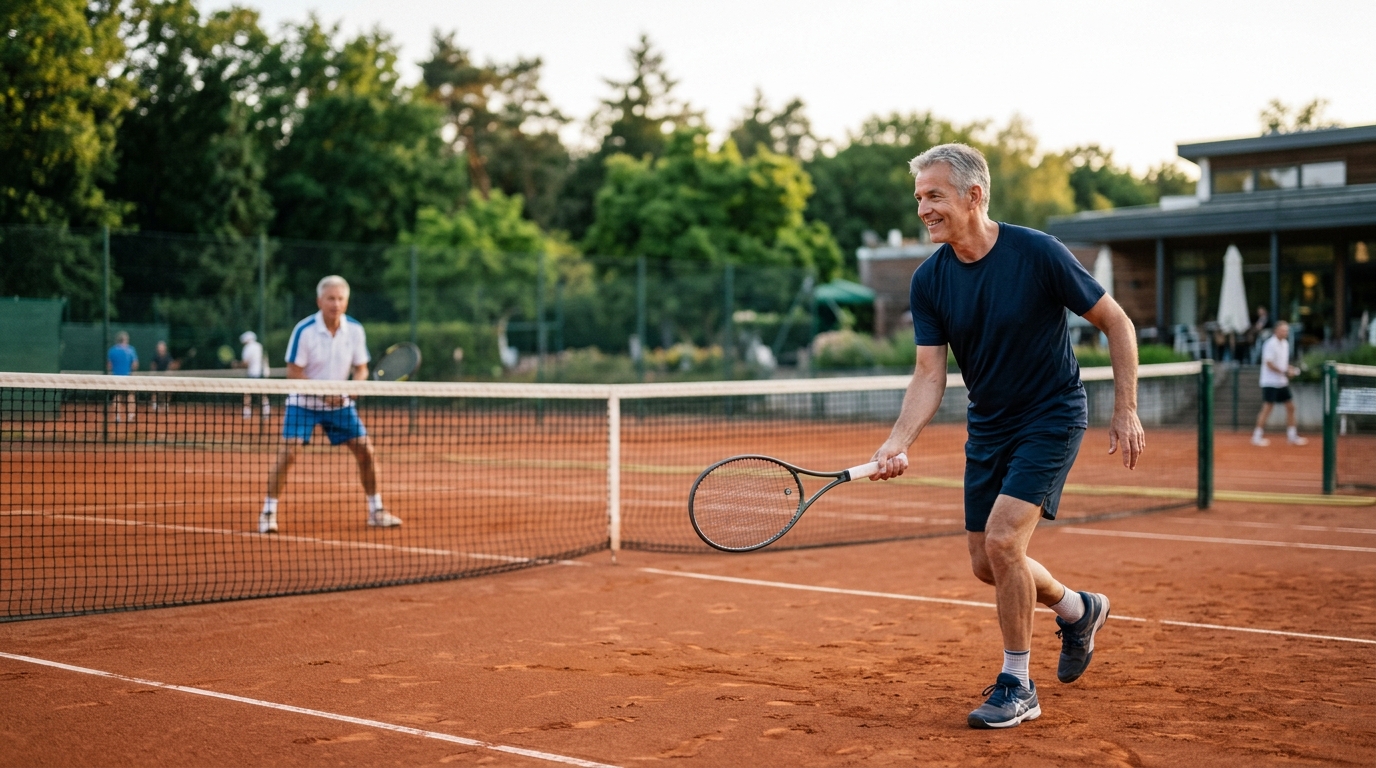
{ "article": "Most sports will keep you fit. Tennis, according to a landmark Danish study, will keep you alive longer than almost anything else. That's not a marketing claim — it's a finding that has quietly shifted how cardiologists and sports medicine physicians think about exercise prescriptions for patients over 55.\n\nThe catch? Most tennis coaches have no idea what to do with a 55-year-old who hasn't played in 20 years, or one who's never played at all. They run the same footwork ladders, drill the same kick serve mechanics, and push the same interval conditioning they'd use with a college player. The result, predictably, is rotator cuff problems, knee flare-ups, and a student who quits after six weeks.\n\nSenior tennis lessons done right look fundamentally different from standard adult instruction. Here's what the research says, and what that means for how you should be coached.\n\n## The Study That Changed How Doctors Think About Tennis and Longevity\n\nThe Copenhagen City Heart Study tracked over 8,500 adults across 25 years — one of the longest and most rigorous longitudinal studies on exercise and mortality ever conducted. The results, published in Mayo Clinic Proceedings in 2018, were striking: tennis players outlived joggers by roughly 9.7 years in terms of life expectancy gains from their sport. Badminton came second. Jogging, despite its cultural dominance as the default "healthy" exercise, came in near the bottom of the list.\n\nThe researchers attributed the longevity advantage not just to cardiovascular conditioning, but to the social dimension of racket sports. Tennis requires a partner. It demands communication, coordination, and sustained mental engagement. These social and cognitive elements appear to compound the physical benefits in ways that solitary exercise simply doesn't replicate.\n\nFor physicians advising patients in the 55-75 age bracket, this data shifted the conversation. Tennis stopped being a hobby and started being a clinical recommendation — with the caveat that the sport needs to be taught and practiced in ways appropriate for aging bodies.\n\n## What Tennis Does for Your Heart, Bones, and Balance After 55\n\n### Cardiovascular Benefits: More Effective Than Jogging, Easier on Your Knees\n\nTennis improves cardiovascular health in seniors through a mechanism that's actually better suited to older hearts than steady-state cardio. A typical recreational tennis rally lasts 4-10 seconds, followed by 10-20 seconds of recovery. This natural interval structure — high effort, brief rest, repeat — trains the cardiovascular system in a way that mirrors medically supervised interval training protocols.\n\nThe difference from jogging is meaningful. Continuous running at moderate intensity keeps your heart rate in a single zone for extended periods. Tennis forces repeated accelerations and decelerations, which improves cardiac output, heart rate variability, and aerobic capacity more efficiently for the time invested. Studies on recreational tennis players over 50 have found VO2 max improvements comparable to structured interval training programs.\n\nAnd the knee comparison matters. Running generates ground reaction forces of roughly 2.5 times body weight per stride. Tennis involves more lateral movement and shorter bursts, with softer courts (clay or cushioned hard courts) reducing impact substantially. For someone managing mild osteoarthritis or a history of knee problems, that distinction is the difference between a sport they can play and one they can't.\n\n### Bone Density and Balance: The Two Things That Prevent Falls\n\nFalls are the leading cause of injury-related death in adults over 65. Two physical attributes predict fall risk more reliably than any other: bone density and dynamic balance. Tennis directly addresses both.\n\nThe multidirectional loading of tennis — lateral shuffles, split steps, reaching strokes — stimulates bone remodeling in the hips, spine, and wrists. This is weight-bearing exercise with variety, which is exactly what bone tissue responds to. Walking, while beneficial, is too repetitive and low-intensity to produce the same osteogenic stimulus.\n\nBalance is where tennis becomes particularly valuable. The sport demands constant proprioceptive adjustment — reading ball trajectory, repositioning, recovering to center court. Over time, this trains the neuromuscular systems responsible for balance in ways that static exercises like standing on one foot simply can't replicate at the same intensity. A coach who understands senior physiology will build these balance challenges into every session deliberately, not as an afterthought.\n\n## How Senior Tennis Lessons Differ From Standard Adult Lessons\n\nHere's the uncomfortable truth about most tennis instruction: the curriculum was built around young, athletic bodies. The footwork patterns, the serve mechanics, the conditioning drills — they were developed for players whose joints have full range of motion, whose tendons are supple, and whose recovery time is measured in hours rather than days.\n\nApplying that curriculum to a 60-year-old is not just ineffective. It's a reliable path to injury.\n\nThe coaches who do this well aren't just slowing things down or using softer balls (though both have their place). They're fundamentally rethinking the mechanics and the training stimulus.\n\n### Modified Serve Mechanics That Protect Your Shoulder\n\nThe conventional serve technique taught to younger players involves a full trophy position — arm fully extended overhead, significant shoulder external rotation, explosive hip and trunk rotation. For a 25-year-old with full shoulder mobility, this is fine. For someone over 55 with even moderate rotator cuff degeneration (which imaging studies suggest affects over 50% of adults in this age group, often asymptomatically), it's a setup for impingement or worse.\n\nA senior-appropriate serve modification might include:\n\n- A shortened backswing that reduces shoulder external rotation load\n- A "waiter's tray" or abbreviated trophy position that keeps the elbow below shoulder height during the loading phase\n- Emphasis on leg drive and trunk rotation rather than arm speed to generate pace\n- A flatter serve trajectory that reduces the overhead extension required compared to a heavy topspin or kick serve\n\nNone of these modifications mean the serve becomes ineffective. They mean the serve becomes sustainable — something you can practice 50 times in a session without inflaming tissue that takes weeks to calm down.\n\nFor a deeper look at serve mechanics that translate across age groups, why your tennis serve isn't working (it's probably your toss, not your arm) covers the foundational issues that affect players at every level.\n\n### Rally-Based Drills vs. Sprint-Based Drills\n\nThe standard adult group clinic often involves a lot of running. Cone drills, suicide sprints to the net and back, rapid-fire ball feeding that demands explosive first steps. For senior players, this approach creates two problems: injury risk from explosive acceleration on joints that need more warm-up time, and excessive fatigue that degrades technique and discourages continued participation.\n\nRally-based drills accomplish the same cardiovascular and technical objectives with a fraction of the injury risk. Instead of sprinting to a cone and back, a senior player rallies crosscourt for 90 seconds — moving continuously but at a self-regulated pace, reading the ball, recovering position, building pattern recognition. The cardio load is real. The joint stress is manageable.\n\nThe best senior coaches I've observed structure sessions around sustained rally sequences with built-in recovery: 3-4 minutes of active play, 90 seconds of instruction and rest, repeat. This mirrors the natural structure of recreational doubles, which is where most senior players spend the majority of their court time anyway.\n\nSpeaking of doubles — the tactical dimension of senior tennis is often undercoached. Doubles positioning that actually wins points is worth reading before your first competitive club match.\n\n## What to Ask a Coach Before Your First Senior Lesson\n\nNot every coach who lists "all ages" on their website has actually thought through what senior instruction requires. A few questions that reveal whether they have:\n\n**"How do you modify serve mechanics for players with limited shoulder mobility?"** A coach who gives you a blank look or says "we'll just work on your toss" hasn't thought about this. A coach who can describe specific adjustments to the backswing and trophy position has.\n\n**"What's your approach to warm-up for players over 55?"** The answer should involve at least 10-15 minutes of progressive movement — not two minutes of arm circles before you start hitting. Tendons and joint capsules in older adults need significantly more time to reach working temperature.\n\n**"Do you have experience with players managing arthritis, joint replacements, or cardiovascular conditions?"** This isn't about finding a coach who's also a physical therapist. It's about finding one who understands when to modify, when to back off, and when to refer.\n\n**"What does a typical first month of lessons look like for a new senior student?"** The answer should emphasize technical foundation, gradual load progression, and rally-based play — not a rush to match play or complex tactical systems.\n\nThe investment in finding the right coach pays off measurably. Is hiring a tennis coach actually worth it? breaks down the economics, but for senior players the calculation goes beyond money — the right coach is the difference between staying on court for the next 20 years and a shoulder surgery that ends the experiment after three months.\n\n## Group vs. Private Lessons for Seniors: Which Format Works Better\n\nThis depends on what you're optimizing for, and both have genuine advantages.\n\nPrivate lessons give a coach the ability to address your specific physical limitations directly. If you have a hip replacement on the left side, a good coach can spend the entire session adjusting your footwork patterns accordingly. You can't do that in a group of eight.\n\nBut group lessons offer something private sessions can't replicate: the social dimension that the Copenhagen data identified as central to tennis's longevity benefits. Playing with peers, experiencing the mild competitive pressure of group drills, and building relationships with other players your age — these elements matter. They're also what makes the sport sustainable long-term. A private lesson can become a chore. A group you enjoy showing up to does not.\n\nThe practical answer for most seniors starting out: begin with a short series of private lessons (4-6) to establish safe mechanics and identify any physical limitations the coach needs to account for. Then transition into a senior-specific group clinic for the social and motivational benefits, supplementing with occasional private sessions when you're working on a specific technical problem.\n\nFor a thorough breakdown of the cost and experience differences between formats, the group vs. private lesson comparison covers the considerations that apply across all age groups — with senior-specific factors worth weighing carefully.\n\nThe Copenhagen study gave us the data. The question now is execution. Tennis adds years to your life only if you can stay on the court — which means learning the sport in a way that respects what a 55+ body can and can't do on day one, while building toward what it can do in year five.\n\nIf you want to skip the trial-and-error of finding someone qualified, get matched with a coach who specializes in senior players and start with someone who already knows the difference.", "excerpt": "The Copenhagen City Heart Study found tennis players outlive joggers by nearly a decade. But most coaches teach seniors the same way they teach 25-year-olds — and that's where the injuries start. Here's what senior-specific coaching actually looks like, and what to ask before you book your first lesson.", "meta_description": "Senior tennis lessons done right can add years to your life. Learn what makes 55+ coaching different — serve mechanics, rally drills, and what to ask a coach.", "reading_time": 9, "tags": ["senior tennis lessons", "tennis for seniors", "tennis over 55", "tennis fitness benefits", "low impact tennis", "tennis cardiovascular health"], "imagePrompt": "A silver-haired man in his early 60s mid-swing on an outdoor tennis court, racket extended in a smooth forehand follow-through. The setting is a well{ "article": "Most sports will keep you fit. Tennis, according to one of the longest-running cardiovascular studies ever conducted, will keep you alive longer.\n\nThat's not marketing copy. That's the finding from the Copenhagen City Heart Study, which tracked over 8,500 adults across multiple decades and ranked sports by their association with longevity. Tennis came out on top — adding an estimated 9.7 years to participants' lives compared to sedentary individuals. Ahead of cycling. Ahead of swimming. Ahead of jogging.\n\nYour cardiologist may already know this. The problem is that most tennis coaches don't teach accordingly.\n\n## The Study That Changed How Doctors Think About Tennis and Longevity\n\nThe Copenhagen City Heart Study didn't set out to make a case for tennis. It was a broad epidemiological study tracking Danish adults from 1976 onward, examining how lifestyle factors affected cardiovascular mortality and overall lifespan. When researchers broke down exercise type, the results were striking.\n\nTennis players outlived joggers by roughly 9.7 years. Badminton players and soccer players also performed well — but the common thread among the top sports wasn't intensity. It was social interaction combined with varied, reactive movement. Tennis requires constant decision-making, directional changes, and coordination with (or against) another person. That combination appears to do something jogging on a treadmill simply doesn't.\n\nFor adults over 55, this matters enormously. The question isn't whether to exercise — it's which exercise delivers the most return on the physical investment, especially when joints, recovery time, and injury risk become real considerations.\n\n> "The social component of racquet sports may be just as important as the physical component when it comes to longevity outcomes." — researchers commenting on the Copenhagen data\n\nThis is why physicians increasingly recommend tennis specifically, not just "moderate aerobic activity." But there's a catch: the benefits only materialize if you can play consistently. And consistent play after 55 requires coaching that actually understands what's happening in a 55+ body.\n\n## What Tennis Does for Your Heart, Bones, and Balance After 55\n\n### Cardiovascular Benefits: More Effective Than Jogging, Easier on Your Knees\n\nTennis improves cardiovascular health in seniors through a mechanism that steady-state cardio can't replicate: interval-style exertion. A typical rally lasts 3–8 seconds, followed by 10–20 seconds of recovery. This pattern — repeated dozens of times per set — trains both aerobic and anaerobic systems simultaneously.\n\nResearch published in the British Journal of Sports Medicine found that this type of intermittent high-intensity activity improves VO2 max more efficiently than continuous moderate exercise. For someone who's been told their resting heart rate or blood pressure needs work, tennis fitness benefits can show measurable improvement in 8–12 weeks of regular play.\n\nThe knee comparison to jogging is worth dwelling on. Jogging generates ground-reaction forces of roughly 2.5 times body weight with every stride. Tennis involves lateral movement, but the court surface (especially clay or cushioned hard courts) absorbs significantly more impact. Players also stop and redirect rather than continuously pounding in one direction. For adults with mild osteoarthritis or a history of knee issues, this distinction is clinically meaningful.\n\n### Bone Density and Balance: The Two Things That Prevent Falls\n\nFalls are the leading cause of injury-related death in adults over 65. The two physiological factors that predict fall risk most accurately are bone density and dynamic balance — and tennis directly addresses both.\n\nThe multi-directional loading of tennis (lateral shuffles, split steps, reaching for wide balls) stimulates bone remodeling in the hip, spine, and wrist — the three sites most vulnerable to osteoporotic fractures. Weight-bearing aerobic exercise like walking helps, but the varied directional stress of tennis is more effective at building bone than single-plane activities.\n\nBalance is the less-discussed benefit. Every time a player tracks a moving ball, positions their feet, and executes a stroke, they're training the proprioceptive system — the body's internal GPS. Studies on older adults show that regular racquet sport participation reduces fall risk by improving reaction time and postural stability. This isn't a secondary benefit. For a 65-year-old, it may be the most important one.\n\n## How Senior Tennis Lessons Differ From Standard Adult Lessons\n\nHere's where most coaching programs fail older adults: they apply the same technical curriculum regardless of age. A coach who learned to teach from a standard certification program will default to the same footwork patterns, the same serve progression, and the same drill intensity they'd use with a 30-year-old club player.\n\nThe result is predictable. A 58-year-old with a rotator cuff that's seen better days tries to hit a full continental-grip serve with a complete trophy position, loads their shoulder the way a college player does, and ends up in a physiotherapist's office three weeks later. The sport didn't fail them. The coaching did.\n\nSenior-specific coaching isn't about lowering expectations. It's about applying different mechanics to achieve the same outcomes.\n\n### Modified Serve Mechanics That Protect Your Shoulder\n\nThe traditional serve involves a full shoulder external rotation — the "trophy position" — followed by rapid internal rotation through contact. It's biomechanically demanding even for young athletes. For someone with any degree of shoulder impingement, rotator cuff thinning, or reduced thoracic mobility, it's a recipe for a SLAP tear or supraspinatus strain.\n\nA competent coach working with seniors will modify this in several ways:\n\n- Abbreviated backswing: Rather than a full loop, the racquet starts higher, reducing the range of motion required and the time the shoulder spends in a vulnerable position.\n- Reduced trophy position depth: The non-dominant arm doesn't extend as high, which reduces the counter-rotation demand on the trunk and shoulder.\n- Flatter contact point: Hitting slightly more in front reduces the extreme external rotation at contact.\n- Serve-and-volley positioning: Encouraging seniors to approach the net after a solid serve reduces the need to hit 120 mph to win the point — which removes the incentive to over-swing.\n\nNone of these modifications eliminate the serve. They make it sustainable for a body that's been in use for five-plus decades.\n\nFor a deeper look at serve mechanics specifically, why your tennis serve isn't working covers the technical fundamentals that apply at any age — with the toss being a more fixable issue than most players realize.\n\n### Rally-Based Drills vs. Sprint-Based Drills\n\nConventional tennis drills are often designed around speed: cone drills, suicide runs, rapid-fire ball feeds that demand explosive first-step quickness. These drills make sense for developing junior players or competitive adults. For someone over 55, they create a disproportionate injury risk relative to the tennis-specific benefit.\n\nRally-based drills prioritize consistency, placement, and positioning over raw speed. Instead of sprinting to a wide ball, a senior player learns to read the opponent's racquet earlier, take a shorter backswing, and use court position to compensate for reduced pace. This is actually better tennis — and it's achievable without the hamstring strain risk.\n\nPractical examples of rally-based senior drills:\n\n1. Cross-court cooperative rallying — both players hit to the same diagonal, building rally length without directional pressure\n2. Target feeding from mid-court — coach feeds from inside the baseline, reducing the ball speed and allowing more time for footwork setup\n3. Mini-tennis progression — starting at the service line and gradually moving back as confidence and consistency develop\n4. Doubles-pattern drilling — since most seniors play doubles, drilling net approach and poaching patterns is more game-relevant than baseline sprint drills\n\nSpeaking of doubles: if you're playing at the recreational senior level, doubles positioning strategy is worth reading before your next match. The positioning principles there apply directly to the patterns you'd practice in senior-specific lessons.\n\n## What to Ask a Coach Before Your First Senior Lesson\n\nNot every coach who advertises "senior tennis lessons" has actually thought through what that means. Some have simply noticed that older adults are an underserved market. Here's how to tell the difference in a five-minute conversation.\n\nAsk about their approach to injury prevention. A coach who gives a vague answer about "warming up properly" hasn't done the work. You want to hear specific answers: modified serve mechanics, reduced drill intensity, awareness of common 55+ injuries (rotator cuff, knee, Achilles).\n\nAsk what percentage of their current students are over 50. A coach who primarily works with juniors or competitive adults isn't wrong — but they're likely to default to their standard curriculum. Someone whose practice is primarily older adults has been forced to develop genuinely different methods.\n\nAsk how they handle a student who comes in with a pre-existing joint issue. The answer reveals whether they communicate with physiotherapists or sports medicine professionals, or whether they just tell people to "take it easy."\n\nAsk about their lesson structure. A good senior-focused lesson should include an extended warm-up (at least 10–15 minutes), technique work that prioritizes mechanics over pace, and drills designed around rally consistency rather than speed.\n\nThe investment in a qualified coach pays off. Is hiring a tennis coach actually worth it? breaks down the math on this — and the ROI calculation looks different when you factor in injury prevention and the cost of physiotherapy.\n\n## Group vs. Private Lessons for Seniors: Which Format Works Better\n\nThis question doesn't have a universal answer, but it has a directional one: most seniors benefit from starting with private lessons and transitioning to group play once the fundamentals are established.\n\nPrivate lessons allow the coach to assess and address individual physical limitations without the time pressure of managing a group. If you have a left knee that doesn't appreciate lateral movement, a coach can observe that in a private session and adjust your footwork accordingly. In a group setting, that nuance often gets lost.\n\nThat said, group lessons offer something private lessons structurally cannot: the social element that the Copenhagen data suggests is part of why tennis works. Playing with others, even in a lesson format, activates the competitive and social circuits that seem to drive the longevity benefit.\n\nA practical approach:\n- First 4–6 weeks: Private lessons to establish mechanics and identify physical constraints\n- Ongoing: A mix of group clinics (for social play and competitive drilling) and occasional private sessions to work on specific technical issues\n\nFor a more detailed breakdown of the cost and format tradeoffs, the group vs. private lesson comparison covers what you're actually paying for in each format — which is a more useful frame than just comparing hourly rates.\n\nThe bottom line on format: the best lesson structure is the one you'll actually keep showing up for. Consistency matters more than perfection in lesson design.\n\n---\n\nThe Copenhagen City Heart Study gave us a remarkable number: 9.7 years. That's what's potentially on the table for adults who play tennis regularly. But those years only materialize if you can play without getting hurt, which means finding a coach who understands that a 60-year-old shoulder is not a 25-year-old shoulder with more mileage — it's a different system that requires different mechanics, different drills, and different expectations.\n\nThe sport is worth it. The coaching has to be worth it too.\n\nGet matched with a coach who specializes in senior players and start with someone who already knows what your doctor knows about the 55+ body.", "excerpt": "The Copenhagen City Heart Study found tennis adds nearly a decade to your life — more than jogging, cycling, or swimming. But most coaches teach seniors the same way they teach 25-year-olds, which leads to injury and frustration. Here's what senior-specific coaching actually looks like, and what to ask before your first lesson.", "meta_description": "Senior tennis lessons aren't just slower adult lessons. Learn what the Copenhagen longevity data means for 55+ players and how proper coaching differs.", "reading_time": 9, "tags": ["senior tennis lessons", "tennis for seniors", "tennis over 55", "tennis cardiovascular health", "tennis fitness benefits", "low impact tennis"], "imagePrompt": "An older adult man in his early 60s, fit and focused, mid-rally on an outdoor tennis court during golden hour. He is positioned at the baseline, racquet extended in a controlled forehand follow-through, wearing casual athletic wear in muted blues and whites. The court surface is terracotta clay with crisp white lines. A coach stands in the mid-court background, partially blurred, watching attentively with a clipboard in hand. The lighting is warm late-afternoon sun casting long shadows across the court, creating a rich amber and ochre color palette. Camera angle is eye-level, slightly wide, capturing both the player and the court environment. Style: premium editorial sports photography, cinematic depth of field, natural and authentic — not posed or stock-photo-like. No text, no logos, no watermarks. 16:9 landscape." }
Tennis After 55: Why Your Doctor Recommends It and What Your Coach Should Know
{ "article": "Most sports will keep you fit. Tennis, according to a landmark Danish study, will keep you alive longer than almost anything else. That's not a marketing claim — it's a finding that ha...