Most people sign up for their first group tennis lesson with a vague mental image: a coach tossing balls, some friendly rallying, maybe a bit of friendly competition. Then they show up and realize they have no idea where to stand, when to rotate, or why the coach just made everyone do lateral shuffles for ten minutes straight.
That gap between expectation and reality isn't your fault. The tennis industry does a genuinely terrible job of explaining how group lessons are actually structured — what happens minute by minute, why classes are sized the way they are, and how coaches decide who belongs in which group. So you end up either underprepared (and a little embarrassed) or in the wrong class entirely.
This article fixes that. We're going to break down the mechanics of group tennis lessons — the formats, the pedagogical logic, the class-size math — so you can walk onto any court knowing exactly what's happening and why.
Common Misconceptions About Group Tennis Lessons
Before we get into how things actually work, let's clear out some myths that send players in the wrong direction.
Myth #1: Group lessons are just private lessons with more people watching.
Nope. A well-designed group lesson isn't a diluted private session — it's a completely different pedagogical model. The social dynamics, the repetition structure, and the competitive pressure are features, not compromises. Watching a peer struggle with the same backhand problem you have is genuinely instructive. Competing in a mini-rally game creates match-pressure repetitions that a private session can't replicate as efficiently.
Myth #2: Any class size is fine as long as the coach is good.
Coach quality matters enormously, but it can't overcome bad ratios. A brilliant coach with 12 students on one court is physically incapable of giving meaningful individual feedback. The math just doesn't work. (We'll get into the specific ratio standards shortly — it's more precise than most people realize.)
Myth #3: Group lessons are only for beginners.
This one is surprisingly persistent. In reality, USTA competitive players regularly use group clinics to sharpen specific skills — net play, return positioning, doubles patterns. Advanced group formats are a staple of professional development programs. The format scales with skill level; it doesn't cap out at intermediate.
Core Principles: How Group Tennis Lessons Are Actually Structured
Here's the fundamental thing to understand: a well-run group lesson has a deliberate architecture. It's not a collection of random drills. Every segment has a purpose, and the sequence matters.
Warm-Up and Footwork Drills
Every session worth attending starts with movement, not hitting. This surprises a lot of new players who just want to start swinging. But footwork is the chassis everything else runs on — your strokes are only as consistent as your ability to get into position before the ball arrives.
Typical warm-up segments run 10-15 minutes and include lateral shuffles, split-step timing drills, and sometimes agility ladder work. A good coach uses this time to observe movement patterns — how you load weight, how you recover after a shot — before a single ball is fed. It's diagnostic as much as it is physical preparation.
Stroke Technique Segments
This is the core instructional block. The coach introduces a technical theme — could be topspin mechanics on the forehand, slice backhand approach shots, first-serve placement, whatever the class's progression calls for. In a 90-minute session, this segment typically runs 30-40 minutes.
The structure inside this block usually follows a feed-drill-rally pattern: the coach feeds balls to isolate the technique, players drill it cooperatively, then it's tested in a controlled rally context. Each player gets repetitions, but the number of quality reps per person is directly tied to class size — which is exactly why the ratio conversation matters.
Match Play and Supervised Rallying
The final segment is where technique meets pressure. Mini-matches, point-play drills, or supervised rallying with specific constraints ("serve and volley only," "no forehand winner from the baseline") force players to execute under something resembling competitive conditions.
This is the segment most recreational players undervalue. It's also where a lot of group lesson formats fall short — they run out of time and skip it. If your class regularly skips match play, that's a red flag worth raising with your coach.
Common Group Lesson Formats Explained
Not all group lessons are the same thing. There are at least four distinct formats in common use, and they serve very different purposes.
Clinics vs. Ongoing Group Classes
A clinic is a theme-based intensive — usually a single session or a weekend workshop focused on one specific skill set. Doubles strategy clinics, serve clinics, net-play clinics. They're excellent for filling a specific gap in your game or getting a concentrated dose of instruction on something you've been struggling with.
Ongoing group classes are structured progressions. You enroll for a season or a block of weeks, the curriculum builds on itself, and the coach tracks your development over time. These are the format to choose if you're trying to build a complete game from scratch or move meaningfully up the skill ladder.
The mistake I see constantly: players sign up for a series of drop-in clinics and wonder why they're not improving. Clinics don't compound. Progressions do.
Drop-In Sessions vs. Structured Progressions
Drop-in sessions are exactly what they sound like — show up when you can, play with whoever's there, get some coached drills. They're fantastic for maintaining fitness, getting court time, and staying connected to the game during busy stretches. But they're not a development tool.
Structured progressions have a curriculum. Week 3 builds on Week 2. The coach knows where each player is in their development arc. If you're serious about improving — not just playing — this is the format that actually moves the needle.
For a deeper look at how these formats compare to private instruction, the breakdown in group tennis lessons vs. private lessons is worth reading before you commit to either path.
Ideal Class Sizes and Why They Matter
This is where the pedagogical logic gets interesting — and where most programs either earn or lose their credibility.
The 4-to-1 Student-to-Coach Ratio Standard
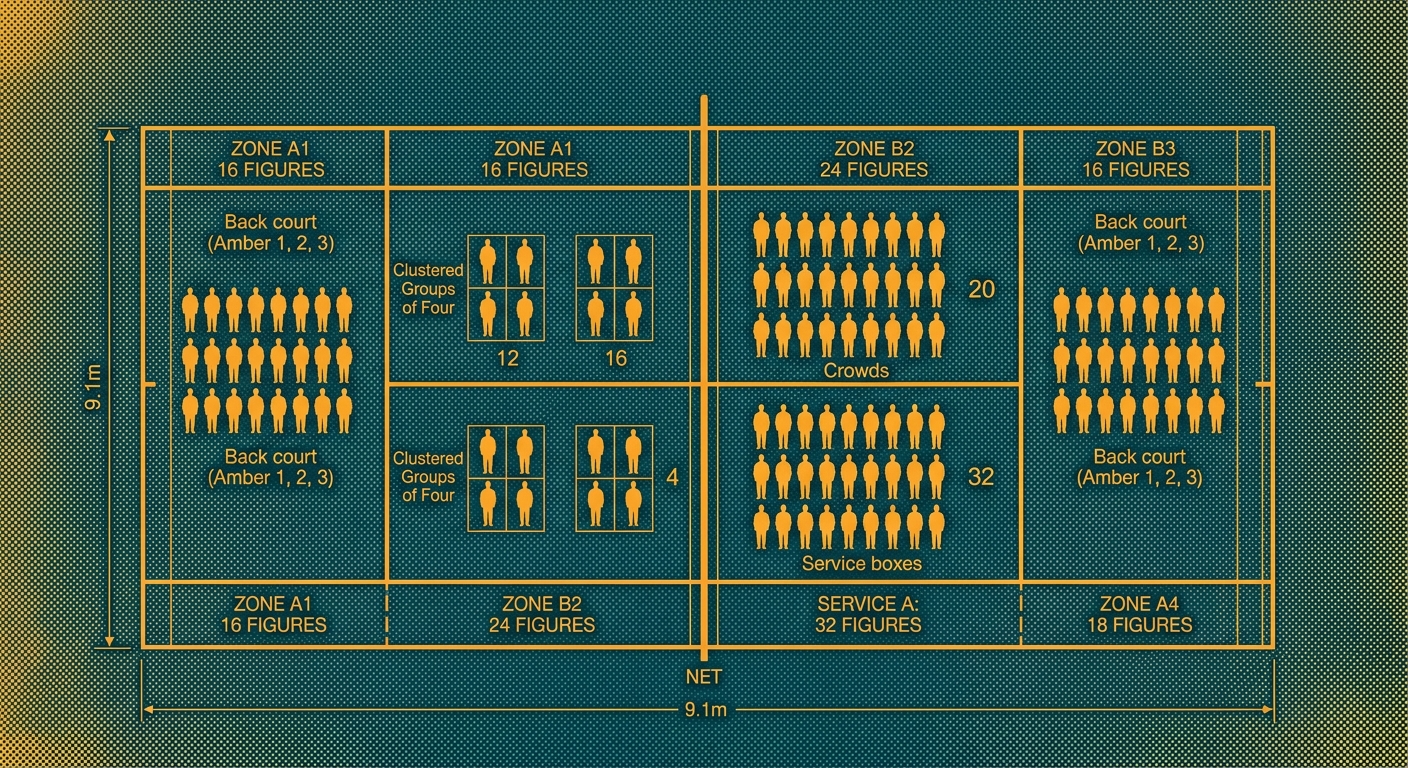
The 4:1 ratio (four students per coach) is widely considered the standard for quality group instruction in recreational tennis. At this ratio, a coach can realistically observe every student during a drill sequence, offer individual corrections between repetitions, and track each player's progress within a single session.
USTA player development guidelines and most certified tennis coach training programs reference this ratio as the baseline for meaningful individual feedback within a group context. Some advanced skill classes can run effectively at 6:1 because experienced players need less hand-holding between repetitions. But for beginners and intermediate players, 6:1 is already stretching it.
Orange County tennis programs at well-regarded facilities typically cap beginner group classes at 6 students per court with one coach — that's a 6:1 ratio, which is workable but requires an efficient coach who manages time well.
What Happens When Classes Get Too Large
Above 8:1, the math breaks down fast. In a 90-minute session, if the coach is the primary ball feeder and needs to give individual feedback to each student, you're looking at roughly 10-12 minutes of direct coach attention per player — total, for the entire session. That's not enough.
What actually happens in oversized classes: the coach defaults to group demonstrations, individual corrections get generic ("bend your knees" applies to everyone), and the better players effectively stop being coached because they're self-sufficient enough to keep the drill moving. The students who need the most help get the least of it.
So when you're evaluating programs, ask directly: what's the maximum class size? If they can't answer specifically, that's information.
Skill-Level Groupings: How Coaches Sort Players
Here's something most programs don't explain clearly: how you end up in a specific group isn't random, and it's not purely self-reported. Good coaches use a combination of signals.
NTRP ratings (the USTA's National Tennis Rating Program, which runs from 1.0 to 7.0) are the most common starting point. Most recreational players fall between 2.5 and 4.0. A 2.5 player is still learning to keep the ball in play; a 4.0 player can sustain rallies and has reliable groundstrokes under moderate pressure.
But self-reported NTRP ratings are notoriously optimistic. (I say this with love.) So most quality programs do a brief assessment — either a short rally evaluation or a few minutes of supervised play — before placing new students.
Coaches also look at:
- Rally consistency: Can you sustain a 10-ball cooperative rally?
- Serve reliability: Do you have a functional serve, or are you still working on getting the ball in the box?
- Movement patterns: Are you reacting to the ball or anticipating it?
If you're placed in a group that feels too easy or too hard, say something immediately. A good coach will either adjust in-session or move you at the next class. Being in the wrong group is one of the fastest ways to stall your progress — and one of the most common mistakes adult beginners make in group tennis lessons.
Practical Tactics: Getting the Most Out of Every Group Session
| Technique | Best Use | Outcome |
|---|---|---|
| Arrive 10 minutes early | Warm up independently before class starts | More quality reps during the actual session |
| Ask one specific question per session | When you have a persistent technical problem | Targeted feedback instead of generic corrections |
| Take notes immediately after class | Capture the coach's key correction from that day | Faster technical retention between sessions |
| Play the drill game, not just the drill | During match-play segments, compete intentionally | Builds pressure tolerance alongside technique |
| Record yourself once a month | Use your phone during free-rally segments | Objective data on what's actually changing |
| Communicate your goals to the coach | At enrollment and at session midpoints | Coach can weight drills toward your weak areas |
| Pair with drop-in play between sessions | Outside of structured class time | Accelerates skill consolidation |
The players who improve fastest in group settings are the ones who treat each session as a deliberate practice block, not a social hit. Both are valid reasons to be on the court — but they produce different results.
And if you're in Orange County and looking for programs that actually follow these principles, find group tennis lessons near you to see what's available at your level.
Measuring Success: Are You Actually Improving?
This is where a lot of group lesson participants go wrong — they measure progress by how much they enjoyed the session rather than whether they're actually developing.
Here are the metrics worth tracking:
Rally consistency: Count your maximum cooperative rally length at the start of each month. If it's not growing, something in your training isn't working.
First-serve percentage: Keep a rough mental count during match-play segments. A functional beginner should be getting 50%+ first serves in. Intermediate players should be closer to 60-65%.
Error rate under pressure: During mini-match segments, notice whether your unforced errors are decreasing over time. This is the most honest signal of whether technique is actually consolidating.
Benchmarks by level:
- Beginner (NTRP 2.0-2.5): After 8-10 group sessions, you should sustain 5-8 ball cooperative rallies consistently
- Intermediate (NTRP 3.0-3.5): After a full season of group classes, your dominant groundstroke should hold up under moderate pressure in match play
- Advanced beginner (NTRP 2.5-3.0): After 12 sessions, you should have a functional serve and basic directional control on both wings
If you're not hitting these benchmarks, the issue is either class size (too big), skill grouping (wrong level), or format (drop-in when you need progression). All three are fixable.
Future Trends in Group Tennis Instruction
A few things are genuinely changing how group lessons are delivered, and they're worth knowing about.
Video analysis integration: More programs are incorporating brief video review into group sessions — coaches record a drill segment, then review technique with the group on a tablet. What used to require expensive private sessions is becoming a standard group feature.
Smaller micro-group formats: The 3:1 and 4:1 ratio model is gaining traction as players become more sophisticated about what they're paying for. Programs that offer "semi-private" group formats (2-3 students) are filling a gap between traditional group lessons and full private instruction.
Data-driven skill assessments: Some programs — particularly those affiliated with USTA development pathways — are starting to use ball machine data and rally tracking apps to provide objective placement assessments rather than relying on self-reported ratings.
Themed group series: Instead of generic "beginner group class," programs are increasingly offering themed series — a six-week doubles tactics series, a four-week serve clinic progression. This is genuinely better for skill development and easier to market. Expect to see more of this format across Orange County tennis programs and nationally.
For players interested in the competitive side of development, understanding how group training feeds into tournament preparation is worth exploring — the junior development pipeline, for instance, relies heavily on structured group training before players start entering USTA junior tournaments.
Is a Group Lesson Right for Where You Are Now?
Honest answer: probably yes, but with caveats.
Group lessons are the right format if you're a beginner building foundational skills, an intermediate player who needs competitive pressure and peer repetitions, or an advanced player looking to sharpen a specific area of your game. They're also the most cost-efficient way to get consistent coached court time.
But group lessons alone aren't enough if you have a significant technical flaw that needs individual diagnosis, if you're preparing for competitive play on a specific timeline, or if you're a complete beginner who needs more hand-holding than a 4:1 ratio allows.
In those cases, the smart move is a hybrid approach — group lessons for volume and competitive pressure, private sessions for targeted technical work. The comparison between these two formats is covered in depth in the group tennis lessons vs. private lessons breakdown, which is worth reading before you commit your training budget.
So here's your next step: before you sign up for anything, ask the program three questions. What's the maximum class size? How are students grouped by skill level? And does the format follow a progression or is it drop-in? The answers will tell you almost everything you need to know about whether the program is worth your time and money.
If you're ready to find something that actually checks those boxes, find group tennis lessons near you and see what's available in your area.