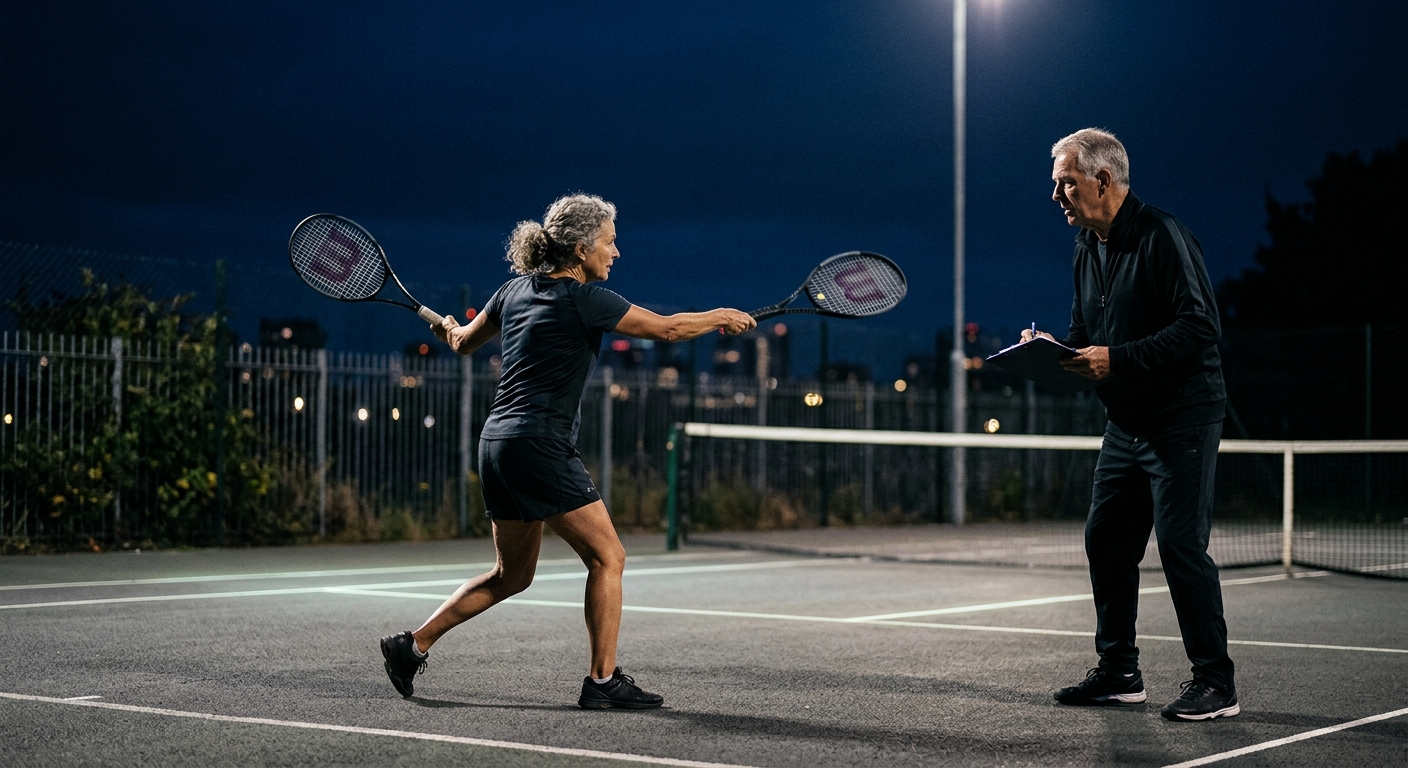
Only about 1 in 3 adults who pick up tennis after 55 are still playing two years later. That number jumps dramatically for those who took structured lessons early on. So before you decide whether to invest in instruction, let's be honest about what you're actually evaluating.
This isn't about becoming a competitive player. For most people over 55, the real question is: will lessons help me play longer, feel better, and actually enjoy this sport — or am I just paying for something I could figure out on my own? That's a health-economics question as much as a sports question. And the answer is almost always the same.
Lessons pay off. But the type of lesson matters enormously.
Why Seniors Ask This Question More Than Younger Players
Younger players treat lessons as skill acceleration. Seniors treat them as a cost-benefit decision — because they're right to.
After 55, the stakes shift. You're not trying to go pro. You're trying to avoid a rotator cuff tear, find a social activity you'll actually stick with, and get real cardiovascular benefit without destroying your knees. The margin for error is smaller. Bad technique doesn't just mean slower progress — it means injury. And injury at 60 has longer recovery times and higher costs than injury at 30.
That's exactly why doctors recommend tennis for seniors — but also why they recommend structured tennis. Self-taught players in this age group consistently develop compensatory mechanics: gripping too tight, over-rotating the shoulder, planting wrong on the follow-through. These habits feel fine for months. Then they don't.
So the question 'are adult tennis lessons worth it' is really asking: what's the cost of not having someone correct your form before it becomes a problem?
The Real Costs: Private Lessons, Group Classes, and Clinics Compared
Private Lesson Pricing for Senior Players
Private lessons run $60–$150 per hour depending on location, coach certification, and facility. In major metro areas — think New York, LA, Chicago — expect the higher end. The Central Park Tennis Center, operated through the City Parks Foundation, offers some of the most accessible public court access in the country, but even there, private instruction through affiliated coaches typically runs $80–$120/hour.
For seniors on fixed incomes, 10 private lessons at $100 each is a $1,000 commitment. That's real money. But here's the math that most people skip: one urgent care visit for tennis elbow runs $200–$400. An MRI is $800–$2,500. Physical therapy for a preventable shoulder issue? Six to twelve sessions at $100–$200 each.
Private lessons are expensive. Preventable injuries are more expensive.
Group Class Costs and Senior Discount Programs
Group clinics are the sweet spot for most adult beginners. Expect $15–$35 per 90-minute session. Many facilities offer senior discounts — typically 10–20% off — and USTA-affiliated programs frequently run subsidized beginner clinics specifically for adults over 50.
The USTA's 'Tennis Welcome Center' network and their senior-focused programming have expanded significantly. Local USTA sections often partner with municipal recreation departments to offer beginner adult programs at $8–$15 per session. These aren't watered-down options. Structured group instruction with a certified coach is genuinely effective for foundational skill-building.
(I've seen seniors make more consistent progress in a well-run group clinic than in sporadic private lessons — consistency beats intensity at this stage.)
Free Options Through City and Parks Programs
Don't overlook free. The City Parks Foundation runs free tennis programs in New York City parks — including beginner adult instruction — that serve thousands of players annually. Similar programs exist through municipal parks departments in most major cities.
These programs vary in quality and availability, but they're a legitimate starting point. They let you test whether you actually enjoy the sport before committing to paid instruction. Start free, validate the interest, then invest.
The Hidden Costs of Not Taking Lessons (Injury, Frustration, Quitting)
This is the section most cost comparisons skip entirely. Let's fix that.
The hidden costs of skipping lessons fall into three categories:
Injury costs. Self-taught adult beginners over 55 have significantly higher rates of overuse injuries in the first 12 months. Tennis elbow (lateral epicondylitis), rotator cuff strain, and knee stress injuries are the most common. These aren't freak accidents — they're technique failures. A coach catches them early. No coach means no catch.
Frustration and attrition. Tennis has a steep learning curve. Players who don't progress feel frustrated and quit. The dropout rate for self-taught adult beginners is substantially higher than for those who take even a short lesson series. You don't just lose the activity — you lose the health benefits and the social connection that came with it.
Wasted court time. Practicing bad habits reinforces them. Ten hours of self-taught play with a flawed forehand doesn't build skill — it builds a problem that takes twice as long to fix later. Structured instruction in the first 8–10 sessions sets a foundation that makes every future hour on court more productive.
So the real cost comparison looks like this:
| Scenario | 6-Month Cost Estimate | Injury Risk | Retention Rate |
|---|---|---|---|
| No lessons, self-taught | $0 instruction + potential $500–$3,000 injury costs | High | Low (~35%) |
| 10 group sessions | $150–$350 | Low-Moderate | Moderate (~60%) |
| 10 private lessons | $600–$1,000 | Low | High (~75%) |
| Mixed (4 private + ongoing group) | $400–$700 | Low | High (~80%) |
The mixed approach consistently delivers the best risk-adjusted return.
Health Benefits That Offset the Financial Investment
Cardiovascular and Cognitive Health ROI
The American Heart Association identifies regular moderate-intensity aerobic activity as essential for adults over 50 — and tennis qualifies decisively. A singles match burns 400–600 calories per hour. Doubles (more accessible for seniors) still delivers 300–450 calories per hour with lower joint impact.
But the cardiovascular story isn't even the most compelling part. A long-term study tracking adults over 20+ years found that tennis players had a 9.7-year longer life expectancy compared to sedentary adults — one of the highest gains of any sport studied. That's not a rounding error. That's a decade.
Cognitive benefits are equally significant. The combination of spatial reasoning, strategic decision-making, and social interaction in tennis creates a uniquely demanding cognitive environment. Research consistently shows this type of multi-dimensional activity reduces dementia risk and slows cognitive decline in adults over 60.
Put a dollar value on that. I'll wait.
Social Connection and Mental Wellbeing
Look, this one doesn't show up on most cost-benefit analyses. It should.
Loneliness in adults over 60 is a documented health crisis — with effects on mortality comparable to smoking 15 cigarettes a day, according to research cited by major health organizations. Tennis lessons, especially group formats, are inherently social. You're scheduled, accountable, and surrounded by people with a shared interest.
The group clinic format specifically creates regular social touchpoints. And unlike gym workouts or solo running, tennis requires a partner or group — which means built-in social structure. For many seniors, this is the highest-value benefit of all, even if it's the hardest to quantify.
Explore senior tennis lesson options near you if you want to find programs that combine skill development with social programming.
How Quickly Do Senior Adults Typically Progress?
Faster than most expect. Slower than impatient people want.
With structured instruction, most adult beginners over 55 can sustain a rally within 4–6 weeks. They can play a functional doubles game within 8–12 weeks. This timeline assumes 1–2 sessions per week plus some independent court time.
The key variable isn't age — it's consistency. A 65-year-old who attends group clinics twice a week will outpace a 45-year-old who shows up sporadically. Athletic background helps but isn't determinative. I've watched former swimmers and cyclists pick up tennis mechanics in half the expected time. I've also watched former team sport athletes struggle with the individual nature of stroke mechanics.
What slows seniors down isn't physical limitation — it's technique anxiety. The fear of doing it wrong. Good coaches address this directly. They set realistic milestones, celebrate incremental progress, and build confidence alongside mechanics.
For a detailed look at how different lesson formats affect learning speed, this breakdown of group tennis lessons vs. private lessons is worth reading before you commit to a format.
When Lessons Are Worth It — and When They're Not
Here's the honest version.
Lessons are worth it when:
- You're starting from scratch or returning after 10+ years away
- You've had a previous shoulder, elbow, or knee injury
- You want to play regularly for 5+ years
- You have a specific goal (doubles league, social group, fitness target)
- You're willing to practice between sessions
Lessons are NOT worth it when:
- You want to try tennis once or twice to see if you like it (use free programs first)
- You already play at an intermediate level and just want court time
- You can't commit to at least 6–8 sessions in a consistent window
- You're looking for a coach to "fix" you in one or two sessions (doesn't work that way)
And here's a nuance most articles miss: the format of lessons matters as much as whether you take them. Private lessons accelerate skill development faster but cost more and lack social benefit. Group clinics build skills more slowly but deliver social connection and are sustainable long-term. Clinics (themed intensive sessions) are excellent for specific skill gaps.
For a direct format comparison, group tennis lessons vs. tennis clinics breaks down which structure builds skills faster depending on your starting point.
Comparing Lesson Formats: A Full Strategy Breakdown
| Strategy | Best For | Pros | Cons | Estimated ROI |
|---|---|---|---|---|
| Private lessons (weekly) | Players with specific technique issues or injury history | Personalized feedback, fastest skill fix, injury prevention focus | Expensive ($80–$150/hr), no social element | High if consistent; poor if sporadic |
| Group clinics (2x/week) | Most adult beginners over 55 | Affordable, social, structured, sustainable | Slower individual feedback, mixed skill levels | Very high — best overall value |
| Tennis clinics (intensive) | Players with one specific weakness | Deep focus on one skill area, often fun format | Short-term, not a complete program | Moderate — best as a supplement |
| City/parks free programs | Complete beginners testing the sport | Zero cost, low commitment, often well-run | Variable quality, limited availability, large groups | Highest short-term ROI (free) |
| Mixed (private start + group ongoing) | Serious beginners who want fast foundation + sustainability | Best of both formats, injury prevention early + social long-term | Requires coordination, moderate cost | Highest long-term ROI |
| Self-taught / YouTube only | Nobody over 55, honestly | Free, flexible | High injury risk, bad habit formation, high dropout | Negative — costs more in the long run |
Measuring Performance: Are You Getting Value?
Don't just show up and hope. Track these:
Skill indicators:
- Can you sustain a 5-shot rally within 4 weeks? 10-shot within 8 weeks?
- Is your coach identifying and correcting specific technique issues each session?
- Are you getting homework — specific things to practice independently?
Health indicators:
- No new joint pain or soreness beyond normal muscle fatigue
- Heart rate reaching moderate-intensity zones during play (50–70% max HR)
- Sleep quality and energy levels — tennis should improve both
Value indicators:
- Are you looking forward to sessions? (Motivation is a leading indicator of retention)
- Are you meeting people and building a tennis social circle?
- Is your coach adjusting instruction based on your progress, not just running the same drills?
If you're three months in and can't answer yes to most of these, the issue might not be tennis — it might be the program or the coach. Don't confuse a bad instructor with a bad investment.
Optimizing for Your Goals
Be specific about what you want. Vague goals produce vague results.
Goal: Stay active and healthy. Prioritize consistency over intensity. Two group sessions per week beats one private lesson per week, every time. The social accountability of group classes dramatically improves attendance rates.
Goal: Play doubles with friends. Start with group clinics, then transition to supervised match play as quickly as your coach recommends. Ask specifically about doubles strategy from day one — many coaches default to singles mechanics unless you direct them otherwise. (This doubles positioning guide is useful even for beginners.)
Goal: Manage or prevent injury. Start with private lessons. The investment in proper technique assessment is highest-value here. Tell your coach about any existing shoulder, elbow, or knee history upfront. A good senior tennis coach will modify instruction accordingly.
Goal: Find a social community. Group clinics and city parks programs win here. The USTA's adult tennis leagues and beginner-friendly club programs are specifically designed to create social tennis communities. Don't underestimate this — it's often what keeps people playing for decades.
For a deeper look at structuring your weekly play for both progress and recovery, check out the senior tennis weekly schedule guide.
Making the Decision: Questions to Ask Before You Sign Up
Before you commit to any program, get honest answers to these:
Does the coach have experience with adult beginners over 55? Not just "adults" — specifically seniors. Technique modification for older bodies requires specific knowledge.
What's the cancellation and makeup policy? Life happens. Programs with rigid policies create dropout pressure.
What's the student-to-coach ratio in group sessions? Above 6:1 and individual feedback suffers. Above 8:1, you're basically watching a demonstration.
Is there a trial session? Any program worth its price should offer one. If they won't, that's information.
What's the progression path? Beginners who have no clear path to intermediate programming often plateau and quit. Ask what happens after the intro series.
Are there players at your level? Playing with people significantly better or worse than you slows development and reduces enjoyment.
And one more thing: read about what to look for in a tennis coach for senior adults before your first consultation. It'll help you ask better questions and spot red flags early.
The bottom line is straightforward. For adults over 55, structured tennis instruction is one of the highest-return investments you can make in your long-term health, social life, and quality of play. The cost is real. The return is measurable. And the alternative — self-teaching your way into an injury and quitting — costs more in every way that matters.
Start with a free or low-cost group program if budget is a constraint. Add private sessions if you hit a technique wall or have injury history. Track your progress. Adjust the format as you improve. And give it at least 10 sessions before you evaluate whether it's working.
Ten sessions. That's the minimum viable investment. Everything before that is just getting started.