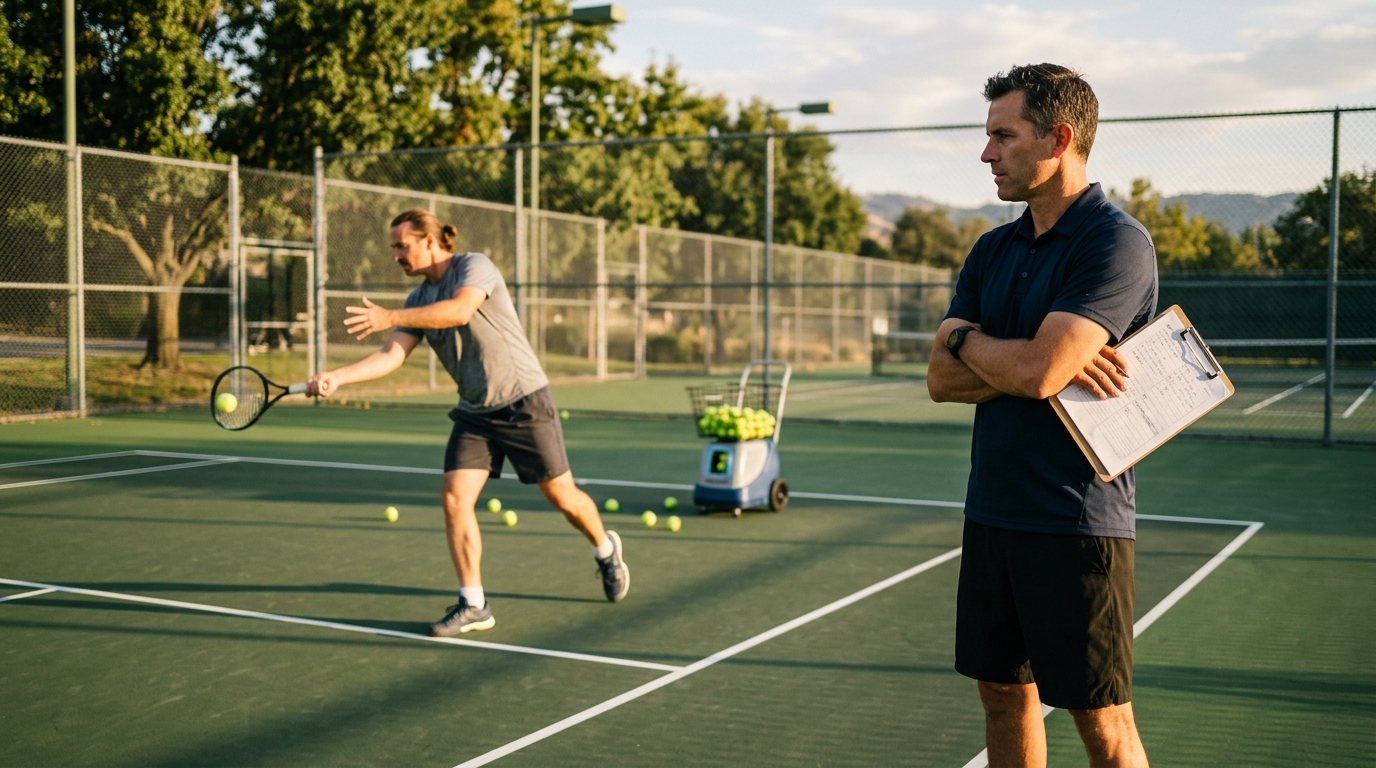
Most adults who pick up tennis spend the first year doing the same thing: watching YouTube videos at midnight, hitting balls into a fence, and asking their friend who played in college to "just show them a few things." A year later, they're still double-faulting on every second serve and wondering why their forehand looks nothing like Federer's.
The question isn't really whether a coach is expensive. It's whether the alternative — grinding through self-teaching for 18 months — is actually cheaper once you account for everything you're spending anyway.
The YouTube Experiment: What 6 Months of Self-Teaching Actually Produces
YouTube tennis instruction has genuinely gotten better. Channels like Top Tennis Training and Feel Tennis produce technically accurate content. The problem isn't the quality of the information — it's the feedback loop. Or rather, the absence of one.
When you watch a video on fixing your backhand slice, you absorb the concept correctly. Then you go hit balls, and your brain does something predictable: it tells you that you're doing it right, even when you're not. Without an external observer, bad habits don't feel like bad habits. They feel like your technique.
A study on motor skill acquisition in adult learners found that self-directed practice without corrective feedback produces measurable improvement for roughly the first 8-12 weeks — and then plateaus. The body has optimized for whatever pattern it's been reinforcing, correct or not. Breaking that pattern later is significantly harder than building the right pattern from the start.
Six months of YouTube-and-hitting-with-friends typically produces this: a player who understands tennis conceptually, has a serviceable but mechanically flawed groundstroke, no reliable serve, and an incomplete understanding of court positioning. That's not nothing. But it's also not what most adult beginners are hoping for.
What a Coach Fixes in 4 Lessons That Takes 18 Months Alone
Here's what experienced coaches consistently report: the most common beginner errors — grip issues, improper contact point, poor unit turn, tossing the ball incorrectly on the serve — are almost invisible to the player making them. They're proprioceptively invisible. Your arm doesn't know it's doing something wrong because it's never felt the right version.
A competent coach identifies these in the first 20 minutes of watching you hit. They fix the grip in lesson one. They address contact point in lesson two. By lesson four, your forehand is structurally sound in a way that would have taken you 18 months of frustrated plateau-breaking to reach alone — if you reached it at all.
This isn't an exaggeration. It's the difference between deliberate practice with feedback and repetitive practice without it. The research on skill acquisition is consistent: feedback quality is the primary driver of improvement rate, not hours spent practicing.
For context on the serve specifically, the toss is almost always the problem — and almost no self-taught player figures that out without someone pointing it out directly.
The Cost Breakdown: $50-$85/Hour Sounds Expensive Until You Do This Math
Let's be concrete about what self-teaching actually costs, because people tend to undercount it.
The self-teaching budget (6 months):
- Court fees: $10-$20/session × 3 sessions/week × 24 weeks = $720-$1,440
- Ball machine rental or purchase: $15-$25/hour rental, or $400-$800 to buy a basic one
- Balls, racket restringing, gear: $150-$300
- Total: roughly $1,300-$2,500 over six months
And at the end of that six months, you're a player with ingrained mechanical flaws that will actively limit your ceiling.
Private Lessons: Cost Per Skill Milestone
Private lessons run $50-$85/hour in most mid-sized U.S. markets, higher in major cities. A typical beginner-to-intermediate progression takes 20-30 private lessons spread over 3-6 months.
- 25 lessons × $65 average = $1,625
- Add court fees and gear: $400-$600
- Total: roughly $2,000-$2,200
The cost is similar. The outcome is not. After 25 private lessons with a competent coach, you're a structurally sound intermediate player. After six months of self-teaching, you're a frustrated beginner with a plateau problem.
The cost-per-skill-milestone math is stark: coaching compresses 2 years of self-directed improvement into 3-6 months. That's not marketing language — it's what coaches and sports scientists studying motor learning have documented repeatedly.
Group Lessons: The Budget Option That Still Works
Group tennis lessons cost significantly less than private lessons — typically $15-$35 per person per session — and for beginners especially, they're more effective than people assume. You get structured instruction, you see other players making the same mistakes (which is genuinely educational), and you get competitive drilling that self-practice can't replicate.
The tradeoff is individual attention. In a group of six, your coach can't watch your forehand for 60 minutes. But for the first 3-4 months of learning, that's less critical than it sounds. The foundational concepts — grip, stance, swing path — are universal, and group instruction covers them well.
Compare group and private lesson costs to find the structure that fits your budget and learning style. For many adult recreational players, a hybrid approach — group lessons for the first 3 months, then occasional private sessions to fix specific issues — is the most cost-effective path.
The Health ROI Nobody Calculates (But Should)
Here's the number most people skip entirely when they're deciding whether coaching is worth the money: tennis fitness benefits are substantial and well-documented, and they kick in much faster when you can actually play the game.
A 2019 study published in the British Journal of Sports Medicine found that racket sports were associated with a 47% reduction in cardiovascular mortality — the highest of any sport studied. Other research has linked regular tennis play to improved bone density, better cognitive function in adults over 50, and lower rates of depression and anxiety.
But here's the catch: you only capture those benefits when you're actually playing tennis, not when you're hitting balls into a fence by yourself for 45 minutes and going home frustrated. The faster you become a functional player — someone who can rally, play points, and join a league — the sooner the health benefits compound.
For adults over 55, this calculus is even more pointed. The physical and cognitive benefits of tennis for older adults are significant enough that many physicians actively recommend it. A coach who understands how to work with older bodies accelerates the path to those benefits.
If you play tennis twice a week for 10 years, the health value of that activity — measured in reduced healthcare costs, improved quality of life, and longevity — is worth tens of thousands of dollars conservatively. Spending $2,000 on coaching to actually become a player who enjoys the game and sticks with it is a rounding error against that number.
When Coaching Isn't Worth It: 3 Scenarios to Save Your Money
This isn't a universal endorsement of hiring a coach regardless of circumstances. There are situations where the math genuinely doesn't work.
1. You're not going to practice between lessons. A coach can fix your grip in a session. If you don't hit balls between sessions, that fix won't stick. Coaching requires practice to be effective. If your schedule genuinely won't allow for 2-3 hitting sessions per week, you'll burn money on lessons that don't compound.
2. You just want casual exercise, not improvement. If you're hitting with your spouse twice a week for fun and have no interest in playing competitively or improving your technique, YouTube is fine. Coaching is for people who want to get better. There's no shame in just wanting to move and have fun.
3. You're hiring the wrong coach. A coach who doesn't have a clear curriculum, can't explain why they're teaching you what they're teaching you, or spends most of the lesson feeding balls without instruction is not compressing your learning timeline — they're just taking your money. More on this below.
How to Make Sure You're Not Wasting Money on the Wrong Coach
The coaching market is uneven. There are excellent coaches charging $60/hour and mediocre ones charging $120/hour. Credentials matter — PTR (Professional Tennis Registry) and USPTA (United States Professional Tennis Association) certification indicates formal training — but they're not the whole picture.
Ask these questions before committing:
- What does your typical progression look like for a player at my level?
- How do you structure lessons — drill-focused, point play, video analysis?
- How will I know I'm improving?
A coach who can answer those questions clearly is a coach who has thought about pedagogy, not just tennis. That's who compresses your learning timeline.
For junior players heading toward competitive play, the coaching relationship becomes even more critical — the demands of USTA tournament preparation require a coach who understands competitive development, not just recreational instruction.
For doubles players, a good coach also addresses tactical development — court positioning and net play are skills that are almost impossible to develop without structured feedback on your decision-making.
The easiest way to avoid a mismatch is to get matched with someone who fits your goals, budget, and schedule from the start. You can get matched with a vetted, certified coach for free — it removes the guesswork of finding someone who's actually qualified to compress your learning timeline rather than just extend their billing one.
The math on coaching is straightforward once you run it honestly. The question was never really whether $65/hour is a lot of money. The question is what you're buying with it — and whether the alternative actually costs less.