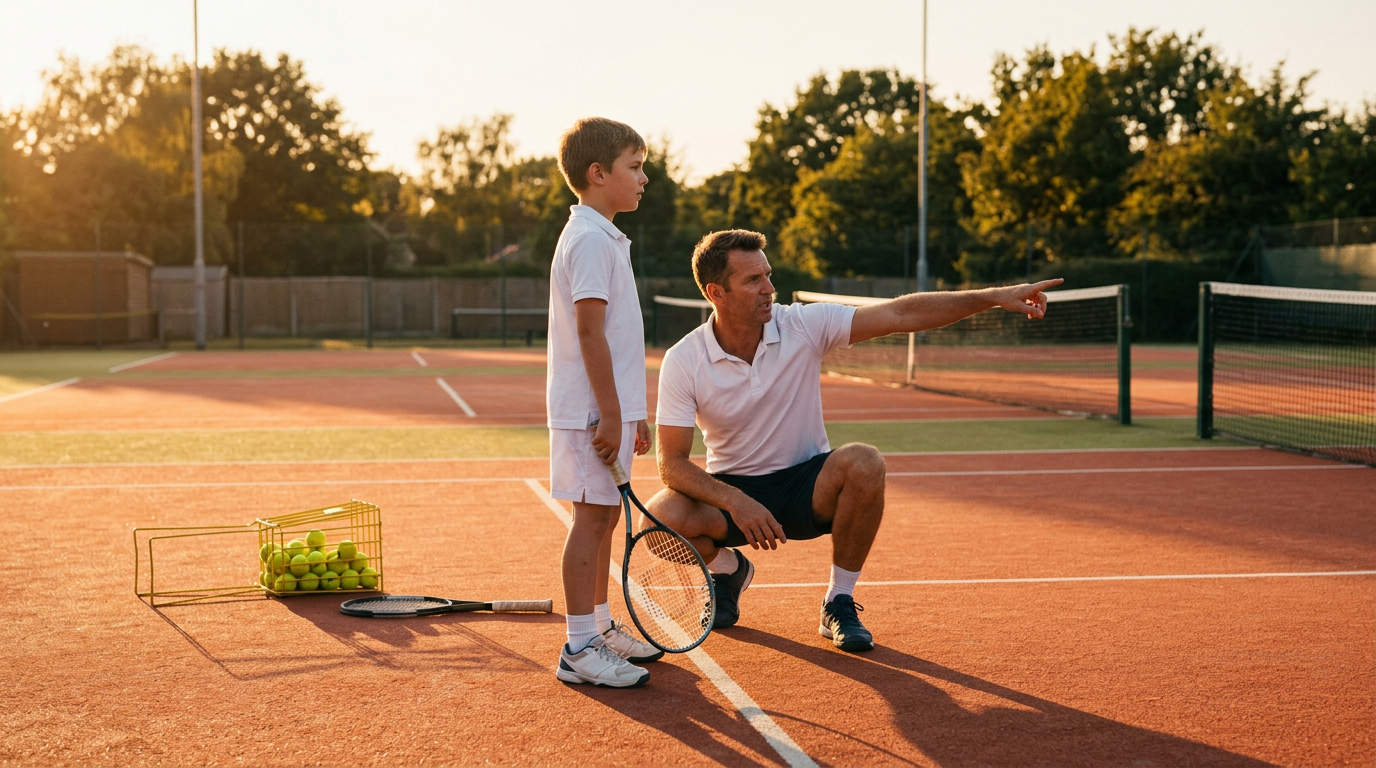
Most parents who ask about competitive junior tennis aren't imagining the Williams sisters. They're imagining their 10-year-old who just beat a kid at the club and suddenly wants to know when the next tournament is. That's a very different conversation — and a much more manageable one than the tennis world sometimes makes it seem.
The horror stories are real: families spending $25,000 a year on travel, kids burning out by 14, coaches who treat a recreational player like a Division I prospect. But those stories represent the extreme end of a pathway that, for most kids, looks nothing like that. The USTA junior system is actually designed with gradual progression in mind. The problem is that nobody explains it to parents before they sign the check.
Here's what the pathway actually looks like — age by age, dollar by dollar, and with honest flags for when a program has lost the plot.
The USTA Junior Pathway: From Local Play Days to Sectional Rankings
The USTA structures junior competition in a way that most parents never fully see mapped out. At the entry level, there are local "play days" and beginner tournaments with no UTR (Universal Tennis Rating) implications. From there, kids can progress to local USTA tournaments, then sectional events, and eventually national-level competition. Each rung requires more commitment — time, money, and emotional bandwidth — than the one below it.
The majority of competitive junior tennis players never leave the local or sectional level. That's not a failure. For most kids, that's the right ceiling, and a good coach knows it.
Ages 6-8: Foundation Stage (and Why Most Kids Shouldn't Compete Yet)
The USTA's 10-and-Under Tennis (10U) format exists precisely because young children aren't developmentally ready for full-court, adult-format competition. Smaller courts, lower-compression balls, shorter rallies — the whole structure is designed to keep the game fun and achievable for small bodies with short attention spans.
At this age, what a coach is actually doing has almost nothing to do with competition. It's coordination, basic stroke patterns, learning to track a moving ball, and — critically — building a relationship with the sport that doesn't sour. A 7-year-old who gets crushed in a tournament and cries for three days is not a competitive tennis player in development. That's a kid who needed more time.
Some 6-8 year olds thrive in 10U play days. They're social, resilient, and genuinely enjoy the format. But parents should resist any coach who's pushing structured competition as a priority at this stage. The foundation being built right now — footwork, hand-eye coordination, a love of hitting — is worth more than any trophy.
Ages 9-12: First Tournaments and What a Coach Prioritizes
This is where competitive junior tennis typically starts in a meaningful sense. Kids in this range are ready to understand scoring, handle some losing, and begin developing tactical awareness. The USTA's 12U and 10U tournament circuits are the entry point.
A junior tennis coach working with this age group is doing several things simultaneously:
- Stroke consolidation: Not perfecting technique, but making sure the forehand, backhand, and serve are reliable enough to survive a match
- Point construction: Teaching kids to think beyond just hitting the ball — where to aim, when to come to net, how to use spin
- Scorekeeping and rules: Surprisingly, many kids entering their first tournaments don't know the full scoring system
- Emotional regulation: Learning to reset after a bad point, not argue calls, and stay focused when losing
At this stage, a good coach is also managing parent expectations as much as player development. The 10-year-old who loses in the first round of a local tournament hasn't failed — they've started the real education.
For whether group or private lessons fit your junior player, this age range is where the question gets interesting. Group training builds competitive instincts through peer play. Private lessons address specific technical weaknesses that show up in matches. Most kids this age benefit from both.
Ages 13-16: Serious Competition and the College Tennis Question
Here's where the stakes genuinely shift. A 14-year-old who's been playing tournaments for four years and has a developing UTR rating is now at a crossroads. Are they playing for the joy of competition, or are they on a college tennis track?
The answer shapes everything — training volume, tournament selection, financial investment, and how much pressure is appropriate.
For kids with legitimate college tennis aspirations, this is the window that matters. College coaches start watching UTR profiles and tournament results in the 14-16 range. A junior who isn't competing at the sectional level by 15 is unlikely to attract Division I attention, though D2, D3, and NAIA programs recruit from a much wider pool.
For kids who love the sport but aren't on a college track, competitive tennis at this age is still enormously valuable — discipline, resilience, physical fitness, the ability to perform under pressure. A good coach frames it that way, rather than manufacturing urgency that doesn't serve the player.
What a Junior Tennis Coach Does That a General Coach Doesn't
A coach who works primarily with adult recreational players or beginners is not automatically equipped to coach competitive juniors. The skill sets overlap, but the job description is different.
Match Strategy Coaching vs. Pure Technique Drilling
General coaching is often technique-first: fix the grip, adjust the toss, clean up the follow-through. That work is necessary and never fully stops. But a junior tennis coach working with tournament players spends a significant portion of time on match strategy — and that's a different discipline entirely.
Match strategy coaching means analyzing an opponent's patterns, building a game plan before stepping on court, and adjusting mid-match when the plan isn't working. It means teaching a 12-year-old to recognize that their opponent hates short balls, then training them to produce short balls on purpose under pressure.
This kind of coaching requires a coach who has watched a lot of junior tennis — not just played it. There's a meaningful difference between a coach who was a good player and a coach who has spent years watching how 11-year-olds actually play points versus how adults do.
If you want to understand whether the investment in specialized coaching makes sense financially, the analysis at Is Hiring a Tennis Coach Actually Worth It? is worth reading before you commit to a high-cost program.
Mental Toughness Training for Kids Who Hate Losing
Every junior tennis player hates losing. The question is whether they hate it productively or destructively.
A junior coach worth their fee has a toolkit for this that goes beyond "stay positive." It includes:
Pre-match routines that create a sense of control before the first ball is struck. For younger kids, this can be as simple as a consistent warm-up sequence and a few minutes of quiet before stepping on court.
Between-point rituals — the bounce of the strings, the towel, the breath — that interrupt the emotional spiral after a bad point. These are trainable habits, not personality traits.
Reframing losses as data rather than verdicts. A coach who reviews match footage with a 13-year-old and asks "what did you learn?" rather than "why did you miss that?" is doing something fundamentally different.
Parents often underestimate how much of a junior coach's job is psychology. The technical coaching is visible — you can watch a lesson and see what's being taught. The mental game work happens in conversations, in how a coach responds when a player throws a tantrum, in the questions asked after a tough loss.
Real Costs: What Competitive Junior Tennis Runs Per Year
Let's be direct about money, because the range is genuinely wide and most programs don't advertise the full picture.
| Level | Annual Cost Estimate | What's Included |
|---|---|---|
| Local beginner (ages 9-11) | $2,000–$5,000 | Group lessons, a few local tournaments, basic equipment |
| Active local competitor | $5,000–$10,000 | Mix of private and group coaching, 8-15 tournaments, travel within 2 hours |
| Sectional-level competitor | $10,000–$20,000 | Private coaching 3-4x/week, 20+ tournaments, regional travel, possibly a hitting partner |
| National-level junior | $25,000–$50,000+ | Elite academy or private coach, national travel, fitness training, video analysis |
The families spending $30K+ are real — but they're a small fraction of competitive junior tennis participants. Most families competing at the local and sectional level are in the $5,000–$15,000 range annually, which is still significant but not the number that gets quoted in alarming newspaper features.
The costs that sneak up on families:
- Tournament entry fees: $30–$80 per event, and kids often play 15-25 events per year
- Stringing: A serious junior player can go through strings every 2-3 weeks at $20-40 per restring
- Shoes: Competitive juniors burn through court shoes faster than parents expect — budget $150-200 every few months
- Travel: Even "local" tournaments often mean a 90-minute drive and a hotel night
None of this is hidden. But it accumulates in ways that families don't always project when they're signing up for their first tournament season.
3 Red Flags That a Junior Program Is Pushing Too Hard
The tennis industry has a financial incentive to escalate commitment. More training hours, more tournaments, more travel — more revenue. A good coach resists this. Here's how to spot the ones who don't.
1. Specialization pressure before age 12 Any program pushing a 10-year-old to quit other sports and focus exclusively on tennis is prioritizing the program's enrollment over the child's development. Multi-sport participation through early adolescence is consistently supported by sports science research as protective against burnout and overuse injury. A coach who disagrees with this is either uninformed or selling something.
2. Tournament volume that exceeds skill development Competing is not the same as developing. A junior who plays 30 tournaments a year but only trains 3 hours a week is reinforcing existing habits — including bad ones — rather than building new skills. The ratio of training to competition should heavily favor training at every level below the national circuit. If a program is scheduling more tournaments than practice sessions, that's backwards.
3. Emotional manipulation around results A coach who sulks after a player loses, withholds praise based on match outcomes, or creates anxiety about rankings in a 12-year-old is not coaching — they're projecting. Junior players at local and sectional levels are not professionals. Their results don't define their worth, and a coach who communicates otherwise is doing damage.
Trust your instincts here. If your kid comes home from practice anxious rather than energized, that's information.
How to Find a Junior Tennis Coach Who Gets the Balance Right
The best junior coaches share a few characteristics that are worth specifically looking for.
They talk about player development in multi-year timelines, not immediate results. Ask a prospective coach: "What would you hope my 11-year-old looks like as a player at 14?" A good answer focuses on skills, habits, and love of the game. A concerning answer focuses on rankings.
They have a clear philosophy about tournament scheduling. Ask how many tournaments they recommend per year for a player at your child's level, and why. A thoughtful answer will reference the training-to-competition ratio and the player's specific development needs. A vague answer — "it depends, we'll see how they do" — suggests they're making it up as they go.
They communicate with parents honestly, including bad news. A coach who only tells you what you want to hear about your child's progress is not serving your child. The coaches who say "your kid has real talent but needs to work on their second serve before we add more tournaments" are the ones worth keeping.
For doubles positioning and strategy, the same principle applies — real coaching addresses the uncomfortable truths, not just the easy wins.
The USTA junior system, used correctly, is one of the best competitive development structures in youth sports. It has built-in progression, age-appropriate formats, and a community of players that most kids find genuinely motivating. The families who navigate it well are the ones who found a coach who treats the pathway as a long game — not a sprint to a ranking.
Browse vetted tennis coaches near you to find someone who understands what competitive junior tennis actually demands at your child's age and level.