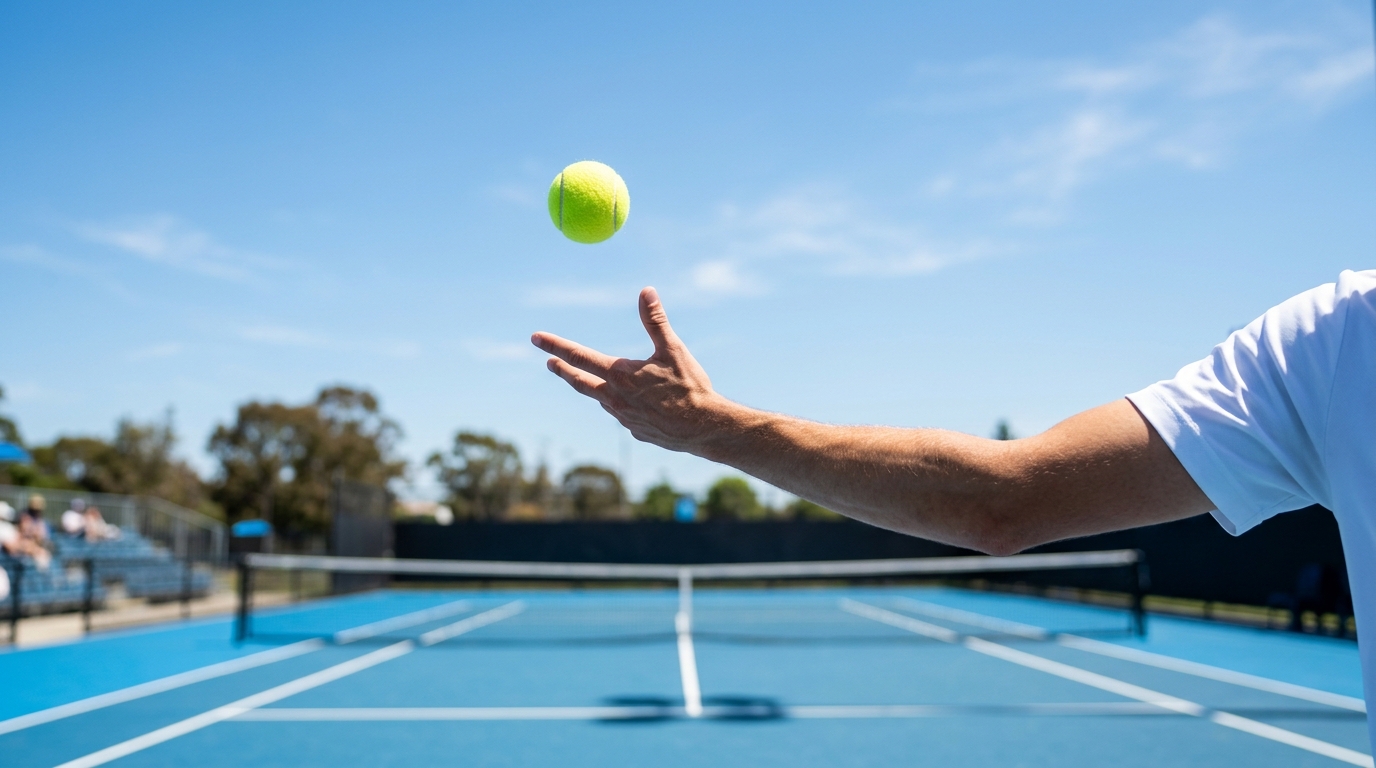
Most recreational players who struggle with their serve spend hours watching slow-motion footage of Federer's arm action, trying to replicate that whip-like pronation at contact. That's not the problem. Nine times out of ten, the serve breaks down before the arm ever gets involved — at the grip, or more often, at the toss.
Coaches who've spent years on court with club players will tell you the same thing: fix the toss, and half the serve problems disappear on their own. The swing follows the toss. If the ball is in the wrong place, the arm will compensate, and compensations compound.
This article isn't about your swing. It's about the two mechanical foundations that make everything else possible — and a framework to figure out which one is actually failing you.
The Two Things Every Serve Depends On (Before You Even Swing)
Tennis serve technique requires proper grip and toss mechanics before any other element can function correctly. That's not a simplification — it's how the physics work. The grip determines what your racket face can do at contact. The toss determines where contact happens. Get either one wrong, and you're essentially solving the wrong equation.
Think of it this way: a perfectly timed swing hitting a ball in the wrong location produces a fault. A slightly imperfect swing on a perfectly placed toss often produces a serviceable ball. The toss is load-bearing in a way the arm mechanics aren't — at least not at the recreational level.
The two foundations, in order of priority:
- Continental grip — the mechanical prerequisite for spin, power, and consistency
- Consistent toss placement — the variable that recreational players most consistently get wrong
Get these right, and the kinetic chain (legs → hips → shoulder → arm → racket) can actually do its job. Skip them, and you're building on sand.
Step 1: Check Your Grip — Why Continental Is Non-Negotiable
Most players know they're supposed to use a continental grip on the serve. A significant portion of them aren't actually using it.
The continental grip isn't just a stylistic preference — it's the physical requirement for generating topspin, slice, and flat pace from the same basic motion. Without it, you physically cannot pronate through the ball the way the serve demands. Your wrist locks up, your elbow compensates, and you end up pushing the ball rather than striking it.
How to Find Continental Grip in 10 Seconds
Hold your racket out in front of you like you're shaking someone's hand — the butt of the handle pointing at your belly button, strings perpendicular to the ground. Now grip it. That's continental.
The technical description: the base knuckle of your index finger sits on bevel 2 (the top-right bevel if you're right-handed, looking down at the handle). The heel pad of your hand sits on bevel 1.
A faster check: hold the racket by the throat with your non-dominant hand. Place your dominant hand flat against the strings, then slide it down to the grip without rotating your wrist. That's your continental.
Once you've found it, it should feel slightly awkward if you've been using an eastern or semi-western grip for groundstrokes. That discomfort is normal. It goes away within a few sessions.
The Frying Pan Grip Trap (and Why It Caps Your Serve at 60 MPH)
The "frying pan" grip — where the racket face sits flat, like you're holding a pan — is an eastern forehand grip rotated onto the serve. Players default to it because it feels natural and makes it easy to see the strings at contact.
The problem: it physically prevents the forearm pronation that generates pace. Your arm can't rotate through the ball. Instead, you end up slapping at it with a stiff wrist, which caps your serve speed around 60-65 mph regardless of how hard you swing. You also lose any meaningful access to kick or slice serves — the grip simply won't allow the racket face angles those spins require.
If your serve has felt "stuck" at the same speed for years despite working on it, check the grip first. It might be the ceiling you've been hitting.
Step 2: Fix Your Toss Before You Fix Anything Else
Here's what coaches consistently observe: players with inconsistent tosses develop compensatory swing patterns that look like technique problems. The late arm swing, the collapsed trophy position, the rushed contact — these are often symptoms of a bad toss, not independent flaws. Fix the toss, and the swing often self-corrects.
A good toss has two qualities: it goes to the same place every time, and it goes to the right place for the serve you're hitting.
The Coin Test: A 2-Minute Toss Consistency Drill
This drill exposes toss problems faster than any amount of serving.
Stand in your service stance. Go through your full toss motion — arm extension, ball release, the whole thing — but don't swing. Let the ball drop. Place a coin (or a ball can lid) where the ball lands.
Do this ten times. If your toss is consistent, the ball should land within a six-inch radius of the coin every time. Most recreational players find their toss scatters 18-24 inches across the court — sometimes in front of their body, sometimes behind, sometimes too far right.
The fix isn't to think harder about where the ball goes. It's to simplify the release. Most toss errors come from one of three places:
- Releasing the ball too early (fingers open before full arm extension) — ball lands short and left
- Flicking the wrist at release — ball spins and drifts unpredictably
- Bending the elbow during the toss arm lift — ball height and direction vary with each rep
The toss arm should move like an elevator: straight up, smooth, releasing the ball at or near full extension with the fingers pointing toward the sky. No flick, no spin, no rush.
Toss Placement for Flat, Slice, and Kick Serves
Consistency isn't the only variable. Placement matters too, and it differs by serve type.
| Serve Type | Toss Location (relative to body) | Why |
|---|---|---|
| Flat | Slightly in front, at 1 o'clock | Allows full arm extension and forward contact |
| Slice | Further right, at 2-3 o'clock | Lets the racket brush around the outside of the ball |
| Kick (topspin) | Behind the head, at 11-12 o'clock | Creates the upward brushing motion that generates topspin |
(For right-handed servers. Mirror for left-handers.)
Most recreational players toss to the same location regardless of serve type, then try to manufacture spin with the arm. That's backwards. The toss sets up the spin; the arm delivers it.
Step 3: The Kinetic Chain — How Power Comes From Your Legs, Not Your Arm
Once the grip and toss are sorted, this is where the real power conversation begins.
The serve is a full-body movement. Power originates from leg drive — specifically the push through the ground at the start of the upward swing. That force travels through the hips rotating forward, into the shoulder turn, down the arm, and out through the racket. Each segment adds velocity. Each segment also has the potential to leak it.
The most common power leak: players who don't bend their knees. Flat-footed serves — where the legs barely move — are almost always arm-dominant. The arm then has to generate all the pace alone, which is both inefficient and hard on the shoulder.
A practical cue that works for most players: before you start your swing, feel your weight drop slightly as your knees bend. At the moment of ball release from the toss, you should be in a slight squat. Then drive up. The sensation should feel like jumping toward the ball, even if your feet don't leave the ground.
You don't need a 130 mph serve. But if your serve feels like it takes effort and still lacks pace, the legs are almost certainly underinvolved.
Self-Diagnosis: Which Part of Your Serve Is Actually Broken?
Before you change anything, identify what's actually wrong. Here's a quick framework:
Symptom: Serve consistently goes into the net Likely cause: Toss too far in front, causing contact below the ideal strike zone. Or grip is too eastern, preventing upward brush at contact.
Symptom: Serve goes long or sails wide consistently Likely cause: Toss too far behind or to the side, forcing a compensatory swing path. Check where your toss lands with the coin test.
Symptom: Serve has no pace despite hard swinging Likely cause: Frying pan grip preventing pronation, or flat-footed stance cutting off leg drive.
Symptom: Serve is inconsistent — sometimes good, sometimes awful, no pattern Likely cause: Toss variation. This is the most common presentation. If you can't predict where your next serve will go, the toss is almost certainly moving around.
Symptom: Arm feels tired after serving, or shoulder aches Likely cause: Arm-dominant serve with minimal leg involvement, or a grip that's forcing awkward wrist angles. This one warrants attention beyond mechanics — connect with a certified coach who can fix your serve in person before it becomes an injury.
The self-diagnosis framework is useful, but it has a ceiling. You can't watch yourself serve. Video helps — even a phone propped against a ball hopper gives you more information than feel alone.
When to Stop Watching YouTube and Get a Coach to Watch You
YouTube has made tennis instruction more accessible than it's ever been. It's also created a generation of players who've watched 200 serve videos and still can't get the ball in the box consistently.
The problem with self-teaching from video: you're watching someone else's body, and you're guessing at what your body is doing. The gap between what you think you're doing and what you're actually doing is often enormous. Coaches who work with recreational players see this constantly — a player convinced their toss is fine, whose toss is clearly 18 inches off target.
A single session with a qualified coach can identify in ten minutes what you've been trying to diagnose for months. The group lessons where you can practice serves with feedback are particularly useful here — you get coached repetitions in a structured environment, and you can watch other players work through the same problems.
If you're serious about improving, it's also worth reading whether hiring a coach is actually worth the investment — the math is more favorable than most players assume, especially when you factor in the time spent plateauing without one.
For players who've been grinding at this for a while: the serve is the one shot in tennis that is entirely within your control. No opponent is rushing you. No ball is coming at you. It's just you, the toss, and the target. That's both the opportunity and the frustration — because when it's broken, there's nowhere to hide.
Start with the grip. Then the toss. Run the coin test this week, and see where your ball actually lands. The answer to what's wrong with your serve is probably already there, waiting to be measured rather than guessed at.