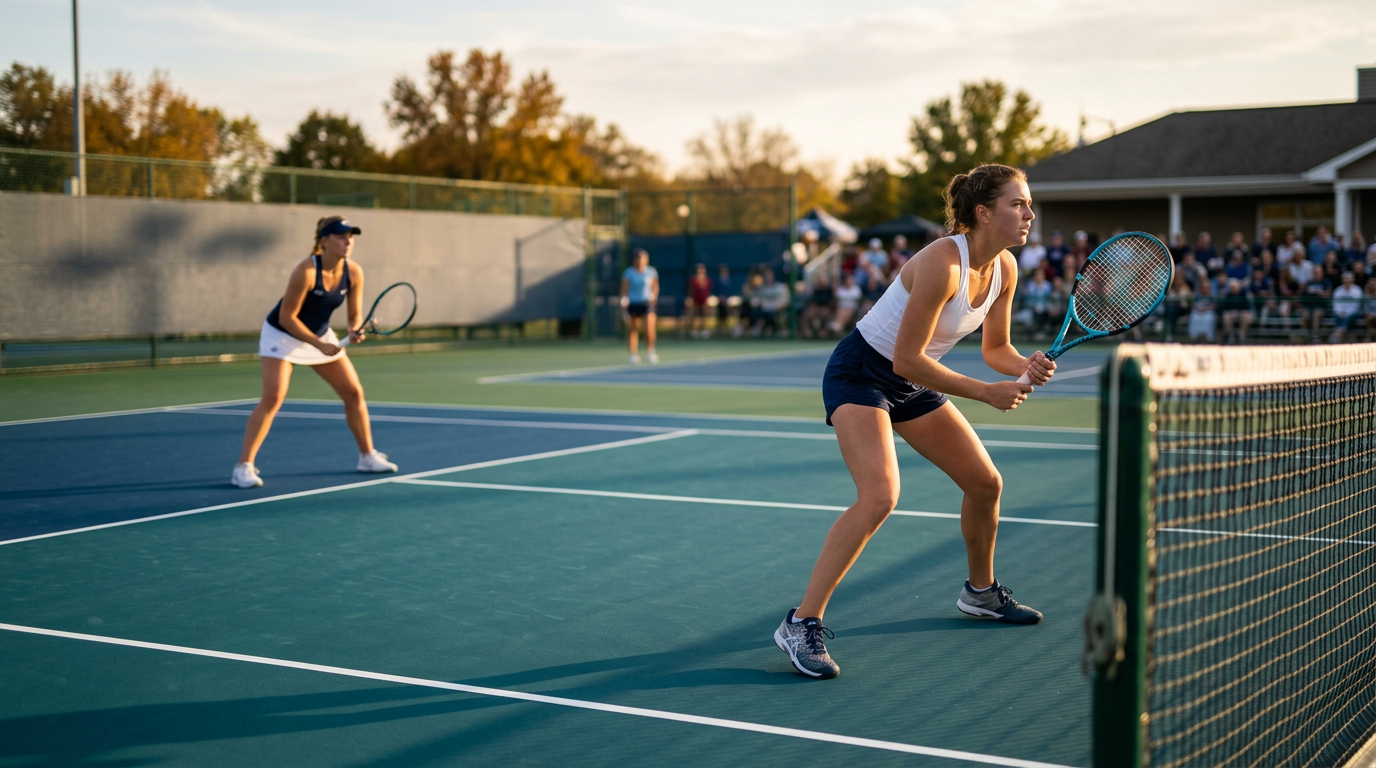
Most recreational doubles teams have one thing in common: they lose points before the ball even crosses the net. Not because of bad strokes. Because of where they're standing.
Watch any club-level doubles match for ten minutes and you'll see it — one player camped at the service line (too close to the net to volley, too far back to poach), the other glued to the baseline wondering if they should come forward. The result is a team that covers roughly 40% of the court while handing the other pair easy angles all day.
Doubles strategy is fundamentally about net positioning and communication. Get those two things right, and you win points your opponents didn't even realize they were giving away.
Why 90% of Recreational Doubles Teams Lose Because of Where They Stand
The service line is a dead zone. This is the single most important thing to understand about doubles positioning, and almost nobody at the club level acts on it.
When you stand at the service line — roughly halfway between the net and the baseline — you're in the worst possible position on the court. You're too far from the net to put away a volley with any angle. You're too close to the net to handle a lob. You're stationary when you should be moving. Every opponent worth their club membership will drill the ball right at your feet.
The problem compounds when you add a second player who's also unsure where to go. Now you have two people in the wrong spots, each waiting for the other to make a decision. The opposing team, meanwhile, has set up in a sensible formation and is simply executing.
Here's what the research and coaching experience consistently shows: most points in recreational doubles are won or lost on positioning decisions, not on shot quality. A 4.0 player with good court positioning will beat a 4.5 player who wanders. That's not a feel-good platitude — it's geometry.
Three formations solve most of the positioning problems you'll encounter at the club level. Learn them, know when to use each, and you'll immediately look (and play) like a team that's actually thought about this.
The 3 Doubles Formations You Need to Know (and When to Use Each)
One-Up-One-Back: The Default That Works Until It Doesn't
This is the starting formation for most points in recreational doubles: one player at the net, one player at the baseline. It's the default for good reason — it applies pressure at the net while keeping a player back to handle deep groundstrokes.
The net player's job is not to stand still. That's the mistake. They should be positioned about 8-10 feet from the net, roughly in the middle of their service box, ready to move laterally to poach or diagonally to cut off a cross-court shot. When your partner is hitting, you read the opponent's body position and make a decision: hold your ground, step in to volley, or fake a poach to force a weaker return.
The baseline player controls the rally and looks for a ball they can drive cross-court or down the line to set up the net player.
Where one-up-one-back breaks down: against teams that consistently lob, or against opponents who've figured out that they can keep hitting at the baseline player indefinitely while the net player stands there. If you've been in this formation for four or five shots and the net player hasn't touched the ball, something needs to change.
Both-Back: When to Swallow Your Pride and Retreat
There's a stigma around both-back in recreational tennis. Players think it looks defensive, passive, like you're surrendering the net. Get over it.
Both-back is the correct formation when:
- You're receiving serve and the incoming ball is deep and fast (you simply don't have time to come forward safely)
- Your opponents are both at the net and lobbing effectively
- One partner has just hit a defensive shot and can't get to the net without getting passed
- You're facing a big server and need time to reset
In both-back, position yourselves about a foot behind the baseline, side by side. Your goal is to hit deep, heavy balls that push the net team back, then look for a short ball to attack. This is not a permanent state — it's a reset position.
The critical error in both-back is staying there too long. Once you've neutralized the pressure and your partner hits a ball that lands short in the opponents' court, both players should be moving forward together. That transition is where most recreational players hesitate.
Australian Formation: The Move That Confuses Every Opponent
The Australian formation is where recreational doubles gets genuinely interesting. It's underused at the club level, which is exactly why it works so well.
In standard doubles, the server's partner stands on the opposite side of the court from the server. In the Australian formation, they stand on the same side — right next to the server, just inside the service box. This means the entire opposite side of the court is open.
Why would you do this? Because it forces the returner to hit down the line instead of cross-court. Most players' cross-court return is their best shot — it's the highest percentage, longest distance, lowest risk. The Australian formation takes that shot away. The returner has to hit down the line, which is harder, more error-prone, and usually weaker.
Use it:
- When the returner is killing your cross-court returns
- When you want to break someone's rhythm
- On a second serve when you need a tactical surprise
After the serve, the server moves to cover the open side of the court, and the net player holds their position to cover the down-the-line ball. Communication before the point is essential here — both players need to know the plan before the ball is in the air.
Net Positioning: The 2-Step Rule That Wins Free Points
Here's a positioning rule that takes thirty seconds to learn and immediately improves your doubles: after every shot your partner makes, take two steps toward the net.
Not one step. Not "move forward when it feels right." Two deliberate steps, every single time your partner makes contact.
This does two things. First, it closes the angle — the closer you are to the net, the more of the court you cover and the easier it is to put volleys away. Second, it creates pressure on the opposing team. A net player who is actively moving forward is a threat. A net player standing still is furniture.
The corollary: if your partner hits a defensive shot (a lob, a high ball they had to scramble for, a ball they hit from behind the baseline), take two steps back. You're about to face a ball hit from a position of strength, and you need time.
Practice this movement pattern in your next match — just this one thing — and you'll notice how much more involved you become in points. Net players who move win more points. Full stop.
One more thing on net positioning: stop standing in the middle of the service box. When you're at net, you should be close enough that your racket can reach the tape if you extend your arm. That's the target distance. Anything further back and you're giving up angles you could be owning.
Hand Signals and Verbal Calls: How to Talk to Your Partner Without Shouting
Doubles strategy lives and dies on communication, and most recreational teams either don't communicate at all or try to have a full tactical discussion mid-rally. Neither works.
The solution is a simple hand-signal system used before the serve. The net player hides their hand behind their back (so the opponents can't see) and signals their intention:
| Signal | Meaning |
|---|---|
| Open hand (fingers spread) | I'm staying — hit your serve to the body or T |
| Closed fist | I'm poaching — serve out wide to pull them cross-court |
| Index finger pointing | I'm faking the poach — serve wherever you want |
That's it. Three signals. You can add more as you get comfortable, but three covers 90% of situations.
Verbal calls during the rally are equally simple:
- "Mine" — you're taking the ball
- "Yours" — it's going to your partner
- "Switch" — you've crossed and your partner needs to cover your side
- "Bounce it" — the ball might be going out, let it land
The most common communication failure in recreational doubles is the "yours/mine" collision — both players going for the same ball, or both leaving it for the other. The fix is simple: the player whose forehand is in play calls "mine" early and loudly. Whoever calls first owns the ball. No second-guessing.
Between points, thirty seconds of conversation beats thirty minutes of post-match analysis. Ask: "Did you see how they kept lobbing? Should we go both-back on their serve?" Two sentences. A shared decision. Then play.
Group lessons are ideal for practicing doubles because you get the reps with real partners in real formations — something that's nearly impossible to replicate hitting solo or in a private lesson with just a coach feeding balls.
Why a Doubles-Specific Lesson Is Worth More Than 10 Singles Drills
Most tennis lessons focus on groundstrokes, serve mechanics, and footwork. All useful. None of it addresses why you and your partner keep losing to that couple who've been playing together for six months.
Doubles is a different game. The angles are different. The decision-making is faster. The communication layer doesn't exist in singles at all. A player can have a solid 4.0 singles game and be a disaster in doubles because they've never been coached on the positioning principles that make doubles work.
A coach who understands doubles will watch your team for ten minutes and immediately identify whether your problem is formation (you're starting points in the wrong spots), movement (you're not transitioning between formations), or communication (you're not talking). Those are three different problems with three different fixes.
If you've been playing recreational doubles for years and feel like you're plateauing — not getting better despite playing regularly — the issue almost certainly isn't your forehand. It's the stuff covered in this article: where you stand, when you move, and what you say to your partner.
Is hiring a coach specifically for doubles worth the investment? The math on coaching value generally favors targeted, specific instruction over generic lessons. One session focused entirely on your team's positioning patterns will do more than months of solo drilling.
The formations aren't complicated. One-up-one-back as your default. Both-back when you need to reset. Australian when you want to take something away from the returner. Two steps toward the net after every partner shot. Three hand signals before the serve. Verbal calls during the rally.
None of this requires better strokes. It requires better thinking — and a partner who's on the same page.
If you want someone to actually watch your team and diagnose what's going wrong, find a tennis coach who teaches doubles strategy and book a session with both partners present. Bring the hand signals. Come ready to move.