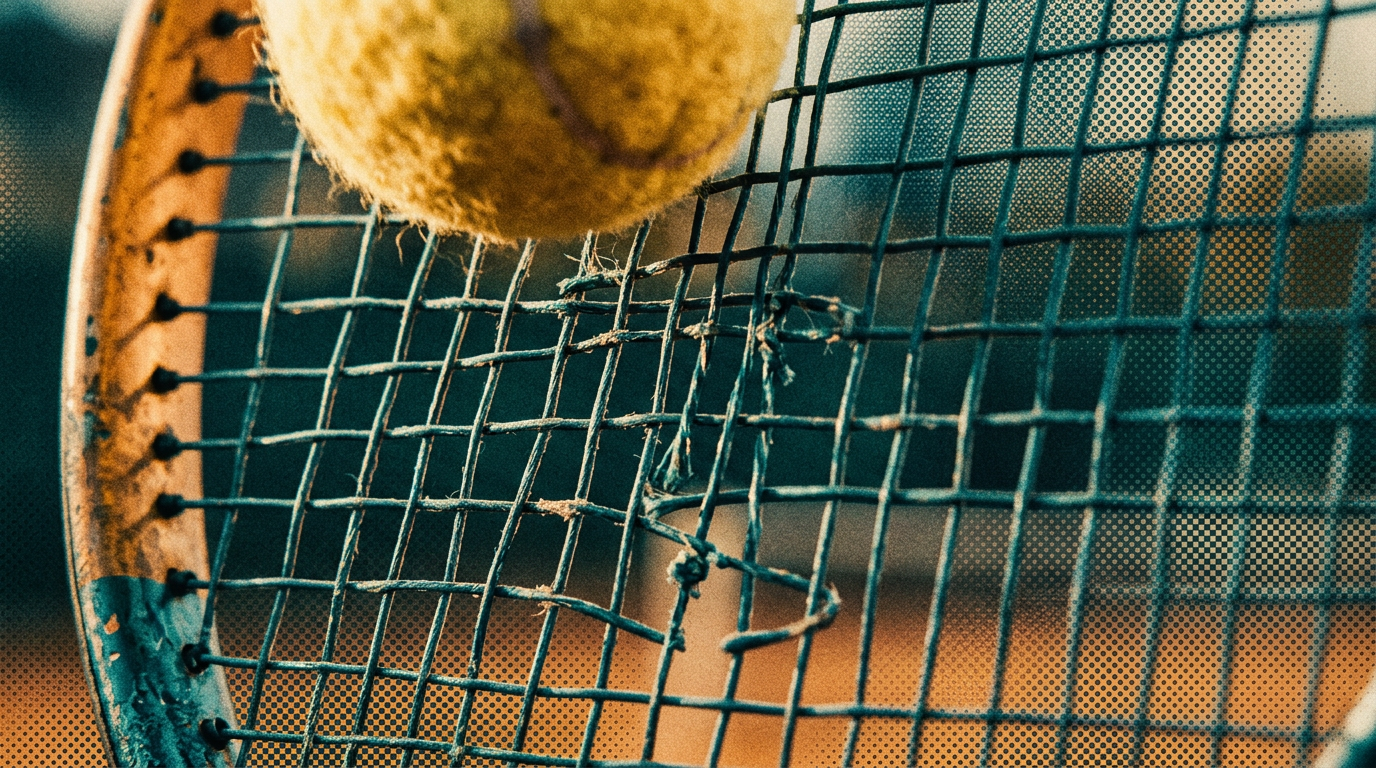
The Counterintuitive Truth: Arm Speed Isn't Where Serve Power Comes From
You've been there. Serve's sitting at 75 mph and you want more. So you wind up, grip tighter, and swing as hard as you possibly can. The ball goes into the net, or long, or clips the frame. You try again. Same result.
Here's the thing — you're not failing because you're not strong enough. You're failing because you're solving the wrong problem.
Serve power doesn't come from arm speed. It comes from body sequencing. The arm is the last link in a chain that starts at your feet and travels through your legs, hips, trunk, and shoulder before it ever reaches your racket. When you skip the early links and just yank your arm through the ball, you're not adding power. You're actually removing it.
This is the single most common mistake recreational players make on the serve. And it's completely understandable — swinging harder feels like it should work. But physics disagrees.
Before we get into mechanics, if you want a broader picture of what's going wrong with your serve overall, start with understanding why your tennis serve technique is failing. That context makes everything below click faster.
The Kinetic Chain Explained for Tennis Players
The kinetic chain is the sequence of body segments — feet, legs, hips, trunk, shoulder, arm, wrist — that work together to transfer and amplify force. In a well-executed serve, energy starts at the ground and builds as it travels upward, each segment adding speed to the next.
Think of it like cracking a whip. The handle moves slowly. The tip moves at several times the speed of sound. The tip doesn't generate its own speed — it receives and amplifies energy from the motion that started at the handle. Your racket is the tip. Your legs are the handle.
When any link in the chain fires out of sequence, or when a link is missing entirely, the energy transfer breaks down. The segments after the break have to compensate. That's when your arm takes over and starts muscling the ball — and that's when everything goes wrong.
Ground Force: Why Your Legs Are Your Biggest Serve Weapon
Leg drive is where it starts. When you push off the ground in your service motion, you're using ground reaction force — the same physics that makes jumping possible. Your legs push down, the ground pushes back up, and that upward force travels through your body.
Research on elite tennis players shows that leg drive contributes significantly to serve velocity. Studies have found that players who generate greater ground reaction forces during the serve consistently produce higher racket head speeds at contact — even when their arm mechanics are identical.
Most recreational players barely use their legs on the serve. They stand relatively flat-footed, rock forward, and rely almost entirely on their arm. The result is a serve that's powered by the weakest link in the chain.
The fix isn't complicated. But it does require timing. The leg push needs to happen before your arm starts accelerating. If you push and swing simultaneously, the energy doesn't stack — it dissipates.
Hip and Trunk Rotation: The Power Transfer Zone
Once ground force initiates the chain, your hips rotate toward the target. This is followed immediately — not simultaneously — by trunk rotation. The slight delay between hip and trunk rotation is called the stretch-shortening cycle, and it's where a significant chunk of your serve power gets generated or lost.
When your hips rotate first, they stretch the muscles of your trunk. Those muscles then snap back like a rubber band, adding rotational speed to the chain. Players who rotate everything at once — hips and shoulders together — skip this elastic energy entirely.
Should rotation then transfers to the shoulder. At this point, if the sequencing is right, your shoulder is being pulled into internal rotation by momentum, not muscled into it by conscious effort.
Shoulder Internal Rotation and Pronation: The Final Multiplier
Shoulder internal rotation is the motion that brings your upper arm forward through the swing. Pronation — the rotation of your forearm so your palm faces outward at contact — is what happens at the end of that rotation.
These two movements, when they happen as the result of a well-sequenced chain rather than deliberate muscular effort, generate racket head speeds that no amount of arm-muscling can replicate. Elite servers can achieve racket head speeds exceeding 120 mph at contact. That doesn't come from a strong arm — it comes from a body that sequences correctly and a hitting arm that stays relaxed long enough to receive the energy the rest of the body generated.
Pronation is also what creates topspin and kick on the serve. If you're struggling with spin or consistency, this guide on the continental grip and toss mechanics breaks down how grip affects your ability to pronate effectively.
Why Trying to Swing Harder Actually Slows Your Racket Down
This is the part most players don't believe until they feel it.
When you consciously try to swing harder, your brain activates more muscle fibers. That sounds good. But it activates antagonist muscles — the ones that oppose the movement — as well as the prime movers. Your body braces against itself. The result is a stiffer, slower swing.
The research on this is clear. Studies measuring EMG activity in tennis players show that the most efficient servers — those with the highest racket head speeds — actually show lower muscle activation in their hitting arm during the swing phase than recreational players. They're not trying harder. They're interfering less.
Muscle Tension and Its Effect on Racket Head Speed
Tension travels up the kinetic chain and stops it. Here's a simple test: squeeze a tennis racket as hard as you can and try to flick your wrist quickly. Now hold it loosely and try the same thing. The loose grip generates a faster wrist snap — every time, without exception.
The same principle applies to the entire arm. A tense arm can't receive and transmit the energy generated by the legs, hips, and trunk. It acts as a brake. The more you try to muscle the serve, the more you're applying that brake.
This is why so many recreational players plateau. They're working against themselves. The serve doesn't need more effort — it needs better sequencing and less interference.
Three Mechanical Changes That Add Speed Without Extra Effort
These aren't tips to think about during a match. They're mechanical adjustments to build through deliberate practice until they're automatic.
Improving Your Trophy Position Depth
The trophy position is the moment in the serve where your non-dominant arm is fully extended toward the toss, your hitting arm is bent at roughly 90 degrees with the racket pointing upward, and your body is coiled and ready to unwind.
Most recreational players get a shallow version of this. Their body isn't fully coiled. Their shoulder turn is incomplete. So when they start swinging, there's no stored elastic energy to release — just arm strength.
To deepen your trophy position, focus on two things: getting your hitting shoulder lower and behind the baseline more than feels natural, and allowing your hips to open slightly toward the net before your shoulders do. This creates the separation between lower and upper body that loads the trunk muscles before the swing begins.
(I've seen this single change add 8-10 mph for players who've been stuck at the same serve speed for years — without any change to how hard they swing.)
For a technical breakdown of how your toss affects your ability to get into this position, this article on serve technique and toss mechanics is worth reading alongside this one.
Using the Leg Push Timing Correctly
Timing the leg drive is where most players go wrong even after they understand the concept. They push off at the same time they start swinging their arm. The energy doesn't stack — it runs parallel.
The leg push should initiate as your toss arm is releasing the ball. By the time your hitting arm starts to accelerate toward the ball, your legs should already be fully extended and the upward force should already be traveling through your hips and trunk.
A drill that helps: practice the serve motion without a racket, focusing only on the jump and hip rotation. Get the legs firing early and the hip turn following. Once that sequence feels natural without a racket, add the racket back in without trying to swing it — just let the arm follow the body's momentum.
Relaxing the Hitting Arm Through Contact
This is the hardest change to make because it's counterintuitive. At the moment you most want to grip tight and push hard, you need to do the opposite.
A loose grip and a relaxed hitting arm allow pronation to happen freely. They allow the wrist to snap through contact. They allow the energy from the rest of your body to actually reach the racket.
Practice this in isolation. Hit serves at 50% perceived effort, focusing entirely on keeping your hitting arm loose. You'll likely find the ball goes faster than your 80% effort serves. That's the proof of concept. Use it.
If you're working on this with structured instruction, train your serve mechanics with a coach to get real-time feedback on tension patterns — it's very difficult to feel your own tension when you're focused on hitting the ball.
How to Practice Power Generation Without a Ball
Shadow swinging is underused and underrated. And it's the fastest way to ingrain the kinetic chain sequence.
Here's a structured approach:
Legs only. Stand in your serve stance. Practice the push and jump without any upper body motion. Feel the ground reaction force. Do 20 reps until the timing feels natural.
Legs and hip rotation. Add the hip turn after the push. Focus on the sequence: push → jump → hips rotate. No arm yet. Do 20 reps.
Full shadow swing at 30% effort. Add the arm, but keep it completely loose. Let the arm follow the body. Don't initiate anything with the arm — just let it go along for the ride. Do 20 reps.
Full shadow swing with pronation focus. Same as above, but focus on allowing your forearm to rotate outward (pronate) as your arm extends. The racket face should finish facing away from you. Do 20 reps.
Do this sequence three times per week for four weeks before you assess whether your serve speed has changed. The pattern needs to be grooved before it shows up in match play.
For players who want to supplement this with equipment-based training, these serve training aids can reinforce the kinetic chain mechanics between practice sessions.
Realistic Serve Speed Gains: What to Expect Over 8 Weeks
Let's be honest about expectations.
If you're currently serving at 70-80 mph and you fix your kinetic chain sequencing, 10-15 mph gains over 8 weeks are realistic. Some players see more. Players who've been gripping tight and muscling the serve for years often see dramatic jumps once they genuinely relax the arm and let the body do the work.
But here's what the timeline actually looks like:
| Week | What You're Working On | Expected Result |
|---|---|---|
| 1-2 | Shadow swing sequencing, no ball | Awkward. Trust the process. |
| 3-4 | Adding ball, 50% effort, focus on relaxation | Serve may feel slower. It's not. |
| 5-6 | Increasing effort gradually, maintaining sequence | First real speed gains appear |
| 7-8 | Full effort with sequenced mechanics | 10-15 mph gain realistic |
Weeks 3-4 are where most players quit. The serve feels slower because they're not muscling it anymore, and the new pattern isn't fully automatic yet. This is the dip before the gain. Push through it.
And if you're not sure whether you're sequencing correctly, online serve lessons vs in-person coaching breaks down which format gives you better feedback on mechanics — because feeling the difference between a sequenced and un-sequenced serve is genuinely hard to do alone.
The serve is the one shot in tennis you control completely. No opponent influences it. No bounce affects it. It's entirely your mechanics, your sequencing, your timing. That means every improvement you make is permanent — and every wasted effort swinging harder is a problem you can fix starting today.
Stop trying to swing harder. Start sequencing better. The speed will follow.