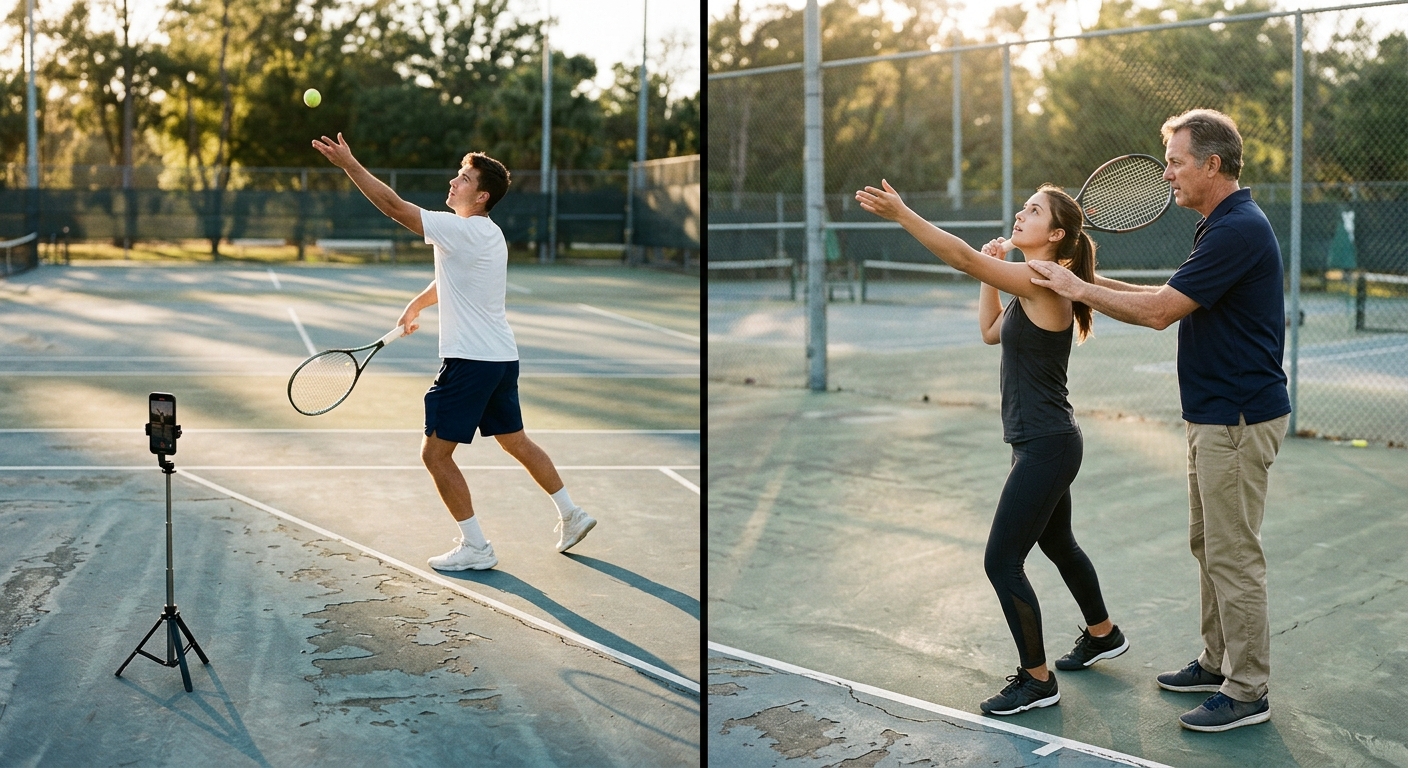
Online Tennis Serve Lessons vs. In-Person Coaching: Which Actually Fixes Technique Faster?
Here's a stat that might surprise you: according to recent surveys of recreational tennis players, nearly 68% who tried online coaching for their serve reported improvement in identifying their problem — but fewer than 40% said it actually fixed it. That gap tells you almost everything you need to know about this debate.
Choosing between online tennis serve lessons and in-person coaching isn't just a budget decision. It's a technical one. And the serve — more than any other stroke in tennis — makes that choice matter enormously. Get it wrong and you're spending money to reinforce bad habits, or paying premium rates for in-person work you didn't actually need.
I've spent years watching players make this call, and the pattern is pretty consistent: people underestimate how format-specific serve correction really is. So let's break it down properly.
KEY TAKEAWAYS
Why the Serve Is Both the Best and Worst Stroke to Fix Remotely
The serve is the only stroke in tennis you control completely. No opponent, no incoming ball speed, no positioning pressure. That makes it ideal for deliberate practice — and theoretically ideal for remote analysis.
But here's the thing: the serve is also the most biomechanically complex stroke in the game. It involves a kinetic chain that runs from your feet through your hips, torso, shoulder, elbow, and wrist — all coordinating within roughly 0.8 seconds. A problem at any link in that chain can manifest as symptoms somewhere else entirely. Your coach watches your elbow drop on the video call. But is the elbow the problem, or is it compensation for a weak shoulder rotation? That question is much harder to answer from a screen.
When you're diagnosing your tennis serve technique problems, getting the root cause right is everything. Video analysis can show you what is happening. It often can't tell you why.
What Online Serve Coaching Can and Cannot Do
What Video Analysis Gets Right
I'll be honest — video analysis tools have gotten genuinely impressive. Swing analysis software like Dartfish, CoachNow, and Hudl Technique can slow footage to frame-by-frame precision, overlay angle measurements, and compare your motion against model serves side by side. A good remote coach using these tools can do things that are genuinely hard in real-time: freeze your trophy position, measure your toss height, track your racket path through contact.
For players with a specific, isolated flaw — say, a continental grip they haven't quite committed to, or a toss that drifts consistently left — remote coaching platforms can be extremely effective. The problem is visible, the fix is demonstrable, and the feedback loop works fine over video.
And the flexibility is real. You record a serve session, upload it, and get annotated feedback within 24-48 hours. For players with unpredictable schedules, that asynchronous model is genuinely valuable. (I've seen busy professionals make meaningful serve improvements this way over 3-4 months of consistent video submission.)
What's Lost Without a Coach on the Court
But video has hard limits. A camera captures what it sees from one angle. Most home setups use one phone, one angle — usually side-on — which means your coach is essentially blind to what's happening from behind you or from above. Serve biomechanics need multiple angles to assess properly, and even professional setups with two cameras still miss tactile information entirely.
There's no way to feel through a screen. A coach can't place a hand on your tossing shoulder to stop it from opening too early. They can't stand behind you and physically guide your trophy position. They can't hear whether your ball toss has a consistent release point or a shaky one. These aren't minor details — for many serve problems, they're the whole fix.
Also worth noting: online lessons require you to self-diagnose to a significant degree. You need to know what to film, how to film it, and how to implement feedback without real-time correction. That's a meaningful skill gap for many players.
What In-Person Coaching Offers That Video Never Can
Real-Time Feedback and Physical Cueing
In-person serve coaching works differently at a neurological level, not just a logistical one. When a coach gives you a physical cue — a tap on the wrist, a repositioned grip, a hand on your back during the trophy position — your proprioceptive system registers it differently than verbal or visual instruction. The body learns movement through movement.
Real-time feedback also collapses the correction loop. Instead of film → upload → review → attempt → repeat over days, your coach sees a bad serve and adjusts you on the next ball. That iteration speed is hard to overstate. In a 60-minute in-person session, you might make 30-40 serve attempts with live correction on each one. That's a density of feedback that asynchronous video simply can't replicate.
Adapting to Your Body Type and Athleticism Live
Here's something online coaching genuinely struggles with: what works for a 6'2" player with long arms is not the same as what works for a 5'6" player with a compact build. Serve technique has universal principles but highly individual application.
An in-person coach watches you move, assesses your shoulder flexibility on the spot, sees how your feet naturally want to position, and adjusts their instruction accordingly. They're not coaching the serve in the abstract — they're coaching your serve. That live adaptation is something no swing analysis software currently handles well, regardless of how good the technology gets.
If you want to understand how different grip choices interact with your natural motion, check out this breakdown of continental grip mechanics for the serve — it illustrates exactly why personalization matters so much here.
Cost Comparison: Online vs. In-Person Serve Lessons
Let's talk numbers, because this is where most people start — and where they sometimes make the wrong call.
| Strategy | Best For | Pros | Cons | Typical ROI |
|---|---|---|---|---|
| Asynchronous online video coaching | Intermediate players with specific, identifiable flaws | Low cost ($30-80/session), flexible scheduling, detailed frame-by-frame analysis | No real-time feedback, single camera angle, requires self-filming discipline | High for isolated fixes; low for complex problems |
| Live virtual lessons (video call) | Players in remote areas; follow-up between in-person sessions | More interactive, immediate verbal feedback, saves travel time | No physical cueing, camera/connection limitations, coach can't see full body position well | Moderate; best as supplement |
| In-person private coaching | Beginners, players with complex multi-flaw serves, competitive players | Real-time correction, physical cueing, full biomechanical assessment | Higher cost ($75-150+/hour depending on location), scheduling constraints | Highest for complex technique correction |
| In-person group clinics | Players wanting serve fundamentals with community | Lower cost than private, social motivation, still get live feedback | Less individual attention, pace set by group | Moderate; good for basics, limited for specific flaws |
| Hybrid model (online + periodic in-person) | Most intermediate to advanced players | Balances cost and correction depth, maintains momentum between in-person sessions | Requires coordination between formats, depends on coach availability | Highest overall when implemented correctly |
So where does the money actually go furthest? In my experience, players with genuinely complex serve problems — multiple flaws, inconsistent motion, grip issues compounding toss issues — waste money on online-only approaches. They spend 4-6 months on video feedback and make marginal progress. Two in-person sessions can sometimes accomplish what 20 video reviews couldn't.
But for an intermediate player who already has solid fundamentals and just needs their kick serve toss position dialed in? Online coaching at $50/session beats paying $130/hour in-person, easily.
Which Format Works Best for Each Player Type
Complete Beginners: Why Starting Online Can Create Bad Habits
Look, I know online lessons are tempting when you're starting out — they're cheaper and accessible. But beginners are the player type I'd most strongly steer toward in-person instruction first, especially for the serve.
Here's why: beginners don't have the movement vocabulary to implement video feedback accurately. When a remote coach says "bring your elbow up higher at the trophy position," an experienced player understands what that means and can feel when they've done it. A beginner guesses. And if they guess wrong and ingrain that wrong movement over hundreds of repetitions, you've now got a compensation pattern layered on top of the original problem.
In-person coaching catches these misinterpretations immediately. It's not about the coach being smarter — it's about the feedback channel being richer.
Intermediate Players with a Specific Flaw: Where Online Shines
This is the sweet spot for online tennis serve lessons. If you're a 3.5-4.0 player who already has a functional serve but knows something specific is wrong — your flat serve has no penetration, your toss is inconsistent under pressure, your slice serve doesn't curve — online video analysis can be excellent.
You know enough to film yourself correctly. You can implement feedback with some accuracy. And the specific nature of your problem means the coach doesn't need to feel your grip or physically position your elbow — they can see what's off and you can adjust it.
For players exploring serve variation at this level, comparing flat vs. kick vs. slice serve mechanics is worth doing alongside your coaching, so you understand what you're working toward.
Players in Remote Areas: Making Online Work for You
Some players simply don't have access to qualified serve coaching within a reasonable distance. For them, online is the only realistic option — and that's okay, as long as you set it up intelligently.
Invest in a proper filming setup: two camera angles if possible (side-on and behind), good lighting, and consistent positioning. Use a coach who specializes in serve mechanics specifically, not just a generalist. And be realistic about the pace of improvement — it will likely be slower than in-person, and that's worth accepting rather than fighting.
The Hybrid Approach: Using Both Formats Strategically
So here's what I actually recommend for most players who ask me: use both, intentionally.
Start with an in-person assessment — even just one or two sessions — to get a proper biomechanical baseline. A good coach will tell you exactly what your serve problems are, prioritize them, and give you specific drills. Then use online coaching or video analysis to maintain momentum between in-person sessions, check your progress, and get accountability.
Think of in-person coaching as the diagnostic and correction phase, and online coaching as the reinforcement and maintenance phase. They're not competing formats — they're sequential ones.
This model also works well for players who travel or have inconsistent schedules. Lock in an in-person session when you're in your home city, use remote coaching platforms when you're on the road or in a busy work period.
And if you're unsure whether any coaching format is worth the investment at all — yes, I know some people wonder — there's a solid breakdown of whether hiring a tennis coach is actually worth it that might help you think through the math.
Questions to Ask Before Signing Up for Either Format
Before you commit your money or your time, run through these questions honestly:
For online coaching:
- Can I accurately describe or show my serve problem on video?
- Do I have a setup that captures at least a side-angle view of my full body?
- Am I self-disciplined enough to film, upload, and implement feedback consistently?
- Is my serve problem specific and isolated, or are there multiple interacting issues?
- Have I played enough to have body awareness when implementing feedback?
For in-person coaching:
- Is there a coach near me who specifically works on serve mechanics (not just general tennis)?
- Can I commit to consistent sessions, or will scheduling gaps undermine the work?
- Am I at a stage where physical cueing and real-time correction will genuinely accelerate my progress?
- Have I considered starting with a group clinic to test a coach's teaching style before committing to private sessions?
For either format:
- What is my specific serve goal? (First serve percentage? Adding a kick serve? More power? Less double faults?)
- What's my realistic timeline, and does the format match it?
- Am I willing to do the homework — the solo serve practice between sessions — that makes any coaching format actually work?
If you want structured help thinking through your specific serve issues before choosing a coaching path, start with diagnosing your tennis serve technique problems — it'll help you go into any coaching relationship with a clearer picture of what you're actually working on.
And when you're ready to take the next step, find in-person serve coaching near you to explore qualified coaches who can give your serve the hands-on attention it needs.
The serve is worth getting right. Just make sure you're using the right tool to fix it.