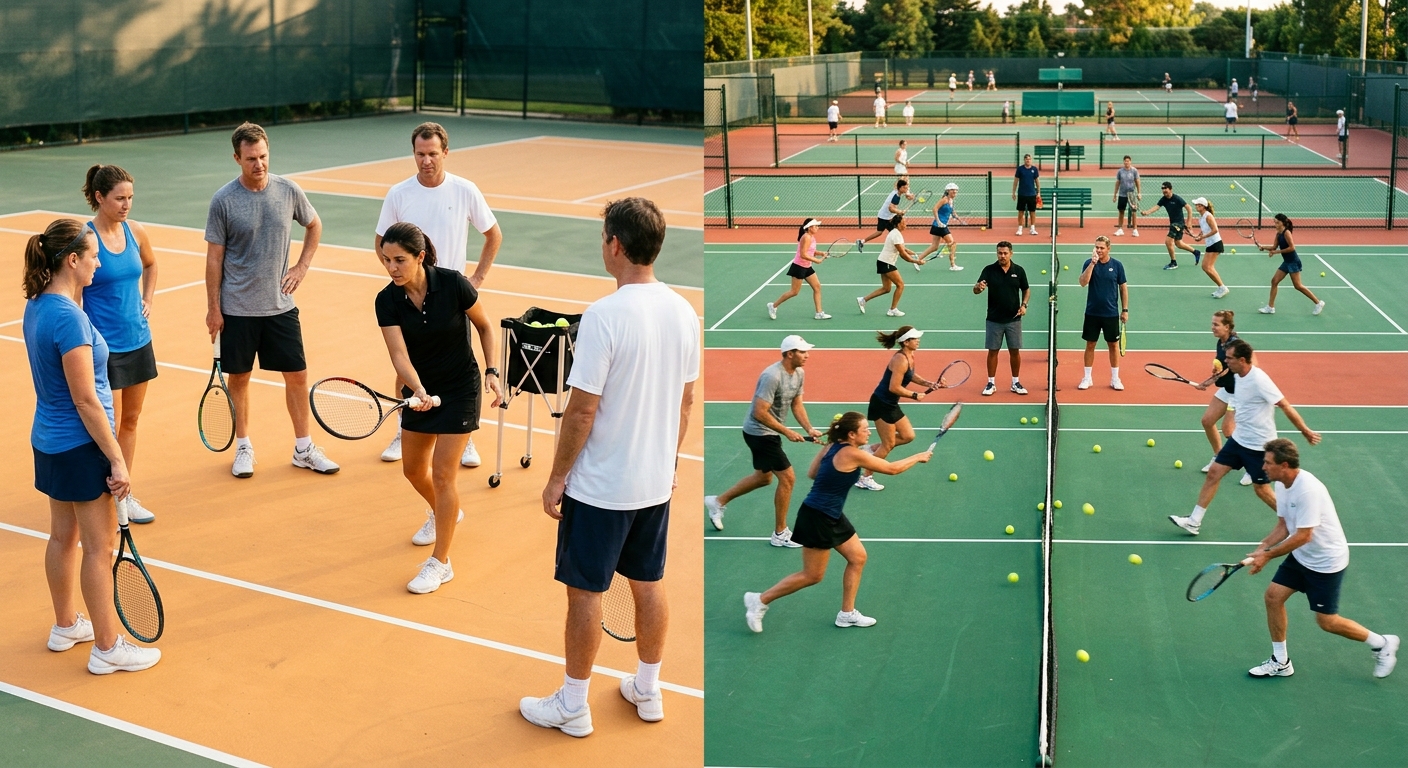
Group lessons and clinics are not the same thing — and confusing the two is one of the most common (and expensive) mistakes recreational players make when trying to improve.
Here's a stat that should get your attention: according to USTA participation data, adult recreational players who commit to a structured learning format improve measurable skill benchmarks roughly 40% faster than those who just rally with friends or drop into random sessions. But which structured format? That's where it gets interesting — and where most players go wrong.
I've watched hundreds of players sign up for a weekend clinic thinking it'll fix their backhand, then show up to group lessons expecting the same intensity. They're disappointed both times — not because the programs were bad, but because they picked the wrong tool for the job.
So let's actually break this down.
Defining the Difference: Lessons vs. Clinics
Before we get into the speed-of-improvement debate, we need to nail down what each format actually is. Because honestly? Most marketing materials blur the lines on purpose.
How Ongoing Group Lessons Are Structured
Ongoing group lessons are exactly what they sound like: regularly scheduled sessions, typically weekly, with the same coach and (mostly) the same group of players. Think of it like a fitness class you sign up for by the month. The coach builds a curriculum, tracks your progress week over week, and sequences drills so each session builds on the last.
Class sizes usually run 4–8 players at the recreational level. You get consistent repetition, incremental feedback, and — critically — a coach who actually knows your tendencies. When your crosscourt forehand is still drifting wide in week six, a good coach notices that. They've been watching.
This is the format that rewards patience. (And yes, I know patience is not the tennis player's strong suit.)
How Tennis Clinics Are Structured
Clinics are concentrated, event-style programs. They might run a weekend, a week-long intensive, or a single multi-hour session focused on one topic — serves, doubles strategy, footwork. USTA clinics and those run by Orange County tennis clubs often follow this model: bring in a specialist coach, pack in 10–20 players, and deliver a high-volume, high-energy experience.
The trade-off is depth for breadth. You're getting exposure to concepts and drills, usually with less individualized attention. But the intensity can be genuinely useful — especially if you're trying to stress-test skills you've already built, or if you want to see how you perform under competitive pressure.
See how group lessons compare to private instruction for a broader look at how these formats stack up against one-on-one coaching too.
Skill Development: Which Format Delivers Faster Results?
This is the real question, right? And the honest answer is: it depends on what you mean by faster.
Repetition and Consistency in Ongoing Lessons
Motor learning research is pretty clear: skill acquisition in sports requires spaced repetition over time. You can't cram a tennis forehand the way you might cram for an exam. The neural pathways need reinforcement across multiple sessions, with sleep cycles in between, before movements become automatic under pressure.
Ongoing group lessons are built for exactly this. Week after week, the same stroke mechanics get drilled, corrected, drilled again. Your coach adjusts based on what they saw last session. You build a relationship with the material — and with your playing partners, which matters more than people think for competitive development.
For beginners especially, this format is almost always the better starting point. The structured progression from basics to game situations mirrors how sports science actually says skills develop. If you're in the Orange County area and just getting started, check out what beginners typically get wrong in their first month of group lessons — it's a useful reality check before you commit to any format.
Intensity and Exposure in Clinics
Here's the thing: clinics have a genuine edge in one specific scenario. If you're an intermediate or advanced player with established mechanics and you need competitive sharpening, a well-run clinic can accelerate your game in ways a weekly group lesson won't.
Why? Because clinics tend to simulate match conditions more aggressively. You're playing with new opponents, different pace, different ball-striking styles. You're getting volume — sometimes 2–3x the ball contact of a regular lesson in a single day. Anaheim tennis programs that run weekend clinics, for example, often pack 3–4 hours of court time into a Saturday intensive.
But — and this is important — if your mechanics aren't solid yet, high-volume clinics can actually reinforce bad habits faster. You're just getting more reps of the wrong thing.
Cost Comparison: Clinics vs. Ongoing Group Lessons
Let's talk money, because this is where the "I'll just do a clinic" logic often falls apart.
| Strategy | Best For | Pros | Cons | ROI |
|---|---|---|---|---|
| Ongoing Group Lessons | Beginners to intermediate players building foundational skills | Consistent progression, coach knows your game, lower per-session cost | Slower intensity curve, requires commitment | High long-term ROI for skill retention |
| Tennis Clinics (Weekend/Intensive) | Intermediate to advanced players stress-testing skills | High ball volume, competitive exposure, specialist coaching | Less individualized feedback, no continuity | High short-term ROI if mechanics are already solid |
| Drop-In Clinics | Social players wanting variety | Flexible, low commitment, fun atmosphere | Inconsistent instruction quality, minimal progression | Low to moderate |
| Hybrid (Lessons + Clinics) | Committed players with specific goals | Best of both worlds, reinforcement + exposure | Higher total cost, scheduling complexity | Highest overall ROI for serious improvers |
| Private Lessons Only | Players needing intensive technical correction | Maximum individual attention | Expensive, no competitive pressure simulation | High for technical issues, moderate otherwise |
Ongoing group lessons in Orange County typically run $25–$45 per session when purchased as a package. Weekend clinics? You're usually looking at $80–$200 for a full-day event, sometimes more if a high-profile coach is running it.
On a per-hour basis, the math often favors group lessons. But clinics offer something different — a compressed experience that's hard to replicate over weeks of regular sessions. So the question isn't really which is cheaper. It's which delivers better value for your specific goal right now.
And if you want a deep-dive on whether any coached format is worth the spend, this breakdown of whether tennis coaching is actually worth the money runs the numbers honestly.
Social and Competitive Benefits of Each Format
Don't sleep on the social dimension here. Tennis is a social sport, and the format you choose shapes who you meet and how you compete.
Ongoing group lessons build community. You see the same faces every week. You notice when Maria's serve suddenly clicks, you get competitive with Dave's topspin, and you have actual context for the feedback your coach gives. There's accountability built in — you don't want to show up to week four having practiced nothing.
Clinics are great for expanding your network fast. You meet 15 new players in a day. You see a range of styles and skill levels. For players looking to find hitting partners, join a team, or scout the local competition, a well-attended clinic run by one of the Orange County tennis clubs is genuinely useful beyond the tennis itself.
For junior players specifically, USTA clinics often serve double duty: skill development and competitive exposure that feeds into tournament readiness. If you've got a kid eyeing tournament play, here's what a junior tennis coach actually does to prep for USTA competition.
Who Should Choose Group Lessons
Group lessons are your format if:
- You're a beginner or low-intermediate player. You need foundational mechanics built correctly before you can benefit from high-volume exposure.
- You want consistent improvement over time. The weekly rhythm and coach continuity are what drive long-term skill retention.
- You're on a budget. Per session, group lessons almost always win on cost.
- You want accountability. Showing up to the same group every week creates social pressure (the good kind) to actually practice between sessions.
- You're returning after a long break. Clinics will frustrate you. Start with structured lessons and rebuild your base.
For understanding exactly what to expect when you walk into your first group lesson, this explainer on how group lessons actually work covers class sizes, formats, and what coaches are actually watching.
Who Should Choose Clinics
Clinics are your format if:
- You're intermediate or advanced with solid mechanics you want to stress-test.
- You're prepping for a specific event — a league match, a tournament, a charity tennis day.
- You want competitive exposure without a weekly commitment. Clinics are naturally flexible.
- You're visiting a new area and want to play quality tennis while traveling.
- You're targeting a specific weakness — footwork, overhead, net play — and want a focused immersion session.
Look, clinics aren't a shortcut to skill. But they're an excellent accelerant if the foundation is already there.
Can You Combine Both? A Hybrid Approach
Short answer: yes, and it's probably the smartest move for anyone serious about improvement.
Here's the model I've seen work repeatedly: use ongoing group lessons as your base — 1–2 times per week throughout the season. Then layer in 2–3 clinics per year at strategic moments. Pre-season clinic to shake off rust. Mid-season clinic to challenge what you've built. End-of-season clinic to prep for any competitive finish.
This gives you the foundational development that group lessons provide, plus the competitive intensity spikes that clinics deliver. The two formats complement each other well when sequenced intentionally.
The key word there is intentionally. Don't just sign up for whatever's available. Know what you're trying to accomplish and pick the format that serves that goal right now.
You can view our group lesson and clinic schedule to see how we've structured both formats for players at different levels in the Orange County area.
Making the Right Call for Your Skill Level and Goals
Here's a simple decision framework. Ask yourself three questions:
1. What's my current skill level? Beginner or low-intermediate → start with group lessons. Intermediate or advanced → clinics are genuinely useful.
2. What's my primary goal right now? Building mechanics from scratch → group lessons, full stop. Competitive sharpening or specific skill focus → clinic.
3. What's my commitment level? Want flexible, low-commitment tennis → drop-in clinics. Want real, measurable improvement → commit to a group lesson series.
The players I've watched improve the fastest aren't the ones who found the magic format. They're the ones who matched the format to their actual goal, committed to it for long enough to see results, and used data — their own performance, coach feedback, match results — to adjust.
So whether you're brand new to the game or you've been playing for years and feel stuck, the format question matters. Getting it right saves you time, money, and the frustration of spinning your wheels in the wrong program.
Start by being honest about where you are. Then pick the format that meets you there — not the one that sounds most intense, most affordable, or most convenient.