Key Takeaways
- The I-formation works because it removes the returner's most reliable target — the down-the-line gap — before the ball is even hit.
- The signal system between server and net player is non-negotiable; without it, you're just guessing and giving up free points.
- Most club players fail at I-formation because the net player moves too early, telegraphing the whole play.
- The I-formation is most effective against returners who favor cross-court returns and struggle with body-oriented balls.
- Australian formation is a simpler, lower-risk alternative when your net player has slower lateral movement.
- You don't need to run I-formation every game — even using it 2-3 times per set creates enough doubt to disrupt a returner's rhythm.
- Practicing I-formation in a structured clinic or lesson setting is the fastest way to get the timing right before deploying it in a real match.
Your doubles partner leans over during the changeover and says, "Let's try the I-formation next game." You nod confidently. Then you both walk to the baseline and realize neither of you actually knows who moves where, when, or what the signal is supposed to be. Sound familiar?
The I-formation is one of those tactics that every intermediate doubles player has heard of but almost nobody executes correctly at the club level. It shows up in YouTube highlight reels, gets mentioned in USTA clinics, and then promptly gets abandoned after one awkward attempt where both players drift the same direction and leave an entire half of the court wide open.
Here's the thing — that's not a talent problem. It's a knowledge problem. The I-formation has a specific geometric logic behind it, a clear set of responsibilities for each player, and a simple communication system that makes the whole thing click. Once you understand why it works, the execution becomes a lot less mysterious.
This article is the complete breakdown. We're covering the geometry, the step-by-step setup, the signal system, common mistakes, when to use it versus the Australian formation, and how to actually practice it. If you want the broader foundation this sits on, start with doubles positioning and strategy fundamentals — then come back here.
What the I-Formation Actually Is (and Why It Confuses Returners)
In a standard doubles setup, the net player stands on the same side as the server — server on the deuce side, net player on the deuce side, roughly in the middle of their service box. The returner knows exactly where both players are. They've been hitting cross-court returns their whole tennis life, and that wide angle to the server's side is their comfort zone.
The I-formation blows that comfort zone up.
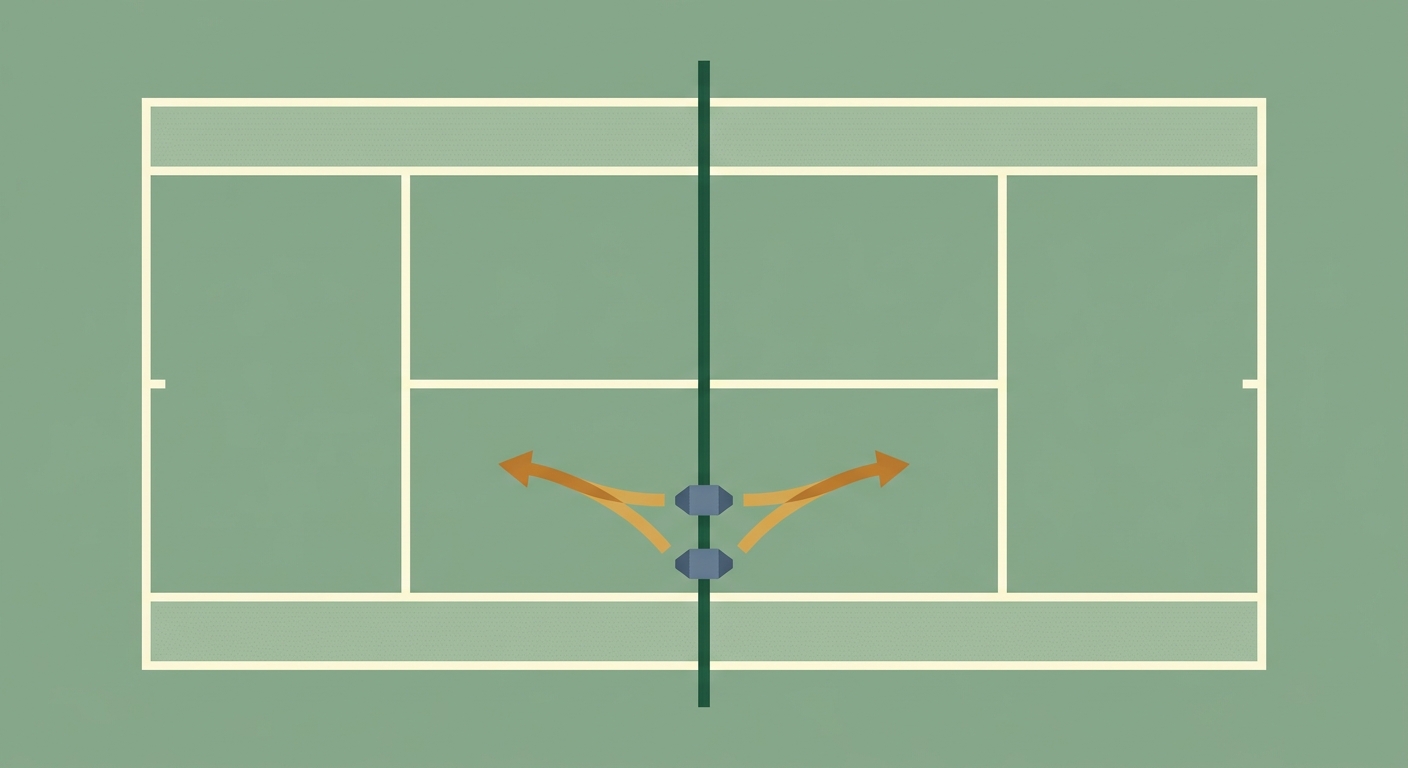
Both the server and the net player line up in the center of the court — the server behind the center hash mark, the net player crouched low at the net directly in front of the server, straddling the center service line. From the returner's perspective, they now have two players stacked in the middle of the court and two open alleys on either side. That's disorienting. Their pattern-recognition is broken.
The key move happens after the serve. The net player and server have pre-agreed (via signal) which direction the net player will move — left or right — the instant the ball leaves the racket. The server moves the opposite direction. Done correctly, one player covers each half of the court, but the returner has no idea which half each player is covering until it's too late to adjust.
And that uncertainty? That's the whole point.
The Geometry Behind Why I-Formation Works
How It Disrupts the Returner's Angles
Most recreational doubles returners have two go-to shots: the cross-court return (wide and safe) and the down-the-line return (risky but effective when the net player is out of position). In standard positioning, the net player is already covering the middle and poach territory, so a sharp cross-court return is the percentage play. Returners lean on it constantly.
In I-formation, the net player is standing directly in the path of that cross-court return. The center of the court is suddenly occupied. The returner's safest shot is now the most dangerous one.
So they try to go down the line. But the server, after serving from near the center mark, has a shorter distance to cover to close that alley. And the net player, moving post-serve, may be going toward that alley anyway.
The returner is essentially choosing between two options that both feel uncomfortable. Under pressure, with a serve coming at them, that discomfort produces errors. That's the geometry at work — not magic, not intimidation. Just angles.
Why It Forces Errors Even on Good Returns
Here's something coaches don't say enough: the I-formation doesn't need to win points outright. It wins points by forcing the returner into lower-percentage decisions.
A 4.0 tennis player who normally hits eight out of ten cross-court returns cleanly might hit five out of ten cleanly when they're uncertain about the net player's position. That's a 37% error rate increase on their best shot. Over a full match, that's a lot of free points.
According to USTA research on recreational doubles play, the return of serve is the second most important shot in doubles after the serve itself — teams that win more than 35% of return games win the vast majority of sets. Disrupting the return, even slightly, has an outsized effect on the scoreboard.
Step-by-Step: How to Set Up and Execute the I-Formation
Server Responsibilities
First, the server needs to adjust their starting position. Instead of standing near the singles sideline (typical for wide serve options), you're moving closer to the center hash mark. This does two things: it gives you better court coverage post-serve, and it reinforces the visual "stack" that confuses the returner.
Serve selection matters here. Body serves and T serves (down the middle) work best in I-formation. Why? Wide serves pull the returner out wide and give them a natural angle to pass down the line — exactly what you're trying to avoid. A T serve or a body serve keeps the ball in front of the net player's starting position and limits the returner's angle options.
After serving, the server moves in the opposite direction from the net player's signal. If the net player signals "I'm going right," the server moves left. Move quickly and decisively. Hesitation kills this tactic.
Net Player Responsibilities and Timing
The net player starts crouched low at the net, directly on the center service line. Lower than normal. Why? Because a high stance telegraphs your movement direction. You want to be a neutral, unreadable shape until the ball is struck.
The timing of the move is everything. Move with the serve — not before, not a full second after. The moment the server's racket contacts the ball, you go. Moving before the serve is obvious and illegal (hindrance). Moving too late means the returner has already committed and you're just scrambling.
Once you move, you're responsible for everything on your side. Poach aggressively. Don't be passive. The whole point of the formation is to take the net and put pressure on — a tentative net player in I-formation is worse than just playing standard.
The Signal System That Makes It Work
This is the part people skip, and it's why their I-formation falls apart. You need a pre-serve signal between server and net player. Simple, fast, and hidden from the returner.
The most common system: the net player holds their hand behind their back (hidden from the returner) and signals before the serve. Open hand = net player moves toward the ad side. Closed fist = net player moves toward the deuce side. Some teams use one finger vs. two fingers. The specific signals don't matter — consistency does.
The server looks at the signal, confirms it (a nod or no reaction), and then serves. Both players know the plan. The returner knows nothing.
(I've seen teams use elaborate five-signal systems and then forget them under pressure. Keep it to two options. Complexity is the enemy of execution.)
Common I-Formation Mistakes at the Club Level
Let's talk about what actually goes wrong, because this is where most club players are losing points they should be winning.
Moving too early. The net player flinches before the serve lands. The returner sees it, adjusts, and passes them easily. Discipline on timing is the number one fix.
Serving wide. The server defaults to their favorite wide serve out of habit. Now the net player is in the wrong position relative to the return angle. Commit to T and body serves when you're running I-formation.
Both players going the same direction. This happens when the signal system breaks down or one player forgets the plan mid-point. The result is a wide-open half of the court. This is why practicing the communication matters as much as the movement.
The net player standing up straight. A tall net player in the I-formation starting position is giving away their move before it happens. Stay low. Make yourself unreadable.
Only using it once. You run I-formation once, it doesn't work perfectly, and you abandon it. But the value of the formation builds over time — the returner is still thinking about it on the next three service games even if you've gone back to standard positioning. Use it enough that it stays in their head.
When NOT to Use the I-Formation
Look, it's not a silver bullet. There are situations where I-formation actively hurts you.
Against a returner who consistently goes down the line, the I-formation can backfire. You're giving them a clear target (the alley the server just vacated) and they have the skill to hit it. Know your opponent.
If your net player has limited lateral mobility, the formation becomes a liability. The whole system depends on the net player moving decisively and covering their half. A slow or hesitant net player leaves you exposed.
Also, if your serve is inconsistent, don't run I-formation on second serves. A slow, loopy second serve gives the returner all the time in the world to read the net player's movement and adjust. Save I-formation for first serves where the pace limits the returner's reaction time.
And honestly — if you and your partner haven't practiced it at all, don't debut it in a tight third set. Use it in a lower-stakes situation first, or better yet, learn doubles formations with a tennis coach before bringing it into match play.
Australian Formation vs. I-Formation: Choosing the Right Wrinkle
These two formations get lumped together, but they're solving slightly different problems.
In the Australian formation, the net player sets up on the same side as the server — so if the server is on the deuce side, the net player is also on the deuce side, near the service box. This immediately blocks the cross-court return lane and forces the returner to go down the line. The server then covers the ad side after serving.
In the I-formation, both players start in the center and split post-serve based on the signal. It's more dynamic, more unpredictable, but requires better timing and communication.
Here's a practical way to think about it:
| Factor | Australian Formation | I-Formation |
|---|---|---|
| Communication required | Low (no signal needed) | High (signal system essential) |
| Net player mobility | Less critical | Critical |
| Serve type that works best | Any | T and body serves |
| Unpredictability | Moderate | High |
| Best against | Cross-court returners | Pattern-dependent returners |
| Learning curve | Lower | Moderate |
For most club players at the 3.5 level, Australian formation is the better starting point. It's simpler, requires less coordination, and still disrupts the returner effectively. Once you've got Australian formation dialed in, I-formation becomes a natural next step — it's more complex but also more difficult to read.
At the 4.0 tennis doubles level, opponents start to solve the Australian formation quickly. That's where I-formation becomes a genuine weapon, because the post-serve movement is genuinely unpredictable.
For more on structuring your doubles learning, best group tennis lessons for adults near me has good guidance on finding programs that actually cover tactical content like this.
How to Practice I-Formation in a Lesson or Clinic Setting
This is the section most articles skip, and it's honestly the most useful one.
You can read about I-formation all day. But the timing, the signal communication, and the movement patterns only click through repetition. Here's a practice protocol that works:
Step 1: Walk-through without a ball. Server and net player position themselves, signal, and execute the split movement — no ball involved. Do this ten times until the movement is automatic. This sounds basic, but most teams have never done it even once.
Step 2: Feed drills. A third person (coach, practice partner) feeds returns from the return position. Server serves, net player executes the signal and moves, and the "returner" hits a predetermined direction. Start with the returner going cross-court, then down the line, so both players learn to cover each scenario.
Step 3: Live return practice. Now the returner hits wherever they want. The server and net player run the formation for real. Track success rate — how often does the formation produce a weak return or an error? You're aiming for disruption, not necessarily a winner every time.
Step 4: Match simulation. Run I-formation for one full service game in a practice set. Debrief afterward. What worked? What broke down? Was the timing off? Did the server default to wide serves?
If you're working with a coach, this is exactly the kind of structured tactical work that separates a good lesson from a mediocre one. And if you're looking at group settings, poaching in doubles is a closely related skill that's worth working on in parallel — the decision-making for poaching and I-formation net play overlaps significantly.
One more thing: practice the signal system under mild pressure. It's easy to remember signals when you're calm. In a tight match, with a big server on the other side and a scoreboard staring at you, people forget. Rehearse it enough that it's reflexive.
Overcoming Obstacles
The two biggest barriers I see at the club level are psychological, not physical.
First, there's the fear of looking dumb. I-formation is visible. Everyone on adjacent courts can see you attempting it. When it goes wrong — and it will, early on — it feels public. Get over this. Every competent doubles player respects the attempt, even when the execution is rough. The players who never try anything new are the ones stuck at the same level for five years.
Second, there's partner resistance. You want to try I-formation, your partner says "let's just play our game." This is a real thing. The solution is to introduce it in low-stakes practice first, not during a league match. Show your partner the signal system, do the walk-through, and let them experience the concept before asking them to execute it under pressure.
And if you're looking for partners or programs where tactical doubles is actually taught, best group tennis lessons for adults near me is a good resource for vetting programs that go beyond just rallying.
Your Next Move
Here's the honest truth about I-formation: it's not complicated, but it does require deliberate practice. The geometry is simple. The signal system takes five minutes to learn. The execution takes a few sessions to feel natural.
Most club players never get there because they try it once in a match, it's messy, and they abandon it. Don't be that player.
Start with the walk-through drill this week. Get the signal system agreed on with your partner. Run it five times in your next practice set. Then bring it into a real match on a second serve when you're up a break and have room to experiment.
And if you want to build this into a real tactical system — not just a one-off trick — learn doubles formations with a tennis coach and get the structured reps that actually make it stick.