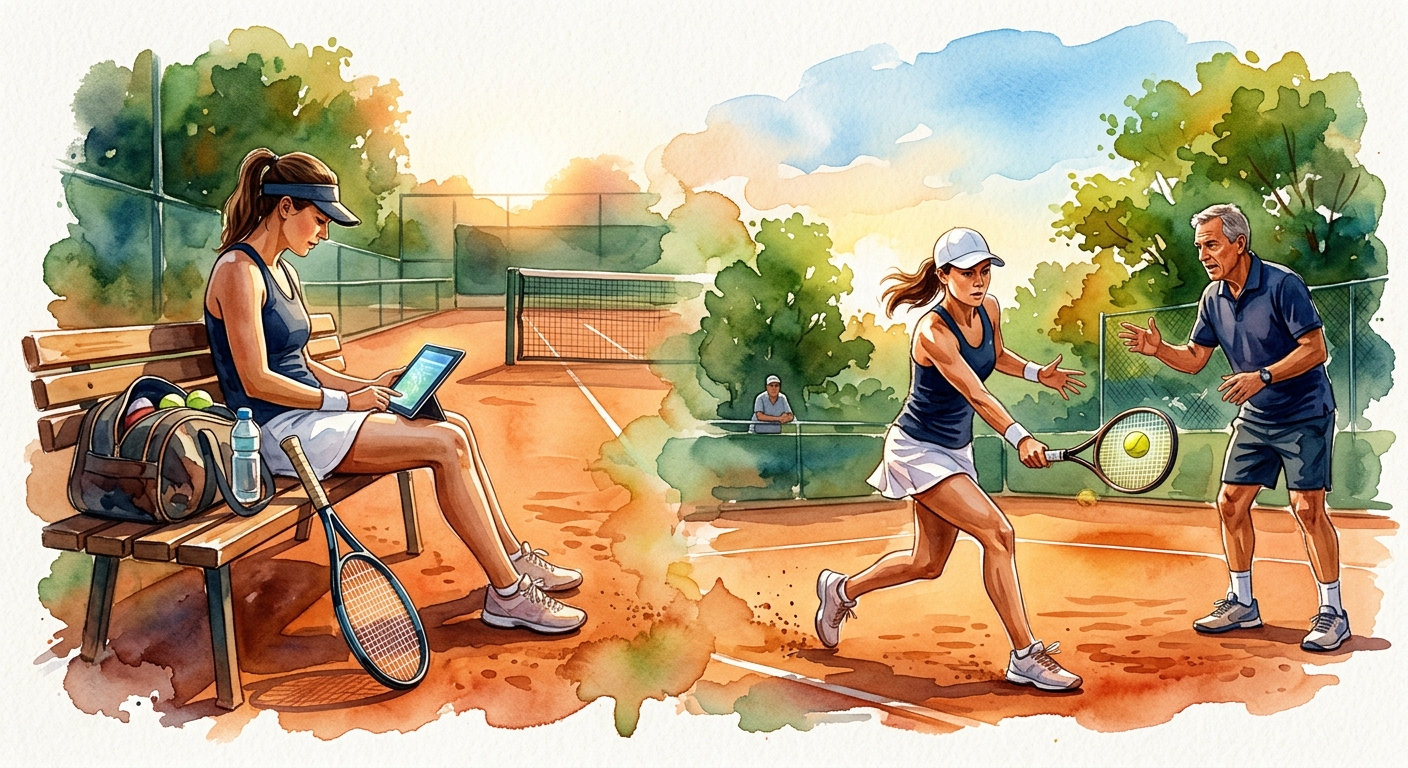
YouTube has 800+ hours of free tennis instruction uploaded every single day. And yet, the average recreational player's NTRP rating hasn't budged meaningfully in years. That tension — between unprecedented access to information and stubbornly slow improvement — is exactly what this article is about.
The debate over tennis coach vs YouTube tutorials usually gets framed as a budget question. It shouldn't be. It's really a question about how humans actually learn motor skills, and whether watching someone else do something correctly translates into doing it correctly yourself. Spoiler: the research says it mostly doesn't — at least not without a feedback loop closing the gap.
But that's not a reason to ignore YouTube entirely. Here's the thing: the best-improving recreational players I've observed over 12 years in this industry use both — strategically, not randomly.
The Rise of Free Tennis Instruction Online: Is a Coach Still Necessary?
The numbers are genuinely staggering. Channels like Essential Tennis, Top Speed Tennis, and Feel Tennis have collectively accumulated hundreds of millions of views. Essential Tennis alone has published over 1,000 instructional videos since 2008. Top Speed Tennis built a subscriber base exceeding 700,000 by focusing almost entirely on biomechanics breakdowns. Feel Tennis, run by Tomaz Mencinger, has carved out a niche emphasizing feel-based learning over mechanical checklists.
This is real content. Serious content. And it's free.
So the question isn't whether YouTube tennis instruction has value — it clearly does. The question is: what kind of value, and where does it stop?
Before you decide whether whether hiring a tennis coach is worth the financial investment makes sense for your situation, you need an honest picture of what each option actually delivers. Let's build that picture.
What YouTube Tennis Channels Actually Do Well
Visual Demonstrations of Technique
YouTube is genuinely excellent at one thing: showing you what correct technique looks like in high definition, often from multiple angles, with slow-motion replay. For a visual learner trying to understand what a modern forehand swing path looks like, or how a continental grip differs from a semi-western, video is arguably better than a verbal explanation from a coach standing next to you.
Top Speed Tennis has built an entire methodology around this. Their biomechanics series breaks down professional strokes frame by frame — the kind of analysis that used to require expensive video software and a biomechanics consultant. Now it's free and searchable.
Tactical Concepts and Pattern Recognition
Beyond technique, YouTube excels at tactical education. Understanding why you should approach on a short ball to your opponent's backhand, or how to use the serve-and-volley pattern in doubles — these are conceptual ideas that translate well to video format. Essential Tennis has an extensive library on point construction and pattern play that's genuinely useful for players trying to think more strategically.
And if you're working with a coach, arriving to a lesson already understanding the concept of inside-out forehand patterns means your coach can spend session time on execution rather than explanation. That's real efficiency.
Top Channels Worth Watching (And What They're Best For)
Not all YouTube tennis content is equal. Here's an honest breakdown of the major players:
Essential Tennis (Ian Westermann): Best for intermediate players wanting structured, methodical instruction. Strong on fundamentals and mental game. Weakness: can be overly mechanical for players who learn better through feel.
Top Speed Tennis (Clay Ballard): Best for players who want biomechanics-based explanations with pro-level comparisons. Excellent slow-motion analysis. Weakness: the technical detail can overwhelm beginners.
Feel Tennis (Tomaz Mencinger): Best for players who've struggled with overly technical instruction and want a more intuitive approach. Mencinger's philosophy explicitly pushes back against checklist-based learning. Weakness: less structured for players who need clear progressions.
Functional Tennis: Best for tactical content, point construction, and understanding professional strategy. Less focused on stroke mechanics.
Watch all four. Use them for different purposes.
Where YouTube Instruction Consistently Falls Short
No Feedback Loop: The Core Problem
Motor learning research is unambiguous on this point. The motor learning feedback loop — the cycle of attempt, error detection, correction, and re-attempt — is the core mechanism by which humans acquire new physical skills. Without feedback, practice doesn't make perfect. It makes permanent.
YouTube provides zero feedback. You watch, you attempt, you have no idea whether your attempt resembled what you watched. You watch again. You attempt again. The video still can't tell you that your elbow is dropping on your serve, or that your weight transfer is happening a half-second too late.
A 2013 study published in the Journal of Motor Behavior found that augmented feedback (external information about movement quality) significantly accelerated skill acquisition compared to practice without feedback — and that the absence of feedback led players to develop confidence in incorrect movement patterns. That last part is the dangerous bit.
Generic Advice That Doesn't Account for Your Specific Flaws
Every instructional video is built for an imaginary average player. The advice is calibrated to the most common errors, not your errors. And your errors are specific, idiosyncratic, and often invisible to you.
I've seen players spend six months working on their forehand swing path after watching Top Speed Tennis videos — genuinely improving their swing path — while their grip was causing every ball to sail long. The video addressed the swing. It couldn't see the grip. A coach in the first session would have caught it.
The Risk of Reinforcing Bad Habits With Confidence
This is the scenario that costs players the most time. You find a YouTube video that explains something in a way that clicks for you. You practice it. It feels better. Your confidence grows. But what actually happened is that you've ingrained a slightly-wrong version of the technique with enough repetitions that it now feels natural — which means it'll take twice as long to unlearn.
Look, this isn't a hypothetical. It's one of the most common things coaches deal with when players come in after a period of self-directed YouTube learning. The habits are grooved. The player is certain they're doing it right. And the coach has to spend the first several sessions not teaching, but un-teaching.
What a Real Coach Provides That No Video Ever Can
Real-Time Error Correction
A qualified coach watching you hit a forehand for 30 seconds knows more about what's wrong with your forehand than 30 hours of YouTube watching can tell you. That's not hyperbole — it's the difference between external observation and self-assessment.
Real-time error correction means the feedback arrives while the movement is still in working memory. You hit the ball, the coach says "your toss drifted left," you toss again, you feel the difference. That feedback loop — attempt, correction, re-attempt — is what the motor learning research identifies as the primary driver of skill acquisition. YouTube structurally cannot provide it.
Personalized Drill Sequencing
A good coach doesn't just correct errors — they sequence drills in an order calibrated to your current level, your learning style, and your specific technical weaknesses. This is sophisticated curriculum design, and it's invisible to the player receiving it.
If you're curious how this plays out over time, the article on how long it takes to fix a tennis serve gets into the specifics of what structured coaching actually looks like across a realistic timeline.
Accountability and Structured Progression
Scheduled lessons create a social contract. You show up, you practice what you were assigned, you report back. That accountability mechanism is underrated as a driver of improvement. Self-directed YouTube learners have no such structure — and most don't practice consistently between viewing sessions.
And there's the NTRP system to consider. Moving from 3.0 to 3.5 to 4.0 requires specific, measurable improvements in specific areas. A coach who understands the NTRP rating system can map your development against those benchmarks and tell you exactly what needs to improve for your next rating jump. YouTube has no awareness of where you are or where you need to go.
The Hybrid Approach: Using YouTube to Supplement Coaching
How to Watch Instructional Videos as a Coached Player
If you're actively working with a coach, YouTube becomes a different kind of resource. Instead of using it as your primary instruction, use it as a visual reference for concepts your coach has already introduced.
Your coach tells you to pronate more on your serve. You go home, find a Top Speed Tennis video on serve pronation, watch it three times, and arrive at your next lesson with a clearer mental image. That's productive use of free resources. The coach provides the diagnosis and the feedback; YouTube reinforces the concept between sessions.
(The key distinction: YouTube is for reinforcing concepts you've already been introduced to by someone who's watched you play — not for self-diagnosing and self-prescribing.)
Bringing Video Concepts to Your Coach for Faster Integration
Some coaches actively welcome this. If you've watched a Feel Tennis video on relaxed grip pressure and want to explore whether it applies to your situation, bring it up. A good coach will either confirm it's relevant to your game or explain why it isn't — either answer is more valuable than the video alone.
This also works for tactical ideas. Watching an Essential Tennis breakdown of approach shot patterns and then asking your coach to drill it in your next session is a legitimate way to accelerate tactical development.
For players deciding between formats, the comparison between semi-private tennis lessons vs group clinics is worth reading — the hybrid approach works differently depending on what coaching format you're in.
Cost Comparison: Free YouTube vs. Paid Coaching Over 12 Months
Let's put actual numbers to this. The comparison below assumes a recreational adult player in a mid-sized U.S. market, practicing twice per week.
| Strategy | Best For | Pros | Cons | Estimated 12-Month Cost |
|---|---|---|---|---|
| YouTube Only | Complete beginners exploring the sport; budget-constrained players | Free; on-demand; massive content library; multiple teaching philosophies | No feedback; risk of ingraining bad habits; no personalization; no progression structure | $0 (plus court time: ~$600-$1,200/year) |
| Private Lessons Only (weekly) | Serious improvers; players with specific technical problems; competitive juniors | Maximum personalization; fastest error correction; structured progression | Expensive; dependent on coach quality; limited repetition volume | $3,600-$7,800/year ($75-$150/session) |
| Group Clinics Only (weekly) | Social players; budget-conscious improvers; beginners to intermediate | Affordable; social; live instruction; match-play practice | Less individual attention; pace set by group; feedback is diluted | $1,200-$2,400/year ($25-$50/session) |
| Semi-Private Lessons (bi-weekly) | Intermediate players wanting coaching without full private cost | More individual attention than groups; cost-sharing; good feedback | Less frequent than ideal; still less personalized than private | $1,800-$3,600/year |
| YouTube + Monthly Private Check-ins | Budget-conscious players who self-practice consistently | Low cost; coach catches habit drift; YouTube reinforces concepts | Requires discipline; coach sees you infrequently; feedback gaps between sessions | $900-$1,800/year |
| YouTube + Weekly Group Clinic | Most recreational players — best overall value | Live feedback in clinic; YouTube for concept reinforcement; social element | Group feedback still limited; YouTube risks still present without private correction | $1,200-$2,400/year |
The math here is important. Pure YouTube costs almost nothing beyond court time. But if it takes you 18 months to ingrain a wrong technique and then another 12 months with a coach to fix it, the "free" option cost you 30 months of slower tennis. That's not free — that's expensive in time.
The most cost-efficient path for most recreational players is the YouTube + weekly group clinic combination, with quarterly private lesson check-ins to catch technical drift. That runs approximately $1,500-$2,800 per year depending on your market — and it gives you live feedback, social play, concept reinforcement, and periodic personalized correction.
Verdict: When to Use YouTube, When to Hire a Coach, and When to Do Both
Here's the honest breakdown based on player profile:
Use YouTube primarily if: You're in the first month of picking up a racket and just want to understand basic grips, scoring, and fundamental concepts before investing in lessons. Or if you're a higher-level player (4.0+) who already has solid fundamentals and is using video for tactical study.
Hire a coach if: You've been playing for more than 3 months and haven't improved noticeably. You have a specific technical problem (serve, forehand, backhand) that's costing you points. You're preparing for competitive play and the NTRP rating system matters to your goals. You've been self-teaching and suspect you've developed bad habits.
Do both if: You're an intermediate player (3.0-3.5 NTRP) on a budget. Use group clinics or semi-private lessons for live feedback, and use YouTube channels like Feel Tennis and Essential Tennis between sessions to reinforce what your coach is teaching. This is the sweet spot for most recreational players.
What age you're starting also matters. The article on what age is too late to start competitive junior tennis gets into how learning timelines differ across ages — and the YouTube vs. coaching calculus shifts accordingly.
The bottom line: YouTube is a genuinely valuable resource when used correctly. But "correctly" means as a supplement to live instruction, not a replacement for it. The motor learning feedback loop doesn't close itself. Someone has to watch you play, identify what's wrong, and tell you — and no algorithm has figured out how to do that yet.
If you're ready to stop guessing and start improving with actual feedback, work with a coach who can fix what YouTube can't and see what structured progression actually looks like.
Court time costs estimated based on USTA facility averages for 2026. Lesson pricing reflects mid-market U.S. rates and will vary by region and coach certification level.