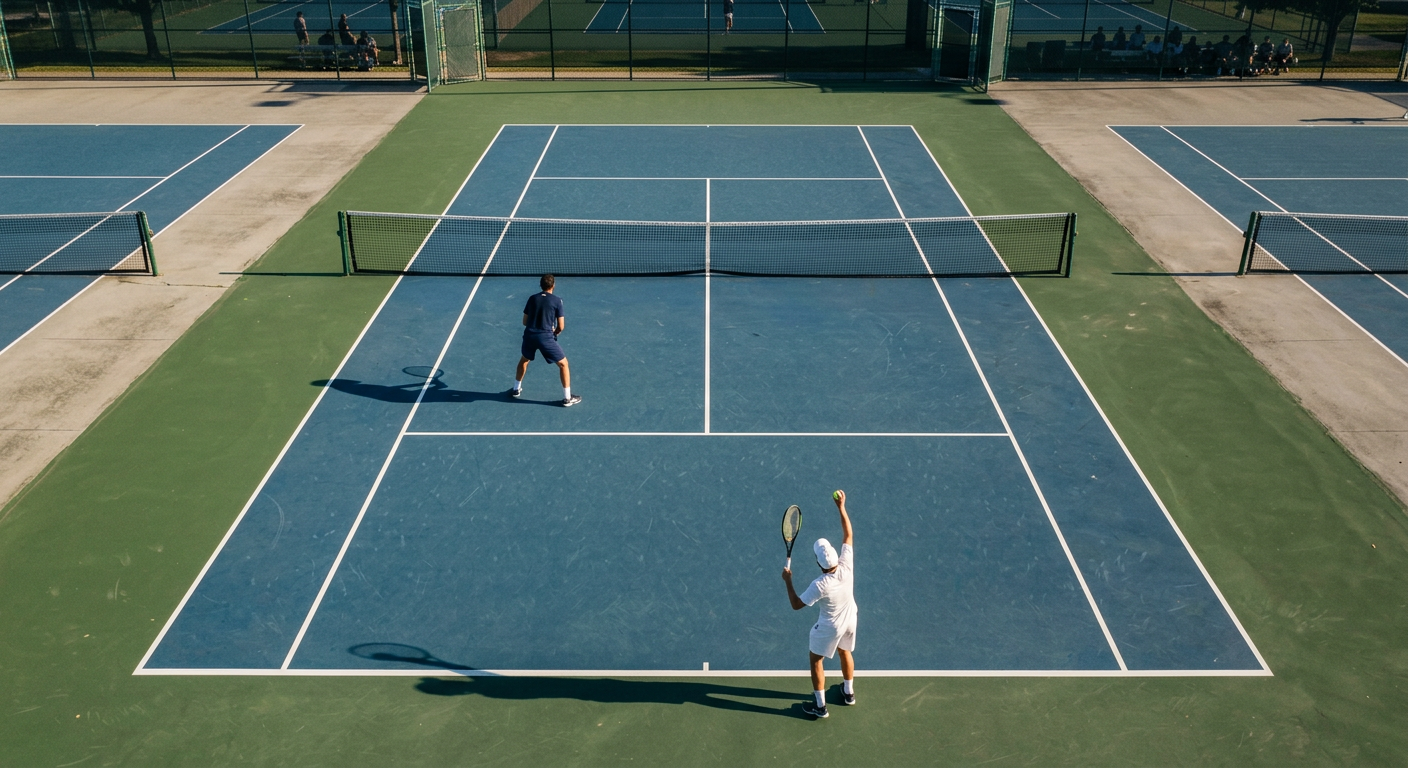
The Most Misunderstood Position in Club Doubles
Most club doubles players treat the server's partner role like a waiting position — stand near the net, look threatening, and hope the ball comes to you. That's exactly why so many points fall apart before they even develop.
The net player in doubles is arguably the most tactically demanding position on the court. Every single point requires a series of rapid decisions: where to stand, what to watch, when to move, when to hold, and how to communicate — all within fractions of a second. And yet, studies of recreational tennis patterns consistently show that net players at the 3.0-3.5 level are stationary on more than 70% of points, moving neither to poach nor to cover the lob.
That passivity is costing you points. This guide focuses exclusively on the server's partner role, walking through every decision you need to make from the moment your partner winds up to serve until the point ends. Think of it as a decision-tree reference for one specific position — because that position deserves dedicated attention.
For the broader picture of how this role connects to overall court organization, see how net player positioning fits into a winning doubles strategy.
Where to Stand Before the Serve: The Correct Starting Position
Your starting position sets the ceiling for what you can do on any given point. Get it wrong, and you've already eliminated half your options before the serve is even struck.
The standard recommendation — and the one backed by court geometry — is to stand roughly in the middle of the service box, laterally centered between the singles sideline and the center service line. Depth-wise, you want to be approximately 3 to 4 feet behind the net. That puts you close enough to angle volleys sharply, but far enough back to have reaction time on hard returns and enough footwork room to cover a lob.
Why Standing Too Close to the Net Is a Mistake
Here's the thing: players who crowd the net at 18 inches think they look aggressive. What they've actually done is eliminate the lob as a threat — against themselves. When a returner sees a net player glued to the tape, a lob is almost automatic. And from that depth, you cannot recover.
Data from ITF technical coaching resources suggests that the optimal net player depth gives you roughly 0.6 to 0.8 seconds of additional reaction time compared to a position at the net tape — which is the difference between tracking a lob and watching it land behind you.
So: 3 to 4 feet back from the net, service box center. That's your baseline.
Adjusting Your Position Based on Serve Direction
Not every serve is the same, and your starting position should shift subtly based on where your partner is serving.
- T-serve (down the middle): The return angle is limited. The returner can't go wide cross-court without the ball going into the net. You can cheat slightly toward the center — closer to the T-position — because a poach opportunity is more likely.
- Wide serve: The returner has a sharper cross-court angle available. Shift slightly toward the sideline to protect that lane, and be more conservative about poaching unless you've signaled it pre-point.
- Body serve: Return options are reduced because the returner is jammed. Position yourself centrally and be ready to poach an off-balance reply.
This positional micro-adjustment is something most club players simply never do. It takes about two weeks of deliberate practice to make it automatic.
What You Should Be Watching During the Serve
This is where the doubles tennis net player positioning question gets genuinely interesting — and where most players get it completely wrong.
Reading the Returner's Body and Racket
Don't watch the ball. I know that sounds counterintuitive, but your job is not to track the serve — it's to read the returner.
By the time the serve crosses the net, your eyes should already be on the returner's shoulders and racket face. Shoulder rotation tells you the direction of the return before the ball is struck. An open stance with shoulders facing cross-court means the return is almost certainly going cross-court to your partner. A closed stance or early hip turn toward the line? That's a down-the-line return coming — potentially right at you.
Professional doubles players at the ATP/WTA level demonstrate this consistently: the net player's head turns toward the returner within 0.2 to 0.3 seconds of the serve being struck, not after the return is already in flight.
Tracking the Ball vs. Watching Your Opponent
There's a brief window — roughly the moment the return leaves the returner's racket — where you shift from reading the opponent to tracking the ball. This two-phase visual approach is what separates reactive net players from anticipatory ones.
Reactive: you see the ball, then you move. Anticipatory: you read the body, pre-load your movement, then confirm with the ball.
Anticipatory net players win more points. The pre-loading means you're already shifting your weight in the right direction before the ball has fully left the strings.
Your Movement Options Once the Return Is Hit
Once the return is airborne, you have three primary decisions. Understanding each — and knowing which cues trigger which response — is the core of the doubles tennis net player role.
When to Poach and When to Hold
Poaching is not random aggression. It's a calculated movement based on two conditions: (1) you've read a cross-court return coming toward your partner, and (2) the ball's trajectory gives you a genuine interception opportunity with a volley angle that creates a winner or forces a weak reply.
The mistake most club players make is poaching late — moving after the ball has already passed the service line on their side. At that point, you're lunging at a ball below net height with no angle. That's not a poach; that's a gift to the opponents.
Effective poaching means moving early, before the ball crosses the net, based on your read of the returner. You cross toward center, intercept the ball above net height if possible, and direct your volley to the open court — typically the gap between the two opponents or angled sharply away from the baseline player.
For a detailed breakdown of poaching mechanics and timing, how to poach effectively in doubles goes deep on the footwork and decision triggers.
How to Cover the Lob Over Your Head
Lob coverage is the shot most net players dread, and the anxiety is understandable — you're moving backward at full sprint while trying to hit an overhead or let the ball bounce for a defensive reply.
The key cue is early recognition. If the returner opens their racket face and lifts through the ball — you'll see the follow-through going upward rather than forward — that's your signal to turn and run. Don't wait to see the ball go over your head.
The standard protocol: turn sideways (don't backpedal), sprint toward the baseline, and call "mine" loudly if you're going for it or "yours" if your partner has a better angle. Communication eliminates the hesitation that turns a manageable lob into a lost point.
And if the lob lands deep and you can't hit an overhead with confidence? Let it bounce, reset to the baseline, and play the point from there. One point lost is better than a mis-hit overhead that gives your opponents an easy put-away.
What to Do When the Return Goes to Your Partner
This is the most neglected scenario in net player coaching. When the return goes to your partner at the baseline, your job is to move toward the center service line — specifically toward the T-position area — to reduce the open court on your side.
Why? Because if your partner hits a quality approach shot or a deep groundstroke, the opponents will be looking for the gap down your sideline. Drifting toward center takes that gap away. It also positions you to poach your partner's reply if the opponent's response comes back cross-court.
This is active net play. You're not standing still; you're repositioning on every shot.
Communication with Your Serving Partner: Before and During the Point
Pre-point communication is one of the highest-leverage habits in doubles, and it costs you nothing but 10 seconds between points.
The most common system uses hand signals behind your back, shown to your partner before the serve:
- Open hand (fingers spread): You're staying — not poaching.
- Closed fist: You're poaching on this serve.
- One finger pointing: You're faking the poach (moving then returning to position).
Beyond signals, a quick verbal exchange — 'I'll poach if it's a T-serve' or 'cover the lob, I'm going wide' — gives both players a shared mental map for the point. Teams that communicate before each point win significantly more service games than those who operate independently. (In my experience coaching club doubles, this single habit accounts for more improvement than any technical adjustment.)
During the point, vocal cues matter just as much: 'mine,' 'yours,' 'switch,' and 'bounce it' should be part of your automatic vocabulary. Silence at the net leads to confusion, and confusion leads to lost points.
For a deeper look at how these communication systems fit into broader doubles patterns, check out best doubles drills for intermediate players — several of those drills specifically train net player communication under pressure.
Common Net Player Errors and How to Fix Them
Error 1: Watching the serve instead of the returner. Fix: In practice, force yourself to turn your head toward the returner the moment you hear the ball leave your partner's strings. Drill this with a dedicated ball-watching partner who calls out 'returner' as the serve is hit.
Error 2: Standing flat-footed. Fix: Use a split step timed to the returner's contact. This is the same split step you'd use at the baseline — a small hop that loads your legs for explosive movement in any direction. Without it, your first step is always half a beat late.
Error 3: Poaching and then stopping mid-court. Fix: Every poach must be committed. If you start moving, go all the way. A half-poach leaves your side of the court exposed and your partner confused about coverage.
Error 4: Ignoring volley angles. Fix: Before any practice session, spend five minutes drilling angled volleys from the service box — specifically the sharp cross-court volley and the put-away down the middle. Knowing your volley angles makes poaching decisions easier because you know what you can do with the ball when you intercept it.
Error 5: Never adjusting position between points. Fix: After every point, verbally confirm with your partner what worked and what needs to change. Treat each point as data. The comparison between 3.0 vs 4.0 doubles strategy makes clear that the jump in level is largely about decision quality, not physical ability.
Building Net Player Confidence Through Focused Practice
Confidence at the net comes from repetition in realistic scenarios — not from hitting volleys against a ball machine in isolation.
The most effective practice structure I've seen for developing the server's partner role involves three-ball sequences: serve → return → net player reaction. The net player practices reading the returner's body, making a movement decision (poach, hold, or lob coverage), and executing the appropriate shot. Running 20 of these sequences in a 30-minute session builds the pattern recognition that translates directly into match play.
Another useful drill: the 'signal and go' exercise, where the server's partner signals a poach, the server adjusts their target accordingly, and both players execute the pre-planned sequence. This reinforces the communication habit and makes the coordination feel natural under pressure.
If you want to accelerate this development significantly, sharpen your net game with targeted doubles coaching gives you access to structured instruction specifically designed around the decision-making demands of the net player role.
The server's partner is not a passive observer. Every point is a live tactical problem — and the players who treat it that way are the ones who control the net, not just occupy it.