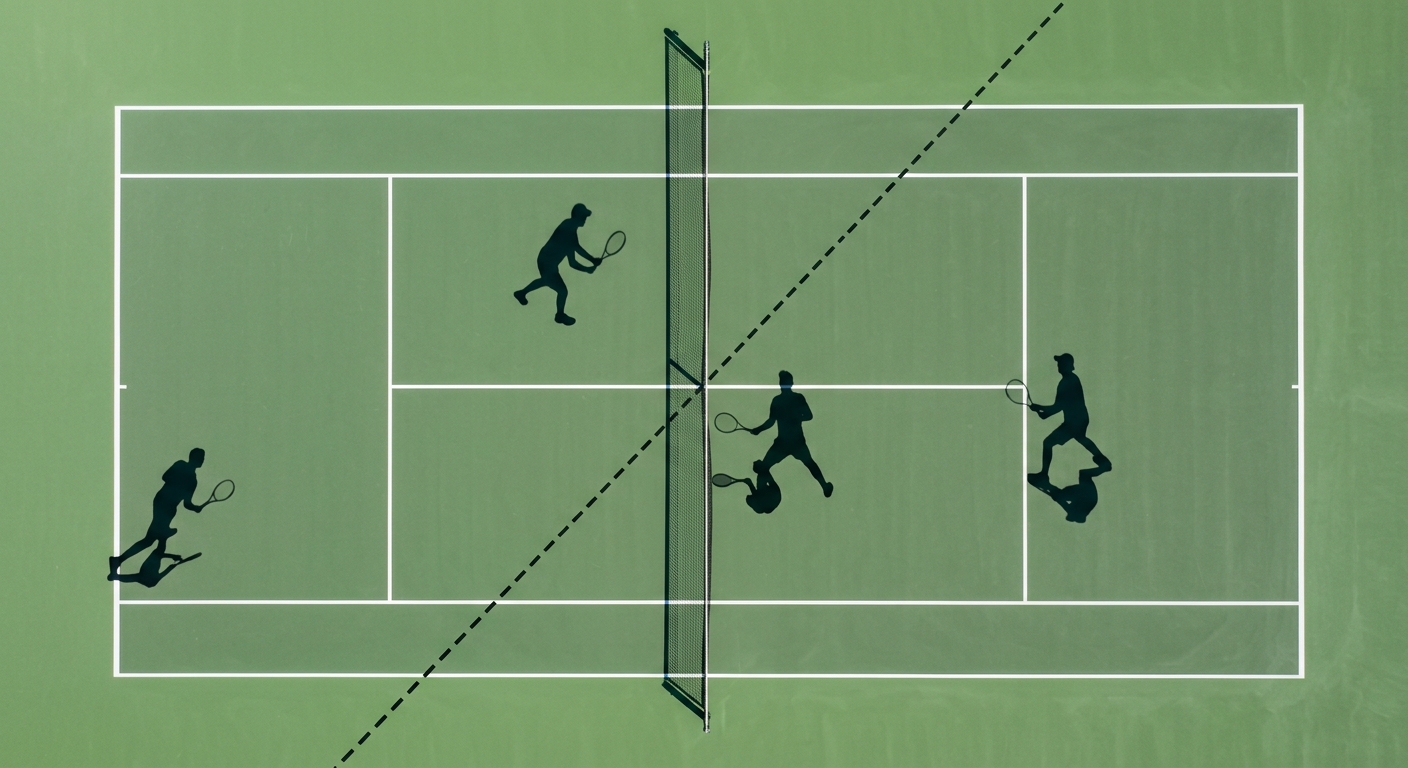
Why Most Club Players Are Standing in the Wrong Place
Here's the thing — club doubles is basically a positioning game with some tennis attached to it. I've watched thousands of hours of recreational doubles across USTA leagues, club ladders, and weekend round-robins, and the single most common pattern isn't a bad backhand or a weak serve. It's players standing exactly where their opponents want them to be.
Positioning errors are silent. They don't feel like mistakes in the moment. You're on the court, you're moving, the ball goes into the net, and you chalk it up to "off day." But that point was probably over before anyone swung a racket.
The good news? These are fixable right now, today, without changing your technique at all. Understanding the doubles positioning principles that actually win points gives you the framework — this article gives you the five specific errors that are costing club players matches every single weekend, broken down by role so you know exactly which one applies to you.
Let's go through them one by one.
Mistake #1: The Net Player Who Hugs the Service Box Line
Walk onto any club doubles court and watch the net player during the serve. Nine times out of ten, they're standing about three feet inside the service box, practically leaning on the service box T-line. It feels safe. You can see everything. You have time to react.
Except you don't actually have more time — you just have worse angles and shorter reach on every volley.
When you're deep in the service box, your opponent at the net has a much wider corridor to pass you. Lobs clear you more easily. And the balls you do reach are lower, harder to put away, and require more precision to keep in the court. You're essentially volunteering to play defence from the net position.
Where You Should Actually Stand at the Net
The correct position is roughly halfway between the service box line and the net — call it eight to ten feet from the net depending on your height and reach. At this depth, your angles close dramatically, your volleys contact the ball higher in the swing window, and opponents need a near-perfect passing shot to beat you.
Yes, the lob becomes a bigger threat. That's a fair trade. A lob over your head is one shot. A poorly positioned net player who bleeds easy passes is a pattern that repeats every point.
Practical drill: put a racket cover or cone on the court halfway between the T and the net. That's your target starting position before every point. Build the habit before you build the volley.
And if you want to really sharpen this, look at how the Australian formation vs I-formation changes where the net player sets up depending on the server's direction — it's the same principle applied to more advanced situations.
Mistake #2: The Server Who Stays Glued to the Baseline
This one is almost universal at the 3.0 level. Server hits the ball, watches it land, and stays parked behind the baseline waiting to see what happens. Which, to be fair, is fine in singles. In doubles, it's a slow-motion concession.
Here's why it matters: when you stay back after your serve, you've just handed the returning team a free pass to a one-up-one-back battle — which they want, because it's comfortable. You're essentially playing two-on-one at the net (your partner) and two-on-one at the baseline (you, alone, covering the whole court). That arithmetic doesn't work.
According to USTA recreational doubles data, most points at the 3.5 level and below are decided within the first four shots of the rally. If you're still at the baseline for shots three and four, you're playing from the worst possible position on the court.
How to Transition Forward After Your Serve
You don't need to chip-and-charge like it's Wimbledon in 1985. But you do need a plan.
Option A: Hit your serve and immediately take 3–4 steps forward, split-step as the return comes, and evaluate. If the return is weak or mid-court, continue forward. If it's aggressive, handle it from the mid-court and look for the next opportunity.
Option B: On second serves where you're less confident, serve out wide to open an angle, and use your partner's poach to take the pressure off your approach.
The mental shift is key: your default after serving should be move forward until the ball tells you not to. Not stay back until the ball tells you to go. That single reversal changes how many points you reach in an attacking position.
If your serve mechanics are keeping you from executing this transition — because you're off-balance after the delivery — that's a technique issue worth working on with a tennis coach separately from your positioning work.
Mistake #3: Both Players Staying Back After the Return
The return team hangs back. Both of them. One player returns, stands there, and their partner on the baseline takes a small shuffle step and also stands there. Now it's two-back versus one-up-one-back, and the serving team just needs to be patient.
This is the 3.0 tennis doubles strategy trap in its purest form — the "let's just get it back" mentality extends to positioning, and suddenly you're playing baseline singles with a partner next to you.
The One-Up-One-Back Trap and How to Escape It
The returnee's partner should almost always start at the net on the return of serve — positioned correctly (see Mistake #1), not hugging the T-line. When the return goes in successfully, the returning player's job is to join their partner at the net as quickly as possible.
The pathway:
- Partner stands at net before the point starts
- Returner hits a deep, neutral return
- Returner follows the ball forward — even if it's not a perfect return
- Both players are at the net within two shots
The "follow your return to the net" habit doesn't mean charging blindly. If your return is a floater that lands short, you stop, deal with whatever comes back, and look for the next opening. But if your return is solid and deep, move.
For a detailed breakdown of how positioning shifts based on skill level, the 3.0 vs 4.0 doubles strategy comparison is genuinely useful — it shows you exactly what the tactical upgrade looks like in practice.
Mistake #4: Moving Laterally Instead of as a Unit
Picture this: the ball goes wide to your partner's side. Your partner slides left to cover it. You... stand exactly where you were, leaving a gap in the middle the size of a parking space.
Or the reverse: you poach toward the middle, your partner covers, and now there's a gaping hole down your alley because nobody communicated the shift.
This is the most common "invisible" positioning error in club doubles because each player thinks they're doing the right thing individually. And they kind of are. The problem is doubles isn't two singles players sharing a court — it's a two-person unit that should move like one organism.
The 'Shadow' Principle: Moving Together to Close Gaps
The shadow principle is simple: when one player moves, the other mirrors them. You're connected by an imaginary rod through the middle of the court. Your partner shifts two steps right, you shift two steps right. The gap between you stays constant, but you've collectively relocated to cover the threat.
This applies whether you're both at the net, both at the baseline, or in a one-up-one-back setup. The team moves, not the individual.
Communication is the unlock here (sorry — the key here). A simple "moving" or "got it" call as you poach or shift tells your partner to fill the space you just vacated. It takes about three practice sessions to make this automatic. Without it, you'll keep leaving the middle open — which brings us to Mistake #5.
Mistake #5: Ignoring the Middle of the Court
Ask most club doubles players where they aim when they don't have a clear winner. They'll say "deep" or "crosscourt" or "wherever there's space." Almost nobody says "the middle."
And yet the middle is where doubles matches are won. Not occasionally — consistently.
The math is simple. A ball hit through the middle of the court:
- Travels over the lowest part of the net (the center strap is six inches lower than the sides)
- Forces a communication breakdown between opponents ("yours?" "no, yours" — you've seen this)
- Eliminates both sideline angles for the opponents' reply
- Forces the less comfortable player to hit a shot they didn't prepare for
The T-formation and most standard doubles systems are specifically designed around protecting and attacking the middle. Teams that aim wide are playing into the teeth of a well-positioned pair. Teams that attack the middle are creating problems that good positioning alone can't always solve.
Why the Middle Ball Wins Doubles Matches
At the net, the split-step setup is designed to cover the middle first, wide second. When you aim wide, you're hitting toward the most-covered part of the court. When you aim middle, you're hitting toward the seam — the hardest spot to cover definitively.
The exception: when you have a genuine angle winner and you're certain you can execute it. At 3.0–3.5, that certainty is rare. Default to the middle until you've earned the right to go for the lines.
This is one of those tactics that feels too simple to matter, and then you start winning more points and you wonder why you ever aimed anywhere else.
A Simple Positioning Checklist for Your Next Match
Here's a role-by-role quick reference you can actually use between changeovers.
| Technique | Best Use | Outcome |
|---|---|---|
| Net player halfway to net | Every point at net — default position | More volley options, fewer passes conceded |
| Server transitions forward | After first serves, especially out wide | Eliminates baseline isolation, applies net pressure |
| Returner follows ball to net | After solid, deep returns | Gets both players to net quickly |
| Shadow movement | Any lateral ball that pulls a partner wide | Closes middle gap, maintains unit structure |
| Middle targeting | When no clear angle winner exists | Lower net clearance, communication pressure on opponents |
| First-to-net wins the point | Rally patterns at 3.0–3.5 | Statistically, the team at net wins |
Print it, take a photo, whatever. But use it. Before each service game, run a 5-second mental check: Am I in the right position for this point?
And if you want to drill these habits with reps rather than just reading about them, the best doubles drills for intermediate players are specifically designed around building these positioning patterns under pressure.
Final Thoughts: Position First, Then Swing
Every tennis player wants to fix their technique. Better serve, cleaner backhand, more reliable overhead. All legitimate goals. But at the club level, especially in doubles, technique improvements are slow and positioning improvements are immediate.
You can fix Mistake #1 today. Walk onto the court and stand two steps closer to the net. That's it. That's the change. You don't need a lesson for that — though if you want to work on these positioning fundamentals with a tennis coach, the progress compounds dramatically faster with real-time feedback.
Fix the positioning first. Earn the right to worry about technique. The players who understand this are the ones at the 4.0+ level while everyone else is still wondering why their groundstrokes aren't winning more points.
Start with one mistake from this list. Pick the one you know you're making right now. Apply the fix next match. Then come back for the next one.
Position first. Then swing.