Why Most Men Are Getting the Wrong Haircut (And Don't Know It)
You walk into a barbershop, sit down, and the barber asks what you want. You say "fade on the sides" because that's what you heard someone else say. Or you pull up a photo of a celebrity whose hair looks nothing like yours. The barber nods, does their thing, and you walk out looking... fine. Not great. Just fine.
Here's what actually happened: you picked a haircut based on vocabulary, not suitability. Most men choose styles they can name rather than styles that work with their face shape, hair texture, and lifestyle. They don't know a mid-fade requires weekly touch-ups or that a textured crop only works if you have the right hair density. They just know it looks good on someone else.
This article reframes the entire decision. Instead of starting with "what's popular," we're ranking men's haircuts by three factors that actually matter: how well they suit different face shapes, what hair types they demand, and what level of barber skill they require. By the end, you'll know exactly what to ask for — and more importantly, why that particular cut makes sense for you.
The Four Haircut Families Every Man Should Know
Before we rank individual cuts, you need to understand the taxonomy. Every men's haircut falls into one of four families, and each family has different maintenance demands, styling requirements, and barber skill thresholds.
Fades: Low, Mid, High, and Skin — What the Difference Actually Looks Like
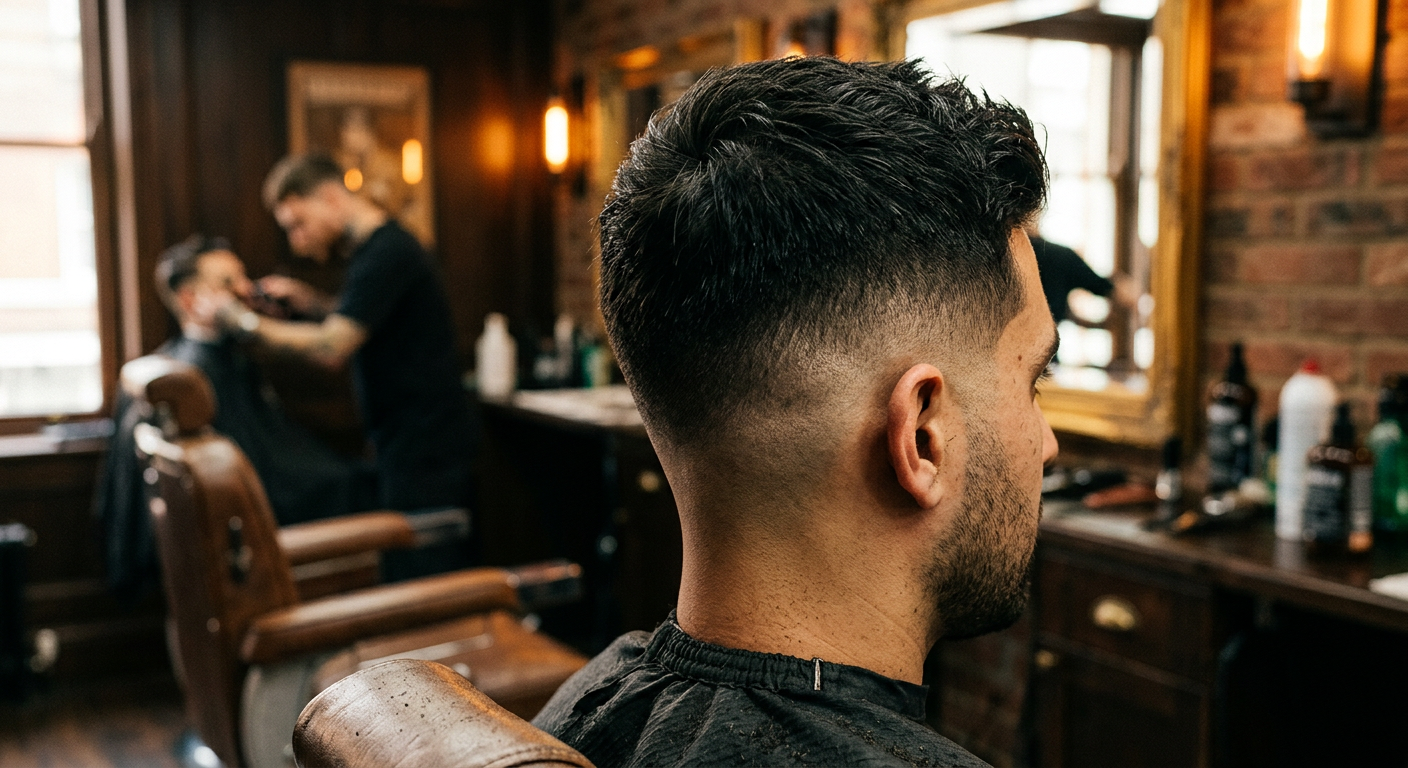
A fade isn't one haircut. It's a technique where hair gradually transitions from longer on top to shorter (or bare skin) on the sides and back. The "low," "mid," and "high" refer to where that transition starts.
Low fade: The blend starts about an inch above the ear. Conservative, works in professional settings, grows out more gracefully. If you're going three weeks between cuts, this is your best bet.
Mid fade: Starts around the temple. The most versatile option — sharp enough to look intentional, forgiving enough to last two weeks without looking sloppy.
High fade: Begins well above the temple, sometimes at the top of the head. Dramatic, modern, requires weekly maintenance. This is the Instagram haircut. It looks incredible for about five days.
Skin fade (also called bald fade): Takes the sides down to bare skin. Requires clipper precision most barbers don't have. If your barber can't blend without visible lines, this will look like a mistake by day three.
The critical thing most men miss: a fade haircut requires a skilled barber with clipper precision. Not every barber can execute a clean fade. The technique demands multiple clipper guards, careful blending, and an eye for symmetry. If you've ever had a fade that looked "striped" or uneven, that wasn't the style's fault — it was the execution.
Fades work best on straight to slightly wavy hair. Coarse or very curly hair can make the blend less visible, which sometimes works in your favor (more forgiving as it grows) but can also look less defined.
Tapers: The Fade's More Conservative Cousin
A taper is often confused with a fade, but the difference matters. A taper gradually shortens the hair without taking it down to skin. The transition is longer, subtler, more traditional.
Tapers are easier to execute, which means more barbers can do them well. They're also more forgiving — a taper at two weeks looks intentional, while a fade at two weeks looks overdue.
If you work in a conservative industry (law, finance, corporate), a taper gives you a clean, professional look without the high-maintenance demands of a fade. It's the difference between getting a haircut every three weeks versus every ten days.
Classic Cuts: Crew Cut, Ivy League, Side Part
These are the workhorses. Low drama, high functionality, minimal styling required.
Crew cut: Uniform short length on top (usually 1-2 inches), tapered or faded sides. Works on nearly every face shape because there's no strong directional element. If you have a round face, keep the top slightly longer to add vertical dimension. If you have an oblong face, keep it shorter to avoid elongating further.
Ivy League: A longer crew cut with enough length on top to side-part. Requires a small amount of product (pomade or light wax) but nothing elaborate. The quintessential "I have my life together" haircut.
Side part: Longer on top (3-4 inches), parted to one side, tapered or faded on the sides. This is the cut your grandfather had, and it still works because the proportions are mathematically sound. The part creates asymmetry, which flatters most face shapes. Requires daily styling — you'll need a comb and product.
Classic cuts are the lowest-risk category. They don't require specialist barbers, they grow out predictably, and they work across a wide range of hair textures. The trade-off: they're not going to turn heads. They're reliable, not remarkable.
Textured and Modern Cuts: Crop, Quiff, Slick Back
This is where things get interesting — and where most men overestimate their hair's capabilities.
Textured crop: Short on the sides, slightly longer on top (1.5-3 inches), cut with texturizing shears to create a "messy" look. This cut only works if you have the right hair density and texture. Thin hair looks sparse. Very coarse hair looks too structured. You need medium-density hair with some natural texture.
Quiff: Longer on top (3-5 inches), styled upward and slightly back. Requires blow-drying and product. If you're not willing to spend five minutes with a blow dryer every morning, don't get this cut. It also demands regular trims — once the top gets too long, it loses shape and just looks like you need a haircut.
Slick back: All one length on top (4-6 inches), combed straight back with pomade or gel. Works best on thick, straight hair. If you have a cowlick or your hair is too fine, it won't stay back — you'll be reapplying product all day.
Modern cuts require more from you and your barber. The barber needs to understand texturizing techniques, point cutting, and how different hair types respond to layering. You need to be willing to style your hair daily. If either of those conditions isn't met, these cuts fail.
How to Match a Haircut to Your Face Shape (Without Guessing)
This is where most men's haircut guides go wrong. They show you a diagram of face shapes and tell you to "figure out which one you are." That's useless. Here's the actual method.
Oval, Square, Round, Oblong: The Quick Visual Test
Stand in front of a mirror. Pull your hair completely back (or imagine it gone). Look at the outline of your face from forehead to jawline.
Oval face: Your face is longer than it is wide, with a gently curved jawline and no sharp angles. You won the genetic lottery. Nearly every haircut works on an oval face. Your only constraint is hair texture.
Square face: Strong, angular jawline. Your forehead, cheekbones, and jaw are roughly the same width. You want to soften those angles, which means avoiding styles that add width at the temples. A textured crop or quiff works well — the volume on top creates vertical dimension. Avoid very short buzz cuts unless you're actively going for the "intimidating" look.
Round face: Your face is about as wide as it is long, with soft curves and no strong angles. You need to add length and avoid width. This means: longer on top, shorter on the sides. A pompadour or quiff adds height. A mid or high fade creates the illusion of a longer face. Do NOT get a bowl cut or anything that adds volume at the sides.
Oblong (long) face: Your face is significantly longer than it is wide. You need to add width and avoid adding more height. Keep the top shorter — a crew cut or textured crop works. Avoid pompadours, high quiffs, or anything that adds vertical volume. A side part can add horizontal balance.
Here's the nuance most guides miss: face shape is a starting point, not a rule. If you have a round face but thick, coarse hair, a longer style might add too much bulk. If you have a square face but thinning hair, you might not have enough density for a textured crop. Face shape and hair texture interact — you can't optimize for one without considering the other.
Hair Texture Changes Everything — Straight vs. Wavy vs. Coarse
Two men with the same face shape can get the same haircut and have completely different results. The variable: hair texture.
Straight hair: The most versatile. Holds shape well, responds to product, works with most cuts. The downside: it shows every mistake. If the fade isn't perfectly blended or the layers aren't even, you'll see it. Straight hair is unforgiving of mediocre barbers.
Wavy hair: Adds natural texture and volume, which can be an advantage or a problem depending on the cut. A textured crop looks incredible on wavy hair — the natural movement does half the styling work for you. But a slick back is harder because the waves fight the direction you're combing. If you have wavy hair, work with it, not against it.
Coarse/thick hair: Holds volume, which means styles like pompadours and quiffs work well. The challenge: it can look "heavy" if there's too much length. You need a barber who understands texturizing and thinning techniques. Without that, you'll end up with a helmet of hair.
Curly hair: Requires a completely different approach. Most traditional men's haircuts don't work on curly hair because they're designed for straight or wavy textures. If you have curly hair, you need a barber who specializes in curly cuts — someone who understands curl patterns, shrinkage, and how to cut dry (not wet). A fade can work, but the top needs to be cut in a way that respects the curl.
Thinning hair: This is the constraint that overrides everything else. If your hair is thinning, your priority is maximizing the appearance of density. Shorter cuts (crew cut, buzz cut) often work better than longer styles because they don't expose the scalp as much. Avoid slick backs or anything that requires combing hair flat — it highlights thinning. A textured crop with a matte product can create the illusion of thickness.
How to Tell Your Barber Exactly What You Want
You've figured out what cut makes sense for your face and hair. Now you have to communicate it. This is where most men fail.
The Five Words That Prevent a Bad Haircut
Don't walk in and say "just clean it up" or "the usual." Even if you've been going to the same barber for years, be specific. Here's the framework:
- Top length: "Leave about two inches on top" or "take the top down to one inch."
- Side style: "Mid fade" or "tapered" or "tight on the sides."
- Blend point: "Start the fade at the temple" or "keep the taper low."
- Texture: "Texturize the top" or "keep it blunt cut."
- Front/fringe: "Leave the front longer" or "bring the hairline forward."
Example: "I want a mid fade starting at the temple, about two inches on top with some texture, and leave the front a bit longer so I can style it forward."
That's enough information for a competent barber to execute exactly what you want. It's specific without being controlling.
How to Use a Reference Photo the Right Way
Reference photos work, but most men use them wrong. Don't show your barber a photo of Chris Hemsworth and expect to walk out looking like him. His hair texture, density, and face shape are different from yours.
Instead, use the photo to communicate specific elements: "I like the length on top in this photo" or "I want the fade to start where his does" or "I like how textured this looks."
Even better: show a photo of someone with similar hair to yours. If you have thin, straight hair, don't show a photo of someone with thick, wavy hair. The barber can't replicate a style that requires a different hair type.
What to Say If You Don't Know What You Want
Here's the honest approach: "I'm not sure exactly what I want, but I know I want something low-maintenance that works with my face shape. What do you think would work?"
A good barber will ask follow-up questions: How much time do you want to spend styling? Do you use product? How often do you want to come in for a cut? What's your work environment like?
If the barber just starts cutting without asking anything, that's a red flag. A professional should be assessing your hair texture, growth patterns, and face shape before making a recommendation.
For more guidance on what to expect during your visit, check out what happens during a hot towel shave — the same attention to detail applies to a quality haircut.
Which Cuts Require a Specialist (And How to Find One)
Not every barber can execute every cut. This isn't a criticism — it's specialization. A barber who's incredible at classic cuts might not have the clipper skills for a perfect skin fade. A barber who specializes in curly hair might not be the right choice for a slick back on straight hair.
Fades Need Clipper Precision — Not Every Barber Is Equal Here
If you want a fade — especially a mid, high, or skin fade — you need a barber with advanced clipper skills. This means:
- Multiple clipper guards and blending techniques
- An understanding of head shape and how to adjust the fade accordingly
- Experience with different hair textures (coarse hair requires different clipper angles than fine hair)
How do you know if a barber has these skills? Look at their work. Most barbers post photos on Instagram. Scroll through and look at the fades. Are the transitions smooth or can you see lines? Do the fades look clean from multiple angles or just from the front?
If you're booking online through platforms like Booksy, check reviews specifically mentioning fades. Generic "great haircut" reviews don't tell you much. You want reviews that say "best fade I've ever had" or "perfect blend."
For more on booking methods, see Booksy vs. booking a barber directly — the platform you use can affect the barber you end up with.
How to Vet a Barber Before You Sit Down
Before you commit to a new barber, do this:
- Check their portfolio: Instagram, shop website, anywhere they post their work. Look for haircuts similar to what you want.
- Read reviews for specifics: Don't just look at the star rating. Read what people say. Are they praising the barber's fade skills? Attention to detail? Ability to work with difficult hair?
- Visit the shop: Walk in and look around. Is it clean? Organized? Do the barbers seem focused or distracted? You can tell a lot about a shop's standards from a five-minute observation.
- Ask about specializations: When you call to book, ask if the barber has experience with the cut you want. A good shop will direct you to the right barber for your needs.
If you're in a city with diverse barbershop cultures, understand that different shops have different strengths. For example, Black barbershops have specific expertise in fades and line-ups that other shops might not match. Similarly, Turkish barbers have techniques — like straight-razor shaves and threading — that set them apart.
Once you find a barber who consistently delivers, stick with them. A men's grooming routine starts with regular barbershop visits every 3–4 weeks. Consistency matters — a barber who knows your hair can make better decisions than someone seeing you for the first time.
How Often You Actually Need a Haircut to Keep It Looking Right
This depends entirely on the cut you choose. Here's the realistic maintenance schedule:
| Haircut Style | Maintenance Frequency | Why |
|---|---|---|
| Skin fade or high fade | 7-10 days | The fade grows out quickly; by two weeks it's lost definition |
| Mid fade | 2-3 weeks | More forgiving than a high fade but still needs regular touch-ups |
| Low fade or taper | 3-4 weeks | Grows out gracefully; still looks intentional at a month |
| Crew cut or buzz cut | 3-4 weeks | Uniform length means it grows out evenly |
| Textured crop | 4-5 weeks | The texture hides growth; you're trimming for shape, not length |
| Quiff or pompadour | 4-6 weeks | Longer styles can go longer between cuts, but you'll need trims to maintain shape |
| Slick back or side part | 5-6 weeks | Longest interval; these styles rely on length, so you're cutting less frequently |
Here's what most men get wrong: they choose a high-maintenance cut without considering the time and cost. A skin fade looks incredible, but if you're only willing to get a haircut once a month, it's the wrong choice. By week three, it doesn't look like a fade anymore — it just looks like you need a haircut.
Match your cut to your maintenance tolerance. If you want to go four weeks between cuts, choose a low fade, taper, or classic cut. If you're willing to go every ten days, a high fade or skin fade is an option.
Cost matters too. At $40-60 per cut, a weekly fade habit costs $2,000-3,000 per year. A cut every four weeks costs $500-750. That's not a judgment — just a reality check. For context on what barbers actually earn from this, see can a barber make $100,000 a year.
And since we're talking about cost: if you're getting quality work, tip appropriately. For guidance, check out how much to tip your barber — it's more nuanced than you think.
What This All Means When You Sit Down Tomorrow
Most men approach a haircut backward. They pick a name ("I want a fade") without understanding what that name requires from their hair, their face, their schedule, and their barber.
The better approach: start with constraints. What's your hair texture? What's your face shape? How much time will you spend styling? How often will you get a cut? What's your barber's skill level?
Once you know those variables, the right haircut becomes obvious. A round-faced guy with thick, wavy hair who wants low maintenance and can only get a cut every four weeks should get a textured crop with a low fade. A square-faced guy with straight hair who's willing to style daily and get cuts every two weeks can pull off a high-fade quiff.
The goal isn't to find the "best" men's haircut — it's to find the one that works for your specific situation. When you walk into a barbershop with that level of clarity, the conversation changes. You're not asking the barber to guess. You're telling them exactly what you need.
If you don't have a barber who can execute what you've decided on, find a barber near you who can execute it. The right cut with the wrong barber still turns out wrong.
And if you're curious about what products your barber is using to finish your cut, we've covered that too: the products your barber uses on your hair.
The difference between a good haircut and a great one isn't the style — it's the match between style, hair, face, and execution. Now you know how to make that match.