Why the Products Matter as Much as the Technique
Your barber just gave you the best haircut you've had in months. You walk out feeling sharp, hair sitting exactly right. Three days later, you're standing in front of your bathroom mirror wondering why you can't recreate what they did. You bought pomade. You watched YouTube tutorials. But your hair looks flat, greasy, or like you're trying too hard.
The problem isn't your technique — it's that you bought the wrong product.
Barbers don't reach for whatever's on the shelf at Target. They use professional-grade products most men have never heard of, formulated specifically for different hair types, textures, and the kind of hold that lasts through a 12-hour day. Some of these products you can (and should) buy for home use. Others only work when a professional applies them. This article names the actual products sitting on barbershop shelves, explains what each one does, and tells you which ones are worth the investment versus which services you should just pay for.
Because here's the reality: the right cut to pair with your styling routine only gets you halfway there. The other half is knowing what your barber used and whether you can replicate it at home.
6 Product Categories Barbers Reach for Every Day
1. Pre-Shave Oils and Shaving Creams
Most men think shaving cream is shaving cream. Barbers know better.
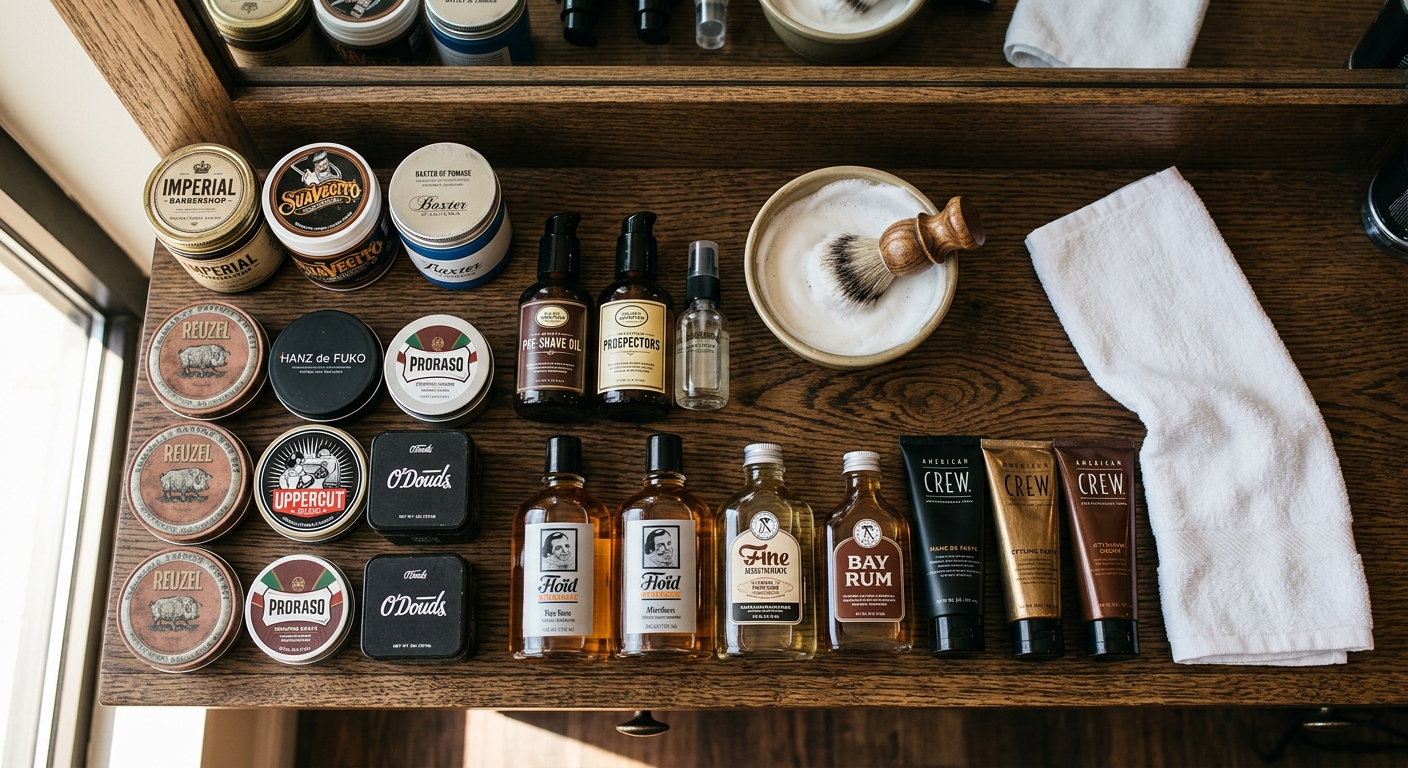
Professional barbershops use pre-shave oils — usually containing jojoba, argan, or grapeseed oil — applied before any blade touches your face. The oil creates a protective barrier between the razor and your skin, reducing friction and preventing razor burn. Brands like Proraso, Clubman Pinaud, and The Art of Shaving dominate barbershop shelves because they're formulated to work under hot towels (which open your pores and soften the hair shaft before the shave begins).
The shaving cream itself is typically a glycerin-based lather applied with a badger hair brush. This isn't aerosol foam from a can — it's a thick, slick cream that barbers whip into a lather in a bowl. The brush exfoliates dead skin cells while lifting the hair away from the face, creating a smoother surface for the razor.
Worth buying for home use? Yes, but only if you're willing to invest in the full setup: pre-shave oil, a quality shaving brush, and a bowl. If you're just doing a quick shave in the shower, stick with a high-quality shaving gel. The ritual matters here — if you're not doing the hot towel prep, the professional-grade cream won't perform better than a good drugstore option.
If you want the full experience without the learning curve, schedule your next barbershop visit and get a hot towel shave done right.
2. Pomades: Water-Based vs. Oil-Based
Pomade is not a single product category — it's two completely different styling approaches that happen to share a name.
Oil-based pomades (like Murray's, Layrite Original, or Suavecito Original Hold) give you that classic slicked-back look with serious shine. They don't wash out easily — you'll need multiple shampoo sessions or a dedicated pomade remover. Barbers use these for traditional styles: side parts, pompadours, slick backs. The hold is strong, the shine is high, and the product builds up in your hair over days (which some guys want for that vintage, never-quite-clean look).
Water-based pomades (Uppercut Deluxe, Baxter of California Clay Pomade, Hanz de Fuko Claymation) wash out with water, offer medium to strong hold, and come in varying shine levels from matte to high gloss. These are what most barbers reach for on clients who want a modern, textured look that still has some structure.
Here's what barbers know that most men don't: pomade works best on slightly damp hair. Not soaking wet, not bone dry — towel-dried with about 20% moisture left. This is when the product distributes evenly and activates properly. If your hair is too dry, the pomade sits on top and looks greasy. If it's too wet, you dilute the hold.
Worth buying for home use? Absolutely, but start with water-based. Oil-based pomades require commitment — they're harder to wash out, and if you apply too much, you'll look like you haven't showered in a week. Water-based gives you room for error.
3. Clay and Matte Paste (What Most Men Should Actually Be Using)
This is the category most men need but don't know exists.
Clay-based products (Baxter Clay Effect, American Crew Forming Cream, Hanz de Fuko Claymation) give you hold without shine. They add texture, volume, and a natural finish that doesn't look like you're wearing product at all. Barbers use these on guys with fine or thinning hair because clay creates the illusion of thickness — it coats each strand and adds grit, making hair look fuller.
Matte paste (like Aveda Men Pure-Formance Grooming Clay or Kevin Murphy Rough.Rider) is similar but typically has a softer hold and works better for shorter styles or messy, textured looks. The key difference: clay gives structure, paste gives separation.
Here's the professional trick: barbers apply clay to dry hair, not damp. Unlike pomade, clay needs friction to activate. They'll rub a small amount (think pea-sized, not quarter-sized) between their palms until it warms up and becomes pliable, then work it through the hair from roots to tips, using their fingers to create texture and movement.
Worth buying for home use? Yes, and this is probably what you should be using if you're not sure what to buy. Clay and matte paste are the most forgiving products — they don't clump, they don't make your hair look greasy, and you can rework your style throughout the day without adding more product.
Most men's grooming products used in barbershops fall into this category because they work on the widest range of hair types and styles.
4. Scalp Treatments and Massage Oils
This is where the line between "product you can buy" and "service you should pay for" starts to blur.
Barbershops use scalp treatments — usually tea tree oil-based or menthol-infused — to cleanse buildup, stimulate blood flow, and treat dandruff or dry scalp. Brands like Paul Mitchell Tea Tree Special Shampoo, Redken Brews Mint Shampoo, and Jack Black True Volume Thickening Shampoo are common. These aren't just regular shampoos with a cooling sensation — they contain active ingredients (salicylic acid, zinc pyrithione, ketoconazole) that actually treat scalp conditions.
The massage oils (often argan, jojoba, or a proprietary blend) are applied during the shampoo or as a standalone scalp massage service. The oil softens the scalp, the massage increases circulation, and the combination promotes healthier hair growth over time.
Here's what most men don't realize: scalp massage benefits aren't just about relaxation. Consistent scalp stimulation (2-3 times per week) can improve hair thickness and reduce shedding by increasing blood flow to the follicles. But the technique matters — barbers are trained to apply the right pressure in circular motions, working from the front of the scalp to the back, then down the sides.
Worth buying for home use? The products, yes. The technique, probably not. You can buy a quality scalp treatment shampoo and use it 2-3 times a week at home. But the massage itself is a service — you're not going to replicate the pressure, rhythm, and coverage that a professional provides. If you have dandruff, thinning hair, or a dry scalp, invest in the products. If you want the full therapeutic benefit, pay for the service.
5. Color Depositing Products and Gray Blending
This is the category most men don't know exists until their barber offers it.
Barbers use semi-permanent color depositing products (American Crew Precision Blend, Just For Men Control GX, Redken Color Camo) to blend gray hair without making it look dyed. These aren't box dyes from the drugstore — they're gradual color treatments that deposit pigment over multiple applications, creating a natural transition between your natural color and the gray.
The professional versions work differently than retail products:
- They're mixed to match your specific hair color (not just "light brown" or "dark brown")
- They're applied strategically — at the temples, sideburns, and beard line where gray shows first
- They fade gradually, so there's no harsh line of demarcation as your hair grows out
Barbers also use toners (purple or blue-tinted shampoos) on men with white or silver hair to remove yellow or brassy tones. This isn't about covering gray — it's about making gray look intentional and polished instead of dull and aged.
Worth buying for home use? No. This is the strongest argument for professional application. Here's why:
Color depositing products are unforgiving. Apply too much, and you look like you dyed your hair in a gas station bathroom. Apply too little, and it does nothing. Miss a spot, and you have a patch of gray surrounded by darker hair. Get it on your skin, and you're walking around with stained temples for three days.
Barbers know how to apply these products evenly, blend them into your natural color, and remove any excess before it stains your skin. They also know when to stop — most men want to reduce gray by 50-70%, not eliminate it entirely. Full coverage looks fake. Subtle blending looks like you just have good genes.
6. Aftershave and Skin Finish Products
The final step in every professional barbershop service is the aftershave or skin finish product.
Barbers use alcohol-based aftershaves (Clubman Pinaud, Proraso Aftershave Lotion, Lucky Tiger Aftershave) immediately after a shave to close pores and disinfect any micro-cuts. The alcohol stings (that's the point — it's working), but it also prevents infection and reduces the risk of razor bumps.
For men with sensitive skin, they'll use an alcohol-free balm (Nivea Men Sensitive Post Shave Balm, Baxter of California After Shave Balm) instead. These products soothe irritation, hydrate the skin, and reduce redness without the sting.
The finish product — usually a light moisturizer or face lotion — is applied after the aftershave has dried. This locks in hydration and gives your skin a healthy, non-greasy finish. Barbers use products like Jack Black Double-Duty Face Moisturizer or Kiehl's Facial Fuel because they absorb quickly and don't leave a shine.
Worth buying for home use? Yes, especially if you shave regularly. A good aftershave and moisturizer will dramatically reduce irritation and keep your skin looking healthy between barbershop visits. But here's the catch: you need to apply them in the right order (aftershave first, moisturizer second) and give each product time to absorb before moving to the next step.
What You Can Replicate at Home vs. What Needs a Professional
Not every product translates from the barbershop to your bathroom. Some require professional application. Others are simple enough that you're wasting money paying someone else to do it.
You can replicate at home:
- Daily styling (pomade, clay, paste)
- Scalp treatment shampoos (though not the massage technique)
- Aftershave and moisturizer application
- Basic beard oil and balm use
You should pay a professional for:
- Any color work (gray blending, toners, dye)
- Scalp treatments that involve chemical exfoliants or prescription-strength ingredients
- Straight razor shaves (the risk of cutting yourself isn't worth the $30 you'd save)
- Beard shaping and line-ups (precision matters, and most men don't have the angles or tools to do this cleanly)
The dividing line is simple: if the product requires precise application, chemical knowledge, or a steady hand working at difficult angles, pay for the service. If it's something you can see in the mirror and adjust as you go, buy the product and do it yourself.
The Case for Getting Color Done at a Barbershop, Not at Home
Let's be specific about why color is the one category you should never attempt at home.
Box dyes and retail color depositing products are formulated for women's hair — longer lengths, different textures, and full-head application. Men's hair is shorter, coarser (especially in the beard), and requires strategic placement. The color needs to blend into a haircut that's only going to last 3-4 weeks before you're back in the chair.
Barbers who specialize in hair coloring at barbershop services understand:
- How to match your natural undertones (most men's hair has red or gold undertones that turn orange if you use the wrong color)
- How much gray to leave visible (50-70% coverage looks natural, 100% looks fake)
- How to apply color only where it's needed (temples, sideburns, scattered grays) instead of saturating your entire head
- How to blend the color into your beard so your facial hair matches your head hair
The professional version also fades more naturally. When you do it yourself, the color line grows out and creates a visible stripe. When a barber does it, they feather the application so the transition is gradual.
If you're considering covering gray, book a consultation at a barbershop that offers color services. They'll show you what 50% coverage looks like versus 70% versus full coverage, and you'll immediately see why this isn't a DIY situation.
Scalp Massage: Why It's a Service, Not a Freebie
Most men think the scalp massage during a shampoo is just a nice touch — a way to make the service feel more luxurious. It's not.
Professional scalp massage (when done correctly) stimulates blood flow to the hair follicles, which delivers more oxygen and nutrients to the roots. Over time, this can improve hair thickness, reduce shedding, and even slow the progression of male pattern baldness. The key phrase: when done correctly.
Barbers are trained to apply firm, consistent pressure using circular motions that cover the entire scalp. They work in sections (front, crown, sides, back) and spend 5-7 minutes on the massage alone. The pressure is firm enough to move the scalp (not just the hair), and the rhythm is slow and deliberate.
You cannot replicate this yourself. You don't have the angles, the pressure control, or the ability to maintain consistent rhythm for 5+ minutes while reaching every section of your scalp. You'll miss spots, apply uneven pressure, and probably give up after 90 seconds.
If you want scalp massage benefits, pay for the service. If your regular men's grooming routine starts with regular barbershop visits every 3–4 weeks, ask your barber to add a scalp treatment. It's usually $10-15 on top of your haircut, and it's the one service that actually delivers measurable results over time.
How to Ask Your Barber What They Used (Without Feeling Awkward)
Most men leave the barbershop with great hair and no idea what product made it look that way. They're too embarrassed to ask, or they assume the barber won't tell them (why would they give away their secrets?).
Here's the reality: barbers want you to ask. They'd rather you buy the right product and maintain your style between visits than show up every week because you can't figure out how to make your hair cooperate.
Here's how to ask:
During the styling: "What are you putting in my hair right now?" (Simple, direct, not awkward.)
At the end of the cut: "I want to buy whatever you just used. What's the brand and where do I get it?" (Most barbershops sell products — they'll point you to the shelf.)
If they used multiple products: "Walk me through what you did — what went in first, what went in second?" (Barbers love explaining their process. You're giving them a chance to teach.)
If you're not sure what to buy: "My hair is [fine/thick/curly/straight]. What's the one product you'd recommend I use every day?" (This gets you a personalized recommendation instead of a generic answer.)
Most barbers will not only tell you what they used — they'll show you how much to use, how to apply it, and what mistakes to avoid. Some will even give you a sample to try before you buy a full-size jar.
The products your barber uses aren't trade secrets. They're tools, and they want you to have the right ones.
If you're still not sure where to start, book your next appointment at a shop that takes the time to explain what they're doing and why. The difference between a $25 haircut and a $50 haircut isn't just the skill — it's the education you get while you're in the chair. And if you're in the market for what happens during a hot towel shave, ask about the products they use during that service too — the pre-shave oil and aftershave balm are often the difference between a smooth shave and razor burn that lasts for days.